POV: Day in the life as a Taco Tour vendor

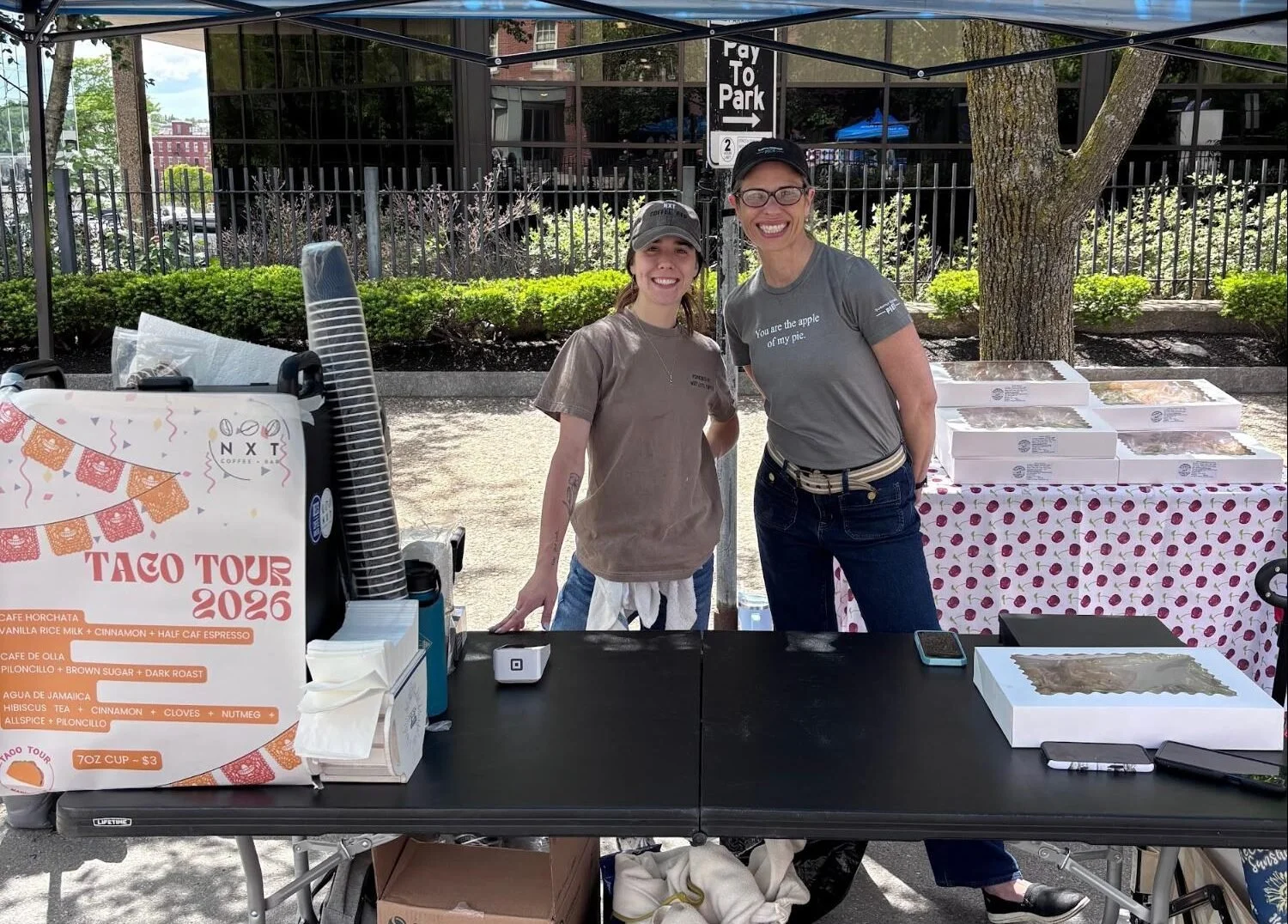
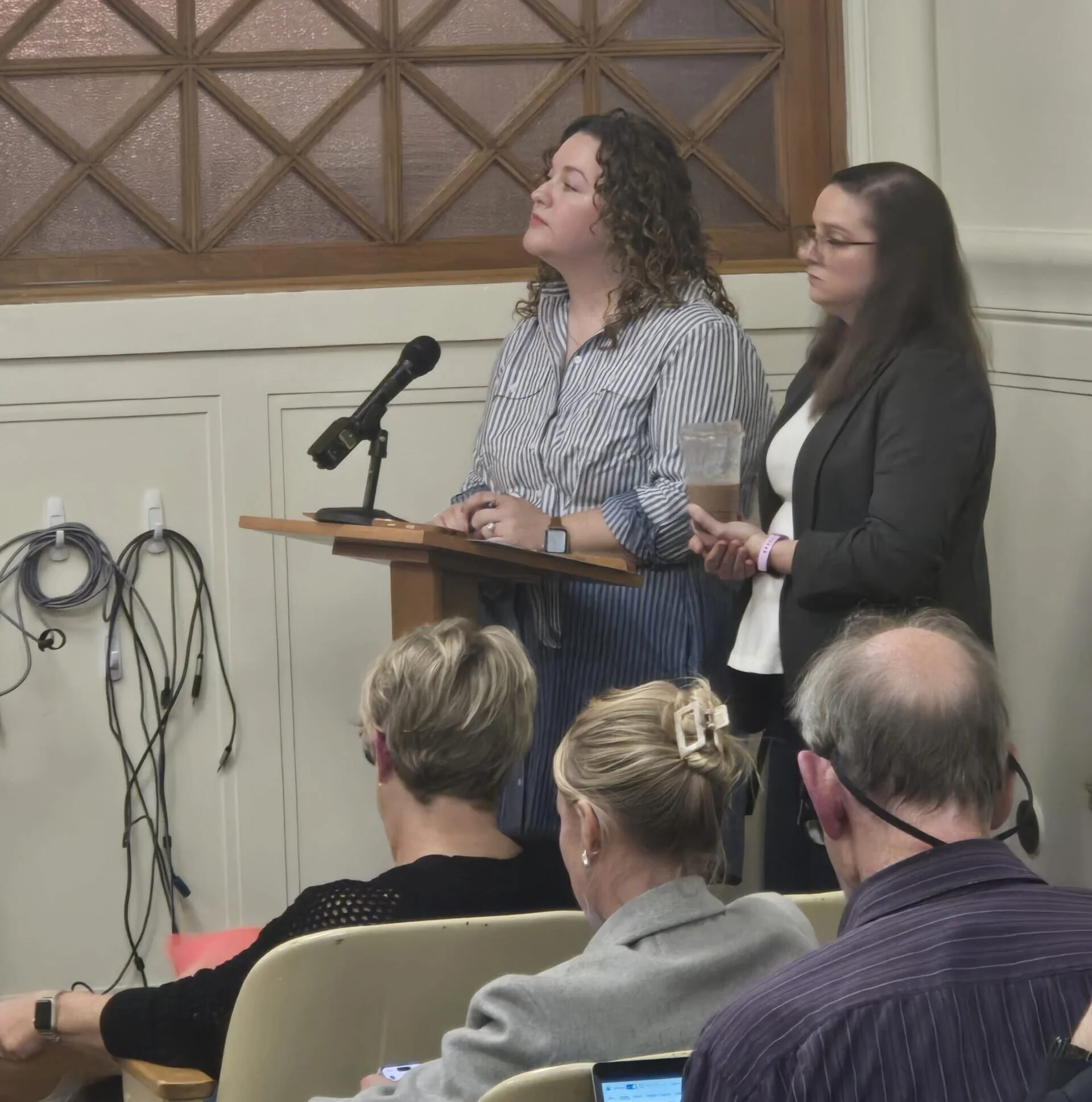
Kaitlin McNicholas, left, of NXT Coffee Bar, and Lauren Collins Cline of Slightly Crooked Pies. Photo/Stephen Dennis

MANCHESTER, NH – What does Taco Tour look like for a participating vendor as thousands of attendees descend on downtown Manchester? 

I embedded myself in two local businesses for the day to experience the labor of love that was the culmination of several months of planning and a collaborative process. 

When I met up with Kaitlin McNicholas, owner of NXT Coffee Bar, and Lauren Collins Cline, owner of Slightly Crooked Pies, at 1 p.m. on Thursday, May 28, it was clear the neighboring businesses had been in full swing since the morning. This was going to be McNicholas’ second year involved with Taco Tour, and for Cline, her first go at the event after opening her storefront just two months prior.

“I thought it was great to share a space with a neighbor this year,” McNicholas said, adding, “It was fun to collaborate and offer items that could be paired together.”

For NXT Coffee Bar, the idea of their menu came together just about a year ago, once their first Taco Tour was under their belt. A combination of authentic hot and iced beverages made within a day of the event for customers to enjoy, which consisted of the Cafe Horchata, Agua de Jamaica, and Cafe de Olla. 

Photo/Stephen Denis

In their inaugural appearance, Slightly Crooked had prepared a trio of their “hand-pies,” which already passed as an empanada lookalike. With flavors consisting of Peach-Mango with Tajín, Cherry Chocolate, and Apple-Cinnamon Churro, their pastries would be a strong complement to their tablemate. 

At 1:30 p.m., the pair made their way down Elm Street to sign in and claim their spot in the purple block, as designated by the official event map. For them, that meant setting up shop at the intersection of Elm and Spring Street, after being asked to shuffle down a couple of times by a friendly staff member from the Greater Manchester Chamber.

After a few trips back and forth from their shop locations, McNicholas and Cline were set up and in position well ahead of the official start time when members of various city departments made the rounds to make sure their operation was up to code. This included a city health inspector, an employee from the Department of Revenue, and a member of Manchester’s Police and Fire departments. 

Shortly after, the owner of the Crescent City food truck positioned on our left informed us that in his rush to arrive on schedule, he had forgotten a table, which normally accompanies a television displaying his menu. McNicholas didn’t hesitate and briskly walked back to her cafe down the road to grab an easily portable pop-up table to serve as a solution. The gesture was returned with the offer of some pork tacos and homemade cookies.

Once things kicked off around 4 p.m., business was a steady stream. McNicholas had several regulars come by, while quite a few customers were excited about the opportunity to finally try Cline’s hand-pies after seeing the buzz related to their storefront opening earlier in the spring. Both businesses were told by several attendees that they had been marked as “must-hit” locations on their printed maps.

This was the first Taco Tour without rain in several years, but it was not without its weather challenges. At various points, the wind knocked over stacks of cups or garnishes for the drinks. Then, just past the midway point of the event, the wind blew open Cline’s cash box, and dollar bills scattered across the sidewalk. In the moment of panic, several bystanders and customers jumped in to chase down and collect each bit of currency and ensure its proper return. 

Both businesses clearly benefited from their shared presence at the table, with dozens of customers stepping up to initially purchase a drink or dessert, and sliding over to try the alternative afterward.

Our table neighbors to our right were a crew from Elliot Hospital, who came over to sample some beverages and vibe to the music that NXT Coffee had bumping from their portable speaker. 

Photo/Stephen Denis

And while the pair of McNicholas and Cline were hard at work serving up patrons, they were still able to get in on enjoying an assortment of tacos. In an expert-level move, they both shared a list of their preferred spots with friends, regular customers, or their employees who were out having fun off the clock, who came through with multiple taco drops throughout the course of the night. 

The Horchata from NXT and the Apple-Cinnamon Churro hand-pies were the biggest hits of the evening by far. Cline sold out of her entire supply by about 7:30 PM, and McNicholas had just enough leftover blends to offer to customers at the cafe the next morning.

That’s right. Both of these businesses, after breaking down their space, returning to their shops, cleaning their equipment, and closing up for the night after 9:00 PM, had plans to open up for regular hours early the next morning. 

“It was amazing,” Cline said, reflecting on her first Taco Tour experience on this side of the table. “I did more business and met more people in four hours than I did at the Hopkinton Fair last year.” McNicholas also noticed the uptick in business compared to her first attempt the year prior. She attributed this to improved weather for patrons, a better location, and the fact that she’s had a year to be on people’s radars. 

Cline’s biggest takeaway from year one was listening to how businesses that have been participating for years have adapted their approach from lessons learned, and she believes that helps make the event better for all involved as it moves forward.

“Everybody helps each other out,” McNicholas chimed in, as she was in the process of consolidating her supplies. “It really shows the community of small business owners that exists within the broader community.”

Stephen Denis is part of the Granite State News Collaborative’s Civic Documenter program. He will be contributing stories from towns in the Greater Manchester area.

This story was produced through the Civic Documenters Program, a collaborative effort to train community members to access and report on local municipalities. For more information visit https://www.collaborativenh.org/civdocnh
CD1 Democratic candidate forum erupts over topic of Israel, Gaza

By Stephen Denis, Manchester Ink Link

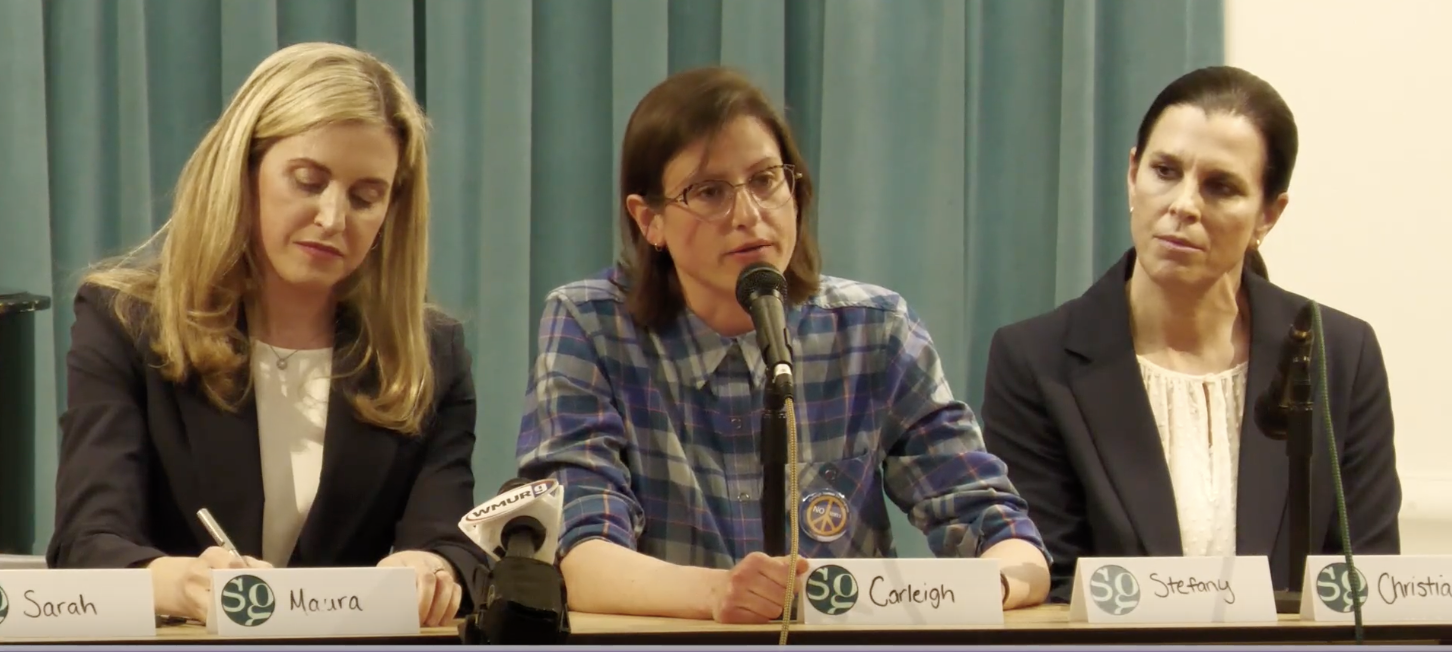
From left, Maura Sulilvan, Carleigh Beriont, Stefany Shaheen, during the CD1 forum held May 13 at the Manchester City Library. MPTV screenshot

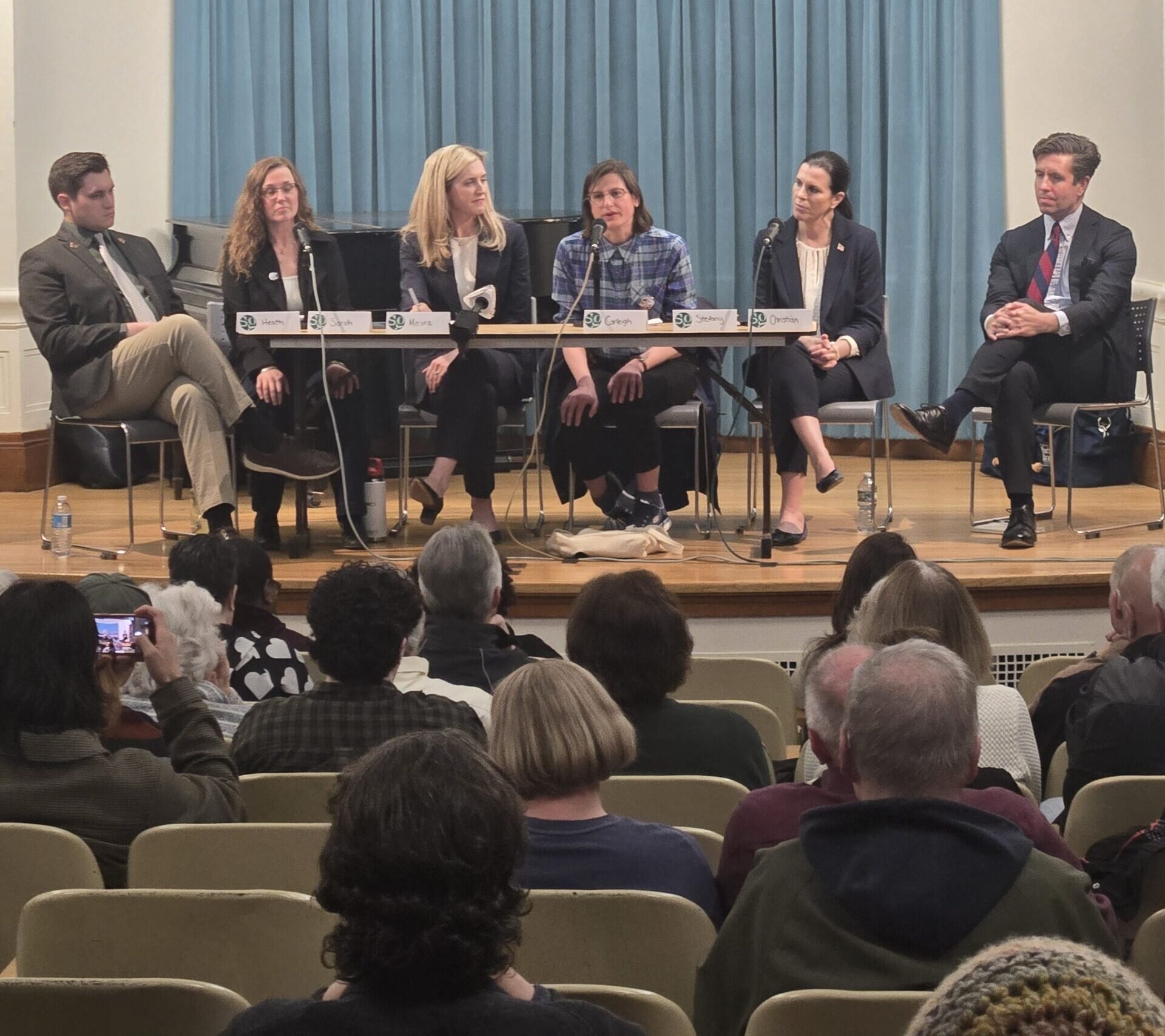
MANCHESTER, NH – The six Democratic candidates vying for the open seat to join the U.S. House of Representatives on behalf of New Hampshire’s 1st Congressional District assembled for a forum on May 13 in the Manchester Public Library Auditorium.

The event was presented and moderated by Spill the Goods, a podcast operated by the duo of Jess Spillers and Cristina Goodwin. The pair are active members in local Democratic circles. Spillers is a former Manchester Board of School Committee Member who stepped down to oppose Jay Ruais in the 2025 mayoral race. Goodwin was a candidate for Alderman in Ward 8 in 2025.

Sponsors of the forum included Ink Link News, Village Play Cafe, and the Southern New Hampshire chapter of the Democratic Socialists of America.

The candidates who make up this race on the Democratic side are Carleigh Beriont, Sarah Chadzynski, Rep. Heath Howard, Stefany Shaheen, Maura Sullivan, and Christian Urrutia. 

GOP candidates include Melissa Bailey, Brian Cole, Anthony DiLorenzo, Elizabeth Girard and Hollie Noveletsky.

Questions were solicited directly from constituents for about two weeks in advance of the event. 

Below is an overview of the popular topics and highlights from a night that was mostly cordial but not without some late fireworks. 

Affordability / Cost of Living

The most-discussed theme of the night was the economic strain Granite Staters are feeling. 

There was alignment from the candidates, that coming from a federal level, there was a direct correlation between President Trump’s tariffs and increased prices for consumers here at home. Similarly, the candidates seemed to agree when Howard stated that decisions made by the conservative state legislature in Concord and Governor Kelly Ayotte were “downshifting cost burdens” onto public schools and working families across the state. 

War in Iran

The candidates also drew a direct connection between the military conflict with Iran, which has entered its 11th week, and skyrocketing energy costs impacting everything from filling up your gas tank to the price of a flight, as the average gas price per gallon reaches $4.48 in New Hampshire, according to AAA. Across the board there was opposition to the war, with Chadzynski alleging Trump’s recent military operations, including the attack on Venezuela and the capture of their President Nicolás Maduro, were in part an effort to posture strength and send a message to China. 

There were also nods in agreement from candidates when Sullivan suggested she would, if elected, drag U.S. Secretary of Defense Pete Hegseth, and anyone else responsible for these “wreckless” military acts, down in front of Congress to be held accountable.

Money in Politics

Billionaires would not find any friends amongst the candidates on this stage, with several of them directly calling for an immediate increase in taxes on their wealth to help fund social services and key parts of their various platforms. 

Urrutia slammed the influence that super PACs and dark money play in  U.S. elections, calling out the “carpet bombing of negative ads” that will flood airwaves this coming fall, and challenged his peers on stage to be more vocal in their opposition. 

Moderators Cristina Goodwin and Jess Spillers. Photo/Stephen Denis

Shaheen touted her success in generating a grassroots financial cash flow during her campaign from supporters across the state and Howard called for the public funding of elections to combat the wealthy and well connected from maintaining an advantage. 

The candidates were loud in their opposition to the Supreme Court decision regarding CItizens United, which was the landmark case that gave greater clearance for corporations and special interest groups to financially contribute to campaigns and candidates. 

Housing

Urrutia, who served as an executive at the vacation rental company Airbnb until a few months ago, was asked directly about the role short-term rentals are playing in the housing crisis. He shared that he believes the needs of each community are different, and so local cities and towns should dictate their policies around corporations acquiring single-family housing units, and not Congress. 

He continued, stating that he believes the current housing crisis is a supply issue, referring to a statistic that says there would need to be five to six million homes built right now to meet current needs and growth across America. 

In a moment of contrast, Howard alternatively said that he believes corporations should be barred from acquiring single-family housing stock, and passing legislation to that effect would be a short-term goal of his during his first term in Congress. 

Immigration Enforcement

A question posed to the panel of candidates was regarding whether they supported calls to abolish ICE (Immigrations and Customs Enforcement), which is the department that has been leading the aggressive crackdown on communities across the country in response to President Trump’s escalated deportation efforts. 

Howard, Urrutia, Beriont, and Chadzynski were clear in their position on supporting the abolishment of ICE.

Chadzynski took it a step further, saying that Congress must outlaw “gestapo-style” tactics being displayed by federal law enforcement, harkening back to her own familial history, where her grandmother was forced to dig her intended grave during the Holocaust. 

Shaheen and Sullivan stopped short of calling for ICE to be abolished, with Shaheen believing the group can be overhauled and held to the same standards and accountability as local police departments, while Sullivan said she wouldn’t support committing a single new dollar to the agency. 

When Shaheen had added that she wouldn’t commit another dollar to the Department of Homeland Security, Beriont countered, saying that holding back funding from Homeland Security would have negative consequences on organizations like FEMA, that provide critical disaster relief. 

Israel and Gaza

As the moderators announced that they were pivoting from questions to allow each candidate the opportunity to make a closing statement, an older gentleman in the audience rose from his seat and began to express his frustration over the lack of any question related to the conflict between Israel and Palestine being included in the event.

After a minute of pleading from Spillers and Goodwin to sit down and allow the forum to move toward its planned conclusion, Chadzynsky hopped off the stage to engage with the man. After a brief exchange and an offer to have a conversation after the event, he agreed to return to his seat, “because she asked nicely.”

As the event seemed ready to return to the closing remarks, a couple more audience members began shouting at the moderators that they wanted to hear from the candidates on Israel and Palestine, with one calling it the most important issue in the country over the last few years. Spillers attempted to quell the rising tension, telling the audience that there were plans to ask a question on the topic but that they’ve run short on time, referring to their time agreement with the library. 

One of those from the audience calling out  during the forum alleged that questions around this topic seem to “conveniently” be omitted during typical candidate forums.

The ongoing disruptions drew anger from some in the room, with one man in close proximity to one of the pro-Palestinian advocates accusing the rhetoric of being antisemitic and likened it to behavior by the KKK. 

After threatening to have some attendees removed if they refused to allow the event to continue, Spillers and Goodwin got approval from the candidates to preempt closing statements and include a final question on the subject. 

The question was whether they believed Israel’s actions in Gaza constituted a genocide, whether they would support ending U.S. aid to the Israeli government, and and how would you best support Jewish people at home and abroad? 

Beriont, Urrutia, and Howard affirmed their mutual position that Israel had committed a genocide, with Howard stating his view that the attack by Hamas on October 7th does not justify the collective punishment of an entire population. 

Chadzynski, the lone candidate of Jewish faith on the panel, said the antisemitic attacks thrown her way on the campaign trail have not altered her view that the United States must join the International Criminal Court and help in prosecuting warrants against Russian leader Vladimir Putin and Israeli Prime Minister Benjamin Netanyahu. 

Sullivan, who is endorsed by the Democratic Majority for Israel, did not directly address whether she believed Israel had committed a genocide in Gaza while referring to atrocities committed by both sides. Shaheen also avoided directly answering the question, during which one of the earlier audience members who interrupted got up and walked out, not before shouting a few remarks toward Shaheen over his dissatisfaction with her answer. 

Final Thoughts

Closing remarks from the candidates took the event past a runtime of 90 minutes. And despite the interruptions, the moderators said they were pleased overall about the turnout. 

“We held this forum in the first place for folks to be able to differentiate themselves,” Spillers said. Added Goodwin, “it’s clear by tonight that the public is interested in something like this,” referring to the nearly full auditorium and lively crowd. Spillers thanked the various press groups in attendance covering the event and the candidates for taking a little extra time with them to answer questions. 

Spillers was also asked about a previous public endorsement she had made of Sullivan’s campaign and whether that factored in at all to the planning of or perceptions around the forum. 

“I did endorse Maura back in 2025 when I was on the school board. I make no bones about that.” Later defending the integrity of her participation in the event despite the endorsement, she noted “These questions came from the public. They truly came from the people. They are not biased nor do they represent mine or Cristina’s personal views and I feel like that was reflected here tonight.”
A recording of the event will be published via Manchester Public Television as well as the Spill the Goods podcast feeds.

Stephen Denis is a participant in the Granite State News Collaborative’s Civic Documenters Program. Learn more here.

This story was produced through the Civic Documenters Program, a collaborative effort to train community members to access and report on local municipalities. For more information visit https://www.collaborativenh.org/civdocnh
Council upholds removal of 2 homes from Bedford Historic District

By Isabella Kifer, Manchester Ink Link

BEDFORD, NH – A dispute over whether two newer homes belong in Bedford’s Historic District—and whether the town followed proper procedures in passing the amendment to remove them—prompted a rehearing April 22 before the Bedford Town Council.

Zoning Amendment #9 removed two homes built after 2018 from Bedford’s Historic District, where properties are typically subject to stricter oversight to preserve historical character. During the meeting James Dumont, who spoke as an abutter of the properties in question, challenged the move, arguing the process may have violated state law and could set a precedent for future removals.

Testimonies were heard from both the petitioners of the rehearing, as well as the legal counsel of the two residents whose homes were removed from the district. Ultimately, the council decided to deny the request for a revote in a 6-0 decision. 

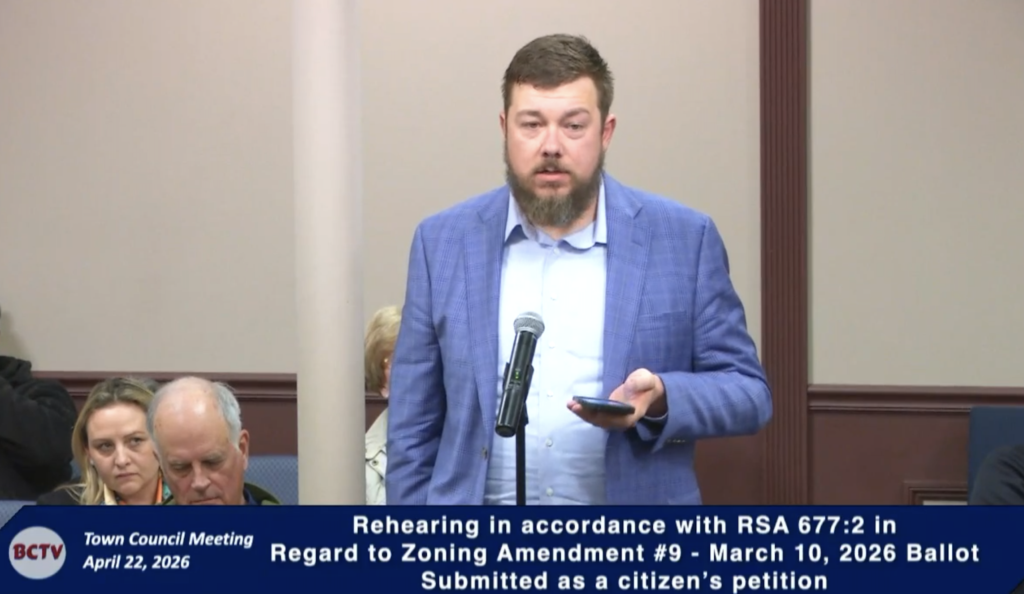
Bedford resident James Dumont spoke as an abutter to the properties in question. Screenshot/BCTV

Dumont opened the rehearing airing his grievances over the amendment. The issue, he said, was not that the voters had made a mistake, but that the process of deciding on and presenting this amendment to voters had not followed New Hampshire law. His overall goal in bringing this issue to the council was to improve these processes. 

Dumont had three main grievances: the lack of careful thought by the Planning Board in voting to support this amendment, the lack of communication to residents in the Historic District, and the possibility that this amendment entailed spot zoning. 

In the issue of the Planning Board, Dumont stated that there was a lack of communication between the Historic District Committee (HDC) and the Planning Board on their recommendation. The HDC voted against removing the two homes from the district in a 4-1 vote. This was communicated to the Planning Board via a liaison, who apparently shared their own opinion on the matter, rather than conveying that of the HDC, without making a distinction between the two. The Planning Board ended up voting 4-1 in support of the bill, contrary to the HDC’s recommendation. 

Dumont also noted that he had never received notice of the rezoning. The lack of communication with residents was cited as being noncompliant with RSA 675:7, which states that “if a proposed amendment to a zoning ordinance would change a boundary of a zoning district and the change would affect 100 or fewer properties, notice of a public hearing on the amendment shall be sent by first class mail to the owners of each affected property.” Although the number of affected was less than one hundred, Dumont said that he never received notice. 

Dumont’s final grievance was in the possibility that this rezoning constituted spot zoning, which he defined as rezoning for private benefit rather than to reflect the town’s overall goals. Since this rezoning included just two properties, there was not a larger purpose that Dumont saw for it. 

Dumont then received questions from councilors to further explain the issue. Clarifying his role, Dumont explained that he is an abutter to the removed properties, and did not want them removed for the integrity of the historical district. When questioned further by Councilor Michael Strand in his interest in the rezoning, Council Chair Phil Greazzo cautioned that this rehearing was only to hear the facts of the case, not to ascertain the background. 

Attorney Laura Gandia spoke on behalf of the residents of the properties removed from the historic district. Screenshot/BCTV

The next to speak was Attorney Laura Gandia, representing the residents of the properties removed by this amendment, Frank Robinson of 324 Wallace Rd and Pat and Jerry MacMonagle of 320 Wallace Rd, who did not want this amendment put to a revote. 

Gandia began by refuting the structural components of Dumont’s argument. Early in Dumont’s speech, he stated that his main goal in holding the rehearing was to improve town processes, not to take action of a revote. This rehearing, however, was held under RSA 677:2, which outlines that the only action a town council can take is to call a special town meeting and have a revote. Since the only action that could be taken under the statute was one which Dumont was not attempting to initiate, Gandia argued that the point of the rehearing was moot. Additionally, she stated, RSA 677:2 only allows for an order or a decision to be repealed, not a procedural defect. 

Gandia also questioned Dumont’s role as an abutter to the affected properties. In 2025, a new definition of abutter was adopted under RSA 672:3, which defined the status of an abutter as someone whose property is within fifty lines of the property in question, as determined by connecting perpendicular lines. Passing out a map to the councilors, Gandia showed that Dumont’s property was not technically abutting the properties removed in the rezoning. 

Gandia then began to refute the validity of each of Dumont’s grievances. Referencing the opportunity for testimony at the Planning Board meeting, Gandia argued that the Planning Board was able to hear residents’ and the Historic District Committee’s opinions. The HDC, Gandia also pointed out, is an advisory committee- it is legal and not unheard of for the Planning Board to disagree with their decision. Thus, Gandia argued that the Planning Board’s decision was well considered, and that what may have been miscommunication does not necessarily mean voters were misinformed.

In the matter of communication with residents, Gandia opined that the town had actually communicated more than they were required to, not less. Under RSA 675:7, if a zoning amendment were affecting less than one hundred properties,  the town would have to give notice by first-class mail to each affected property. In the overlay, the district constituted 165 affected properties, but the town still sent notice to the two owners of the homes which were to be removed from the historic district. Since these were the only properties affected, even amidst a grouping of more than one hundred properties, Gandia said that the town carried out this communication effectively. 

Finally, Gandia addressed the idea of spot zoning, explaining the cause for this specific rezoning. These two homes removed from the district were built in 2018, and thus did not fit the ‘historical’ moniker of being more than fifty years old. This rezoning, Gandia argued, was not a random act, but rather to release newer homes from the rules and regulations of historic homes. 

Having laid out her rebuttal to Dumont and the legality of the rehearing, Gandia closed with informing the council that their only decision now was whether or not to “undermine the will of the voters and have a new special election at the cost of the taxpayers”. 

After these two main sides were shared, a few other residents came up from each side and shared their opinions. Those who were in support of Dumont shared concerns of a lack of communication for abutters and worry for what precedent this could possibly set for the Bedford Historical District. Those in support of the two residents of the non-historic houses shared their confidence in the processes which Dumont had criticized. 

Board Chair Phil Greazzo, left, and Vice Chair Gail Levesque. Screenshot BCTV

The council then ended the time for public comment and discussed amongst themselves. Council Vicd Chair Gail Levesque was concerned about the possible erosion of the historic district, but also questioned the importance of the procedural defects Dumont had expounded upon. As a Planning Board’s decision is merely shown above a ballot, Levesque predicted that voters had most likely been presented with the idea that newer houses should be removed from the historical district and voted off of common sense, the Planning Board’s support being a minimal factor. 

Councilor Strand agreed that this issue clearly had to do with the letter vs. the spirit of the law, and that there were possible issues to this change in the historic district. However, he noted that he didn’t see a legal basis to overturn the amendment by holding a special meeting. Councilor Greazzo concurred.

A motion was made by Councilor Levesque for the Town Council to deny the request for a revote/ special meeting. Councilor Laura Fahey seconded the motion, and the revote was denied in a unanimous 6-0 vote. 

In closing the issue, the council noted that they understood the preparation that had gone into this rehearing, and appreciated the passion on both sides.

Isabella Kifer is part of the Granite State News Collaborative’s Civic Documenter program. 

This story was produced through the Civic Documenters Program, a collaborative effort to train community members to access and report on local municipalities. For more information visit https://www.collaborativenh.org/civdocnh

Hooksett Council clashes over handling of complaints against building inspector

By Stephen Denis, Manchester Ink Link

HOOKSETT, NH – The April 8 Hooksett Town Council meeting came to a halt when Councilor David Smith submitted a summarized account from residents and business owners that disparaged the conduct of the town’s active building inspector. 

Though Councillor Smith did not mention the town employee by name, he shared that what he had collected showed a “consistent pattern of behavior described as rude, condescending, selectively enforced and in some cases, openly retaliatory.” As he continued to describe the interactions that were provided to him, he was interrupted by Council Chairman Timothy Tsantoulis, who warned that the group “may be treading into water that we shouldn’t be” and referenced the state’s public meetings law, with specifics about discussion that could adversely affect the reputation of a town employee or member of the public needing to take place during a non-public session. 

As the debate continued around the logistics and legalities of discussing the matter, Councilor and Council Secretary Randall Lapierre encouraged Smith to read the 91-A public meetings law and summarized the part of the law that provided context for the disagreement on the proper forum for the discussion. When Smith shared that this was his second time addressing concerns around the town’s building inspector to the board and had not seen action on it, Lapierre pointed out that Smith wouldn’t have been privy to any nonpublic discussions that had taken place on the matter prior to his joining the council on July 9, 2025, and made clear to call out that “this board existed before you got on it,” and suggested that Smith doesn’t act like he is aware of that. Smith responded by calling Lapierre “overbearing” and stating that he “doesn’t take care of the people.”

Ad ends in 15

Tsantoulis and Vice-Chairman James Sullivan interjected and encouraged the meeting to move on and into their previously scheduled nonpublic session, where they were due to discuss the proposed contract renewal for Hooksett Chief of Police Justin Sargent, which had been introduced and discussed at their previous meeting, but no conclusion had been reached. 

After a return from a non-public session, the vote to extend Chief Sargent’s contract was approved in a 6-1 vote, with Smith being the lone objection. 

Earlier in the meeting, Sargent was successful in gaining unanimous approval for the detail rate to be increased for the Police Chief and Captain to $70 per hour and reflect a rate of time and a half for detail shifts exceeding 8 hours, effective July 1, 2026. Sargent noted that these roles being called on to work details are rare, usually limited to major event days or for local elections. 

The next Town Council meeting is scheduled for April 22, 2026, and you can find the agenda here.

This story was produced through the Civic Documenters Program, a collaborative effort to train community members to access and report on local municipalities. For more information visit https://www.collaborativenh.org/civdocnh