By Rosemary Ford and Caitlin Agnew
This article has been edited for length and clarity.
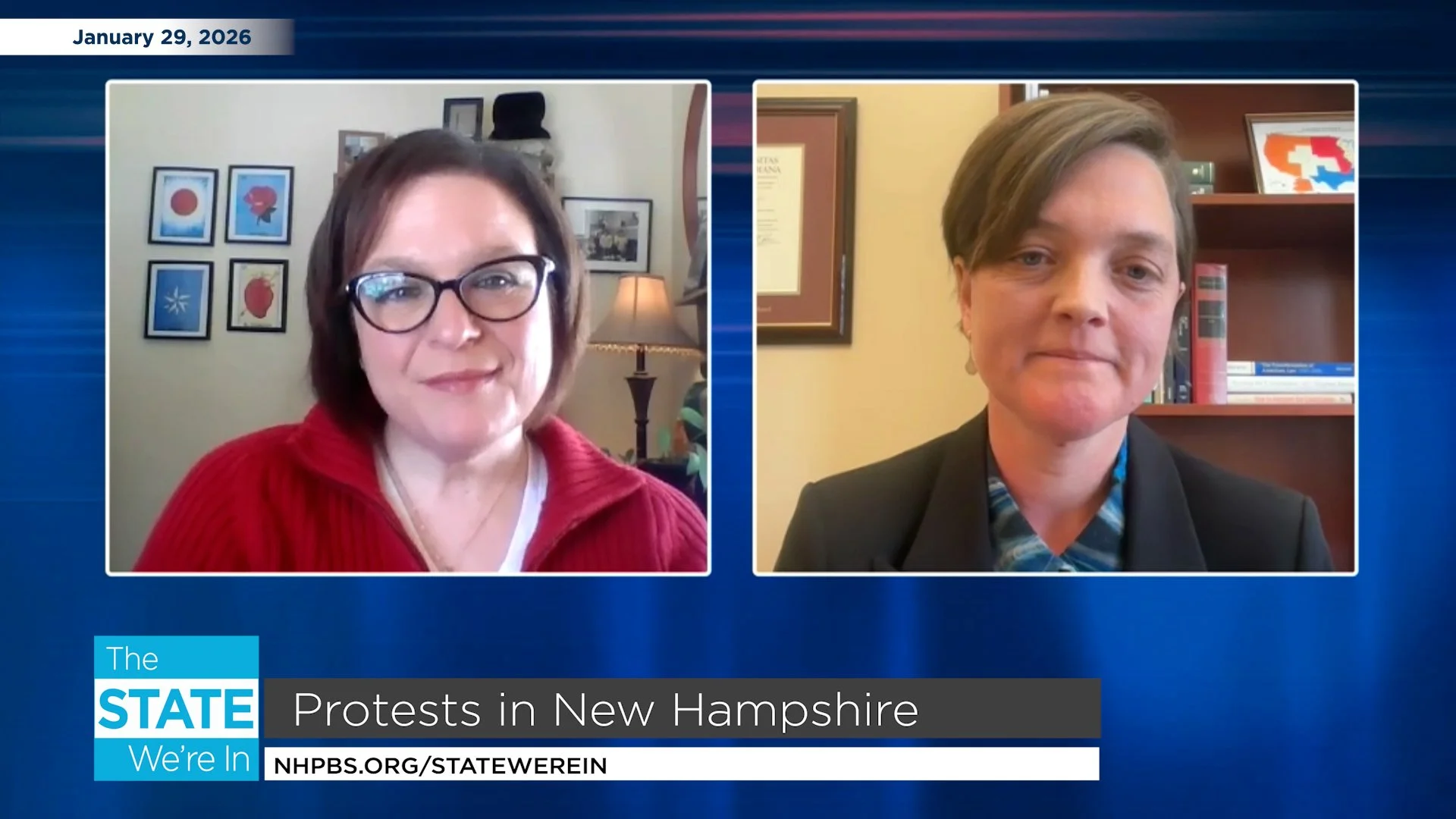
The right to assemble is ingrained in the American Constitution. Is that a right to protest? And what does that right guarantee you? In light of the recent deaths in Minnesota, where people are protesting about the presence of Immigration and Customs Enforcement, or ICE, officers in the area, and as other anti-ICE rallies break out here in New Hampshire and the country, what can protesters do to stay safe but effective? Here to discuss it is Margaret O’Grady, an assistant professor and constitutional law expert at the University of New Hampshire.
Melanie Plenda:
Is protesting something we, as Americans, can do anywhere, anytime and in any manner we want?
Margaret O’Grady:
The answer is a resounding yes. It's not often a constitutional law professor can say a one-word answer, but in this case, the answer is yes. To the second part, are there limits on it? That is also a yes, but I just want to step back for a second and think about how the First Amendment does guarantee the right to assemble, which includes the right to protest.
The actual language is “Congress shall make no law prohibiting the freedom of speech or of the press or of the right of the people peaceably to assemble and to petition the government for redress of grievances.” That's the U.S. Constitution from 1789.
The New Hampshire Constitution was written five years earlier, and arguably has more robust protections for the freedom to assemble. There, it says, ‘The people have a right in an orderly and peaceful manner to assemble and consult upon the common good, give instructions to the representatives and to request of the legislative body by way of petition or remonstrance, redress of the wrongs done to them and of the grievances they suffer.” That word, “remonstrance,” actually means vocal, virulent protest, and so it is enshrined in our Constitution. It's a bedrock principle, both in New Hampshire and federally.
Melanie Plenda:
What are the restrictions?
Margaret O’Grady:
As a blanket matter, speech is quite protected, but just because you're speaking doesn't mean you can commit other crimes. There are state statutes that say you can't riot, you can't disturb the peace, and you must follow laws, generally. There's also what's usually referred to as “time, place and manner” restrictions. That's a phrase that basically means the government, the federal government, a state, a municipality, can say you can protest, but first we're going to say that you can't protest, for example, past 9 p.m. because kids have to be asleep.
The really important thing is, what the government can't put restrictions on is the content of that speech. So any government can't say you're allowed to have a parade or a gathering in front of the State House in support of animal welfare, but you are not allowed to have a gathering in support of the protesters in Minneapolis. That would be a restriction based on the viewpoint and the content of the speech, and that is absolutely unconstitutional. So those restrictions really just have to be based on the time, place, and manner, and not the content.
Melanie Plenda:
What about spontaneous protests? I mean, are those allowed to happen? Or do you have to have a permit?
Margaret O’Grady:
So those are allowed to happen. There's case law saying that when a group of people gathers together in immediate response to a breaking news event, for example, that's got to be allowed. Again, there are restrictions — you can’t be blocking traffic or creating some sort of public safety issue, for example. But what we saw in Minneapolis, for example, after the killings of Alex Pretti and Renée Good, there were spontaneous, very large demonstrations happening, and those are protected. We need to see all of this together as it’s not just that speech and protest are protected in the Constitution, it’s really the bedrock — one of the most important rights that people have.
Melanie Plenda:
What legal responsibilities does a local government have when it comes to protesters?
Margaret O’Grady:
The main thing is to allow the speech to go forward, to protect the rights of the speakers and to protect the rights of the listeners, also. Part of free speech is the freedom to hear what someone else is saying. In that. is protecting the public safety during a protest, which is obviously their number one public safety function, but it is to protect the speaker and to protect the listeners.
Melanie Plenda:
What about police or federal officers? What legal responsibilities do they have?
Margaret O’Grady:
They have constitutional obligations to not violate people's Fourth Amendment rights, regarding search and seizure, not to use deadly force unless there is an imminent threat to themselves or to others, and to ensure that speakers can speak and that also people can hear them. When officers are in a situation where there is a protest, where there are people exercising their First Amendment rights, public safety, of course, is their job but also not preventing speech or preventing people from listening to that speech.
Melanie Plenda:
If they cross those lines, what are the consequences and how are they enforced?
Margaret O’Grady:
That's a really complicated question, and perhaps our first reaction is that it shouldn't be complicated, but it really is.
If we look at specifically the situation of the killing of Renée Good and Alex Pretti, those were federal officers who took their lives. Were they state officers, there might be some more of an availability for a criminal prosecution, and we saw that with the murder of George Floyd. Because we have federal officers, there are other issues at play, which really do constrain the ability of the loved ones of the victims, and also the state, from prosecuting it as a crime.
First, the Department of Justice could prosecute it as a crime. I think we all know from the reaction of the administration blaming the victims immediately, that's very unlikely to happen. In fact, people who worked in the U.S. Attorney's Office in Minnesota resigned because they were told not to investigate the officers, but rather to investigate the family of Renée Good. So I think it's very unlikely we'll see an investigation by the federal officials.
In terms of the state officials, that's the Supremacy Clause immunity doctrine, comes into play. That means that, although a state officer could be found criminally charged for that crime, because it's a federal officer the state will have a very hard time prosecuting that crime. They'll have to go to federal court. They will have to show that the officers cannot make any defense, that anybody in their shoes reasonably acting under the color of their federal authority would have — even if it's mistakenly in the scope of their duties — committed the acts that they committed. That makes it really hard for state prosecutors to prosecute it as a crime.
I think they should try. I always say this to my law students: You represent your client within the confines of what the law is, and you do your best. So I think they should try. But it's a very high hurdle to clear. The vice president said federal officers have absolute immunity. That is not true, but it is true that it’s a high hurdle.
In terms of civil liability, there is no avenue for the families of the victims to sue civilly. There's a statutory ability to sue under Section 1983 — you can sue for tort damages when your constitutional rights have been violated, or on behalf of a loved one who's been killed. But there's no such statutory authority for federal officials to be sued in the same way.
Melanie Plenda:
When you have a conflict between a state and federal government, what are the legalities and rules at play? For example, Minnesota and federal officials seem to be at odds about investigating these deaths and who has jurisdiction.
Margaret O’Grady:
In terms of a crime committed in a state, both should have jurisdiction. I think a lot of these questions then become more political than legal — it’s very unusual to have a federal government that has no appetite for investigating a crime committed by a federal officer, and that's the issue we have here.
The state is trying to assert its severity as a state, but they didn't want ICE to come in in the first place. So these clashes are really foundational to the safety of the people in a state. Usually, it's the safety of the people in a state, and the federal government helps a state, like after a storm cleanup, but this clash is something that is unusual, and I won't say completely unprecedented in our history, but certainly in our recent history.
Melanie Plenda:
Do you have any advice for people who are protesting at these anti-ICE rallies in terms of protecting themselves legally?
Margaret O’Grady:
I think the important thing is to know that you are within your rights to use your voice, and so use it. Make sure you tell people where you're going to be. Do not do anything that violates the law in another way — do not disturb the peace, do not stop traffic. Be peaceful.
You also have the legal right to record. I want to be very clear about that too. There was actually a fairly recent case from the First Circuit, a man recorded an arrest happening on Boston Common, and the First Circuit found that he was within his rights to do so, because recording of police actions in public is a foundational to the First Amendment — freedom of the press and freedom of speech. Bring your phone, charge it, record it, make sure someone knows where you're going to be.
Groups like the ACLU have a lot on their website about how to protest safely, and I think that the main thing is, try to maintain your own peacefulness. And, of course, do not be violent, and make sure you're with people who know you and you feel safe with, and continue on in a way that is as safe as you can be in this situation.
I've been to several gatherings in my town and around the state, and have never felt unsafe. I think a lot of us see what's going on, and of course the deaths of Alex Pretti and Renée Good shook a lot of people. The stakes are very high, and I think we can be inspired by the people of Minneapolis who see the wrongs being done to their neighbors, the terror being inflicted on their neighbors, and they stand out. I don't want us to start walking around and feeling silenced before we even speak out because we're afraid of violence — that would be a really tragic outcome of what we see happening.
Melanie Plenda:
Thank you so much for such great information.Thank you for joining us today.
“The State We’re In” is a weekly digital public affairs show produced by NH PBS and The Marlin Fitzwater Center for Communication at Franklin Pierce University. It is shared with partners in the Granite State News Collaborative, of which both organizations are members. For more information, visit collaborativenh.org.