DiLorenzo claim about Shaheen’s ties to Reid Hoffman misleading

FINDING:

Reid Hoffman did not directly contribute $1 million to the Stefany Shaheen for Congress campaign, but money he contributed to a political action committee in August was eventually used to support the Shaheen campaign. 

CLAIM:

Republican U.S. Senate candidate Anthony DiLorenzo claimed Oct. 26 in a debate with his opponent, Democrat Stefany Shaheen, that Reid Hoffman, the billionaire co-founder of LinkedIn, donated $1 million to Shaheen’s campaign. A similar claim is made on a website, The Truth About Stefany, which is financed by the N.H. Republican Party and not tied directly to DiLorenzo’s campaign 

WHAT WE FOUND 

The Truth About Stefany website features an infographic about Stefany Shaheen with the headline, “She attacks billionaires. Billionaires are paying to elect her,” followed by a list of names and dollar amounts, including LinkedIn co-founder Reid Hoffman and the $1 million figure. A link below the infographic shares further details about his $1 million contribution to New Engagement PAC. 

In addition, during the Oct. 26 Shaheen-DiLorenzo debate, DiLorenzo said of Shaheen, "The largest donation she received was from a notorious Epstein files – Reid Hoffman, $1 million – who not only went to the island but on Epstein's birthday sent him a note that said 'this is for the kids,' or 'the girls. That's who's supporting her." (Hoffman has been criticized for continuing to have ties with the disgraced financier and sex offender Jeffrey Epstein after Epstein pleaded guilty in 2008 to sex offenses involving a minor.)

Federal Election Commission records show that Hoffman — who has donated $41.8 million to support Democrats around the country this election cycle — did not donate directly to the Stefany Shaheen for Congress campaign. In August 2026, Hoffman did make a $1 million contribution to the New Engagement PAC, which in turn made contributions totaling $3 million to the New Leadership PAC later that month. All told, in 2026 New Leadership PAC has spent more than $3 million in independent expenditures in support of Shaheen or in opposition to Shaheen’s challengers.

For context, under the Federal Election Campaign Act, individuals can contribute only a maximum of $3,500 per election to a candidate’s committee. However, contributions to independent Super PACs are not limited, but Super PACs cannot donate to or work in coordination with a candidate’s campaign. 

EVIDENCE

Claims that appear on DiLorenzo’s The Truth About Stefany website:

https://thetruthaboutstefany.com/

“Claims on Anthony DiLorenzo's website that Stefany Shaheen has received $1 million in contributions from LinkedIn founder Reid Hoffman”

“A new request came in -- this one asking if the claims are valid about Stefany Shaheen getting $1m in donations from LinkedIn founder Reid Hoffman. The claims are on a website belonging to congressional candidate Anthony DiLorenzo.”

“Reporting and filing

Each assignment will have a folder identified by its Claim ID, with source materials, a draft template and the project logo. Keep your draft in that folder. Checks should be short and focused: explain the claim, what you found and what the evidence shows, with links to your sources.

Aim for two to three business days, with five as the usual maximum. If it will take longer, update your filing date on the board and email Jeff to let him know when to expect it.”

—--

From website: 

“Less than 9 cents of every dollar raised and spent to elect Stefany Shaheen can be traced to New Hampshire. The rest comes from out-of-state super PACs backed by billionaires like Reid Hoffman, plus registered lobbyists and Washington politicians.”

“Reid Hoffman

California · LinkedIn co-founder · Appears in the Epstein files

$1,000,000”

Drop down menu clicked:

“Hoffman: $1,000,000 to New Engagement PAC, which then sent $3 million to New Leadership PAC, the biggest spender for her. His contacts with Jeffrey Epstein appear in released Epstein records; he has apologized for the association and denies any wrongdoing (Fortune).”

Site links to this:

https://www.fec.gov/data/receipts/?committee_id=C00751503&two_year_transaction_period=2026&data_type=processed

And also this 

https://www.fec.gov/data/independent-expenditures/?committee_id=C00751503&data_type=processed&is_notice=true

And this:

“Where the money came from. As the anti-Sullivan ads began, a DC super PAC, New Engagement PAC, sent New Leadership PAC $3 million (Aug. 25 and 31). New Engagement PAC's largest donor was LinkedIn co-founder Reid Hoffman: $1 million on Aug. 13. It also took $870,000 on Aug. 27 from New Engagement Fund, a group that does not report its donors to the FEC. New Leadership PAC’s own donors include billionaire Rob Hale ($100,000; Forbes 400) and DK Crown Holdings, a DraftKings company ($250,000, its largest corporate check).

Sources: Hoffman contribution · New Engagement PAC transfers · New Leadership PAC donors (FEC) · Forbes 400 list (Boston Globe) · DraftKings subsidiaries (SEC)”

And this 

“She calls her opponent a “MAGA mega-donor working for corporate special interests.” Her own race is being lifted by millions from an out-of-state super PAC, with a billionaire’s $1 million behind its biggest donor. (Stefany Shaheen, Facebook video, June 29, 2026)”

—-

This from 10/26 in Union Leader:

“A week ago, the New Hampshire Republican State Committee created an anti-Shaheen website that included the alleged Hoffman connection.

According to Federal Election reports, Hoffman, a billionaire venture capitalist, gave $1 million to a New Engagement PAC. Shortly after that, this PAC sent $3 million to the Massachusetts-based New Leadership PAC, which then spent more than $750,000 on pro-Shaheen ads during the tight Democratic primary.

Shaheen denied any knowledge about Hoffman.

  • Who is Reid Hoffman? Did he found LinkedIn?

Yes: https://www.reuters.com/article/us-linkedin-m-a-microsoft-idUSKCN0YZ1FP/

Though often see references to him being a CO-founder, so that might be more technically accurate (example https://www.cnbc.com/make-it/2025/01/17/billionaire-linkedin-co-founder-traits-entrepreneurs-need-to-succeed.html)

  • Did he donate ANYTHING directly to Stefany Shaheen?

Not listed in 25-26 as an individual donor anyway, though i see he donated to several others that appear to be single-candidate focused: Gillibrand for Senate and Friends of Mark Warner for example

  • Where has he made donations?

See downloaded FEC spreadsheet for 25-26 numbers (for him as an individual)

  • Did he donate 1 million to New Engagement PAC, and when?

Yes, Aug 13 2026 see screenshot from FEC website as well as downloaded donations spreadsheet

  • Did New Engagement PAC send $3 mill to New Leadership PAC? When? When did “anti-Sullivan ads” begin?

Since August 25 2026 New Engagement PAC has sent New Leadership PAC $3,000,000 via transactions (see FEC screenshot) 8/25 and 8/31

  • Who else did New Engagement fund?

In Aug 2026 only other one was Time to Lead Pac  Aug 04 2026

  • Who else funds New Leadership PAC? 

New Engagement PAC biggest donors in Aug 2026 and overall for 2026 but a number of other donors - see spreadsheet and screenshot; add up total donations to compare

  • Is New Leadership PAC the “biggest spender for her”?

Yes - including pro Shaheen and opposition spending on Sullivan and DiLorenzo

See downloaded sheets for pro Shaheen and anti DiLorenzo spending from 2025-2026.NEED TO ADD IN ANTI SULLIVAN AMOUNTS

  • Who else does New Leadership fund? 

See screenshot/ spreadsheet tab

Total spending $4,983,817.05

  • Where/on who else did they spend $ during this same time frame?

See screenshot / spreadsheet tab

  • Did New Leadership PAC spend $1 million on Shaheen since his donation?

Yes

Source: FEC website https://www.fec.gov/; data uploaded into spreadsheet here; additional website screenshots here

CREDITS

Reporter: Jennifer Leahy, fact-checker

QUESTIONS OR CORRECTIONS

Contact: Jeff Feingold, jfeingoldnhbr@gmail.com
Encouraging absentee voting is legal and allows more accessible voting

FINDING

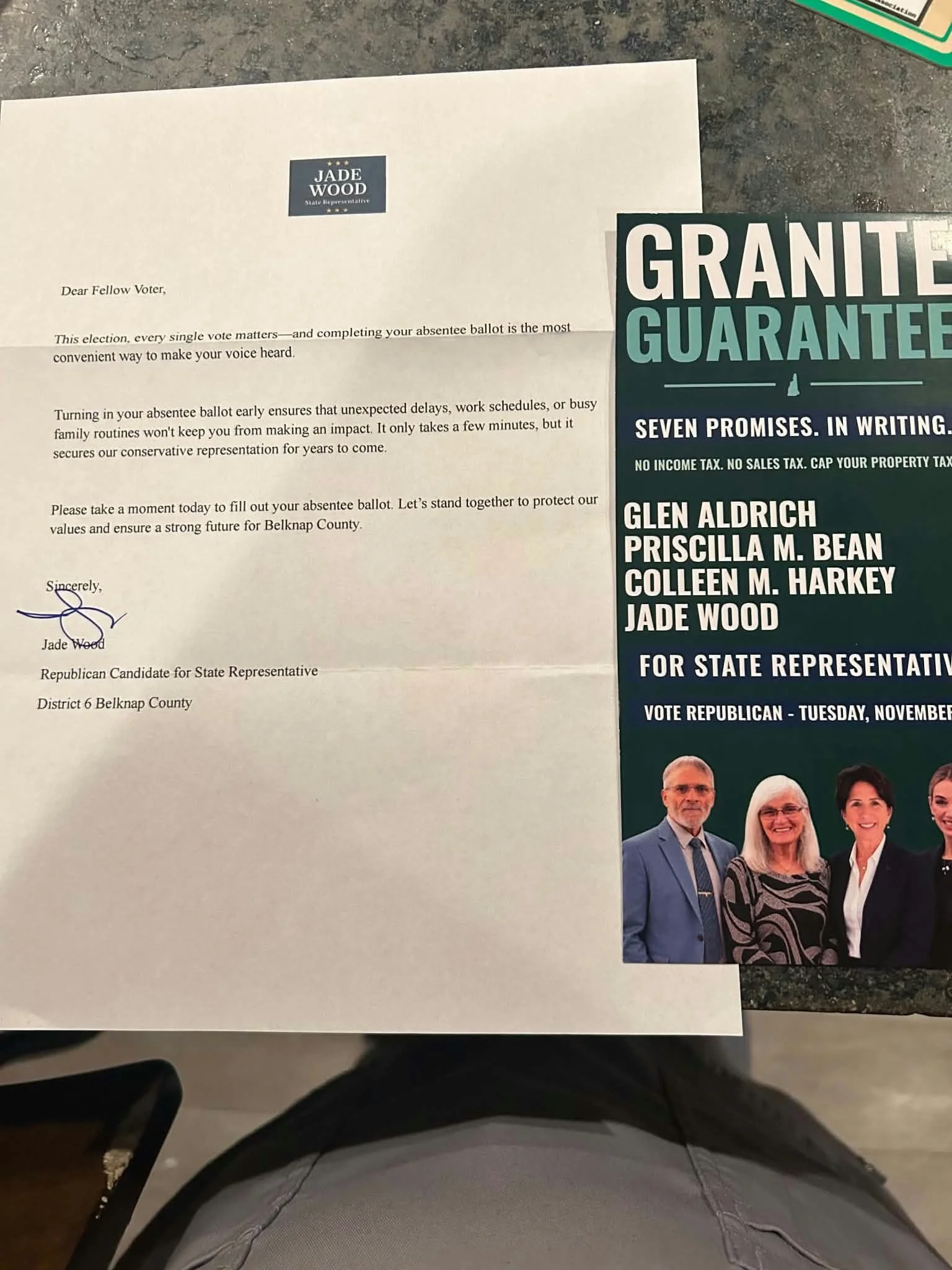
A letter from a Republican candidate in Belknap County, which urged recipients to send in their absentee ballots early, is not illegal. Absentee voting is a legitimate form of voting, and candidates across the spectrum attempt to mobilize as many people as they can during their campaign to win an election.

THE CLAIM

A Laconia Daily Sun reader questioned the legality of a letter sent by Jade Wood, of Gilford, urging people to fill out their absentee ballot and send it in early. In the letter, Wood writes, “Turning in your absentee ballot early ensures that unexpected delays, work schedules, or busy family routines won’t keep you from making an impact.” 

WHAT WE FOUND

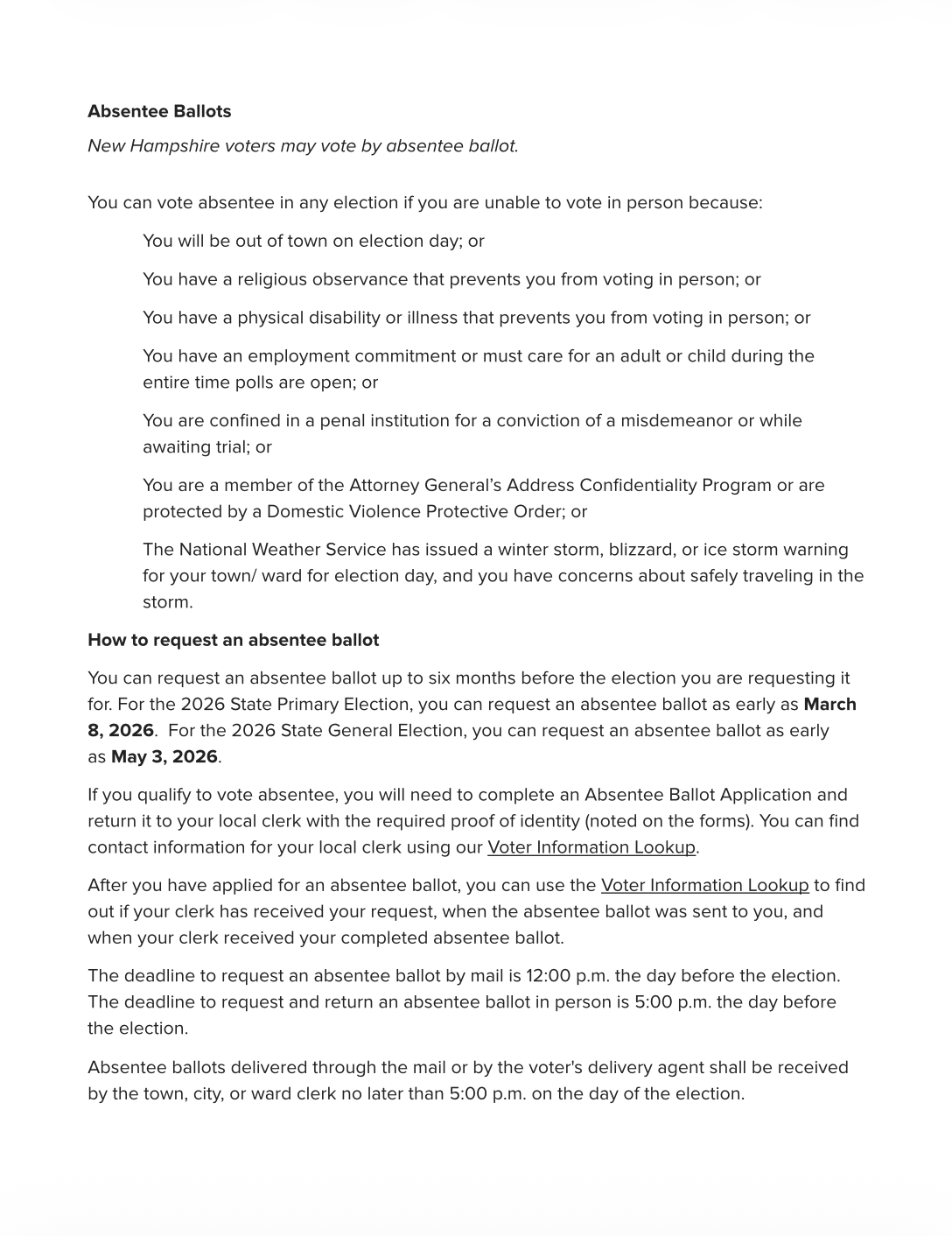
Absentee voting is encouraged to make it easier and more accessible to allow a higher participation in the democratic process of casting a vote. However, New Hampshire allows absentee voting only by someone who is prevented from voting in person because of a temporary absence or a physical disability. A full list of valid circumstances  can be found on the New Hampshire Secretary of State’s website. Among the more common are being out of town on Election Day, a religious observance that prevents from voting in person, or a caretaking or employment commitment.

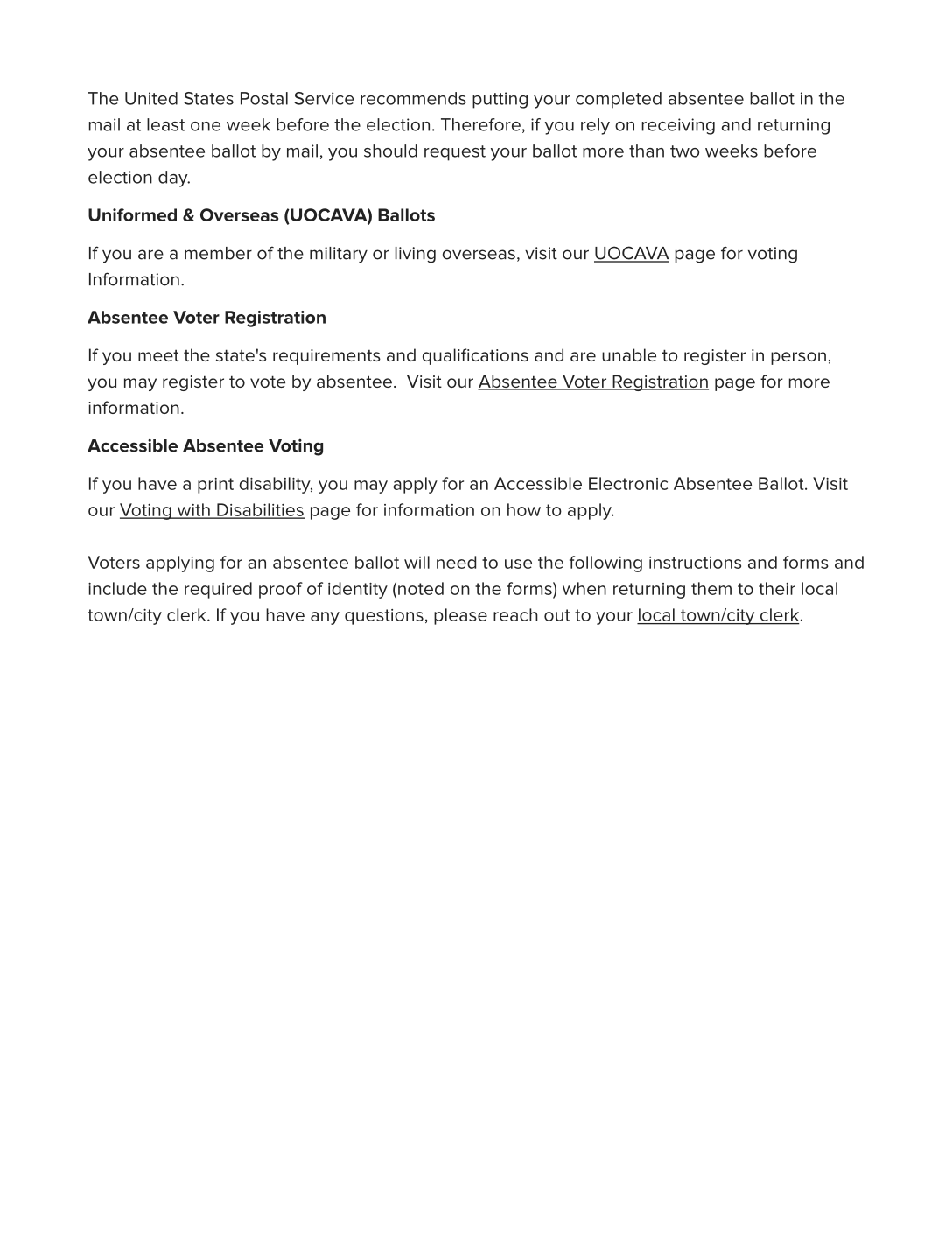
Voters who are qualified must complete an absentee ballot application and return it to their local town or city clerk with the required proof of identity. More information can be found on the Secretary of State’s Absentee Voter Registration page.

If interested in requesting an absentee ballot, voters can ask for one up to six months before the election (2026 State General Election as early as May 3, 2026). The deadline to request an absentee ballot by mail is noon the day before the election, and 5 p.m the day before the election to request and return an absentee ballot in person. Absentee ballots delivered through the mail or by the voter's delivery agent can be received no later than 5 p.m. on the day of the election.

WHAT REMAINS UNCLEAR

Explain any limitations or unanswered questions.

CREDITS

Reporter: Daniel Sarch

Outlet: GSNC

QUESTIONS OR CORRECTIONS

Contact: Jeff Feingold, jfeingoldnhbr@gmail.com
Attack video makes exaggerated claims of Democratic opponent

FINDING

There is no documented evidence that N.H. Sen. Debra Altschiller, D-Stratham, has advocated for offshore wind energy, stopping the use of gas-powered vehicles, or endorsing any net-zero policies, where the total greenhouse gases released into the atmosphere are balanced by an equivalent amount removed.

THE CLAIM

An AI-generated Facebook video posted Sept. 10 by the Lou Gargiulo for NH State Senate District 24 campaign claims that “under her net-zero mandates, offshore wind will clog up the beaches and ocean views. Gas-powered cars will stop working, all so that Deb and her friends can get more power to control your lives.” 

WHAT WE FOUND

Altschiller’s campaign website focuses on issues relating to reproductive rights, property tax relief, education, gun violence prevention, suicide prevention and crime victims’ rights. There is no mention of any climate-related policy. In 2022, she was endorsed by the Sierra Club, a grassroots environmental organization advocating for clean energy and related causes. And Altschiller said in an interview with the Granite State News Collaborative that she supported bringing New Hampshire back into the Regional Greenhouse Gas Initiative (RGGI), an interstate initiative to cap and reduce CO2 emissions from the power sector.

In addition, of the 111 bills sponsored by Altschiller as a state senator, some focus on environmental efforts, including HB1783, which encourages the development and installation of community or regional water and wastewater treatment options, and SB439, which aimed to put environmental and local controls on AI data center construction. No bills explicitly mention the use of offshore wind.

“I have not been part of the group of legislators who are interested in ocean wind energy. We have 18 miles of coastline and a fishing industry,” Altschiller said in the GSNC interview. “We're not talking about it because it's not on the table.”

WHAT REMAINS UNCLEAR

It is unclear where Gargiulo found these views for Debra Altschiller. Gargiulo did not respond for comment.

CREDITS

Reporter: Dan Sarch

Outlet: GSNC

QUESTIONS OR CORRECTIONS

Contact: Jeff Feingold, jfeingoldnhbr@gmail.com
Sununu claims about Pappas voting record, taking paycheck during shutdowns mostly false

FINDING

The claims are mostly false. Sununu’s 68-vote figure relies on procedural votes and concurrent resolutions that had nothing to do with tax policy, and Pappas has rejected his congressional paycheck on multiple occasions during government shutdowns.

THE CLAIMS

Republican U.S. Senate candidate John Sununu claimed at his Sept. 8 primary election victory party and during a debate with his Democratic opponent, U.S. Rep. Chris Pappas, that “on 68 votes … Chris Pappas voted to raise taxes 68 times.” The Sununu campaign and National Republican Senatorial Committee have also claimed that Pappas voted to shut down the government 12 times but still collected a full paycheck each time.

WHAT WE FOUND

The claim that Pappas voted to raise taxes 68 times is essentially false. Many of the bills Sununu cites in the claim passed Congress with bipartisan support. Some also included tax-cutting measures and others were simply procedural votes that did not affect tax policy at all. In fact, of the 68 votes cited by the Sununu campaign, only 16 were actually on the final passage of a bill, making the vast majority of Pappas’s votes purely procedural in nature. 

For example, Sununu cites three Pappas votes on the Inflation Reduction Act, a Biden-era bill that raised taxes on large corporations but also created tax credits meant to encourage green energy consumption. Pappas voted once to pass the final bill. The other two votes cited were procedural decisions — one vote on the rules of debate and another to make the Congressional bill match the Senate bill.

“Some procedural votes are very routine, others are significant,” John Lappie, a political science professor at Plymouth State University who studies elections, wrote in an email. “In some cases, yes, a procedural vote to (say) apply certain rules for debate on the bill (a special rule) can help the bill pass, even if the member ultimately votes against the final bill. Conversely, you can make a House member look like they voted to raise taxes a lot more times than they did if you count all the procedural votes on the bill and the final vote as votes for raising taxes.” 

Some of the votes Sununu cites did not change tax policy at all. Fourteen of the votes were  on four distinct concurrent resolutions — non-binding measures that are meant to express the opinion of Congress but do not have any legal authority. For example, Pappas voted against a resolution stating that a carbon tax would be detrimental to the American economy, but he did not vote for a carbon tax.

In addition, some of the bills Sununu calls tax hikes passed with overwhelmingly bipartisan support, including the Tax Relief for American Families and Workers Act of 2024, a bill that passed the House 357-70. Sununu also includes votes for the Securing a Strong Retirement Act of 2022, which passed the House, 414-5, and the Setting Every Community Up for Retirement Enhancement (SECURE) Act, which passed on a 417-3 vote and President Trump signed into law in his first administration.

The Sununu campaign also has accused Pappas of voting to shut down the government 12 times, and collected a full paycheck each time:

The Sununu campaign did not respond to a request for a list of the 12 votes. Pappas did vote against a plan to reopen the government in November 2025, along with all but six of his fellow Democrats, because they said the plan did not guarantee long-term funding for Affordable Care Act health insurance tax credits. In addition, Pappas has frequently supported measures to keep the government open or reopen it. Most recently, Pappas voted for a bill in September to fund the government through Dec. 11. He also supported bills preventing government shutdowns in 2019, 2020, 2023 and 2024. 

He also publicly refused to take a paycheck during the 2019 shutdown as well as in the fall of 2025. However, in the partial government shutdown that ran from Feb. 14 to April 30 this year and affected only the Department of Homeland Security and no other government functions, Pappas was paid. 

FINDING

These claims are mostly false. Sununu’s 68-vote figure relies on procedural votes and concurrent resolutions that had nothing to do with tax policy, and Pappas has rejected his congressional paycheck on multiple occasions during government shutdowns.

CREDITS

Reporter: James Kelly

Outlet: Plymouth State University’s The Clock

QUESTIONS OR CORRECTIONS

Contact: Jeff Feingold, jfeingoldnhbr@gmail.com

New Hampshire election claims wanted for Fact Check Hub

New Hampshire residents who see an election claim they want checked can submit it to the NH Fact Check Hub, a pilot project of the Granite State News Collaborative partners.

The idea grew directly out of feedback from people across New Hampshire who told Collaborative partners they were uncertain what to trust and concerned about misinformation and disinformation, particularly on social media. Newsroom partners saw the Hub as one way to respond: give residents a place to raise questions and put reporters to work examining the evidence.

The project runs Oct. 5 through Nov. 10, 2026, and invites submissions from campaign ads, social media posts, videos and public statements. The Hub is looking for claims that can be checked against evidence.

To submit a claim, visit the Hub and use the submission form. Include the exact claim and where you saw or heard it. A source link, screenshot or campaign video can help reporters understand the claim and examine the evidence. For longer videos, include the time where the claim appears.

Project coordinators review submissions and select claims for reporting. Journalists examine original sources, consult relevant records and experts, and seek responses when appropriate. Each completed fact check receives editorial review by two editors before publication on the Hub.

The project cannot check every submission. Providing contact information is optional; submitters can request an email when a completed check is available.

If a claim you submit is checked, you can help others by sharing the published fact check on social media, especially where you first encountered the claim. Sharing the reporting and its supporting evidence can help more people find reliable information.

Submit a claim and learn more:
https://collaborativenh.squarespace.com/fact-check-hub