By Rosemary Ford and Caitlin Agnew
This article has been edited for length and clarity.
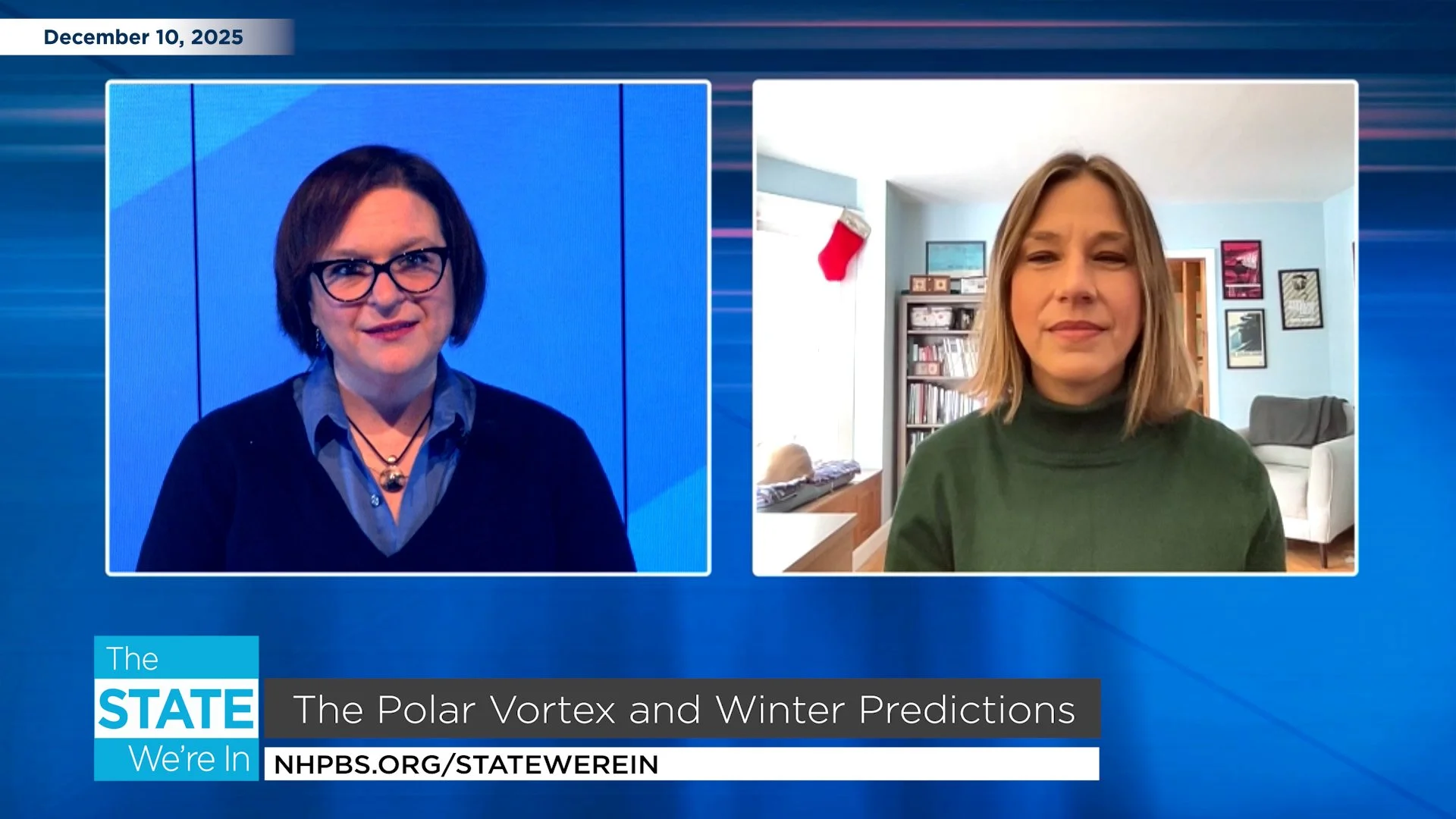
Having just come off our first nor’easter early in the season, the winter ahead seems daunting. With predictions of arctic cold in the coming weeks, should Granite Staters be prepared to hunker down? The Old Farmer’s Almanac predicts a mild winter, but what can we really expect? Here to discuss this is Mary Stampone, New Hampshire’s state climatologist and associate professor in the geography department at the University of New Hampshire.
Melanie Plenda:
What kind of weather can we expect this coming winter? Will it be a heavy snow season?
Mary Stampone:
I expect we'll see a bit of the full range of possible winter weather conditions this season. We've already experienced some severe cold and snow, and the coldest part of the season is still ahead of us, so we'll likely see more of that. It is equally likely that we'll experience some milder weather this winter, as that has become more common in response to global warming.
Melanie Plenda:
What is your process of collecting and analyzing climate data that will go out to the public? How do you spot patterns and make predictions from this?
Mary Stampone:
We all use weather forecasts for daily conditions, but when we need to look ahead over a month or a season, we usually refer to long-term outlooks, which go beyond the weather for the next week or two. Because we're looking so far ahead, the information and a seasonal outlook is less detailed than what we get with a weather forecast.
So, for example, outlooks can't tell us what the temperature will be on any specific day in January or February, or even how much total snow we're going to get this season. But what they do give us is a sense of the type of conditions, and these general conditions are what we can most likely expect to experience over the course of the next several months.
Melanie Plenda:
Can you tell us about the polar vortex? What is it and how will it affect us here in New Hampshire?
Mary Stampone:
The polar vortex is a low pressure system that sits high in the atmosphere. It's typically centered over the pole, but it exists year-round. It's not just a temporary thing. It's always hanging out there, and the spin around it keeps that cold arctic air in the Arctic.
Occasionally, it weakens, and when it weakens, it kind of wobbles around. It can even expand or split. When that happens, that cold arctic air can plunge south, even as far south as Florida. It brings colder-than-normal weather into the U.S. These events can happen once or twice a year, or even not at all. They typically last maybe a few weeks or so, and they're not a permanent weather pattern.
Melanie Plenda:
What does that usually look like when that does occur in New Hampshire?
Mary Stampone:
It tends to bring extremely cold and dangerous weather to New England. But again, it tends to be temporary. You may hear on your forecast, “We’re having an arctic outbreak or a cold weather outbreak headed our way.” A lot of times those are the kinds of patterns that we can expect with the polar vortex weakening.
Melanie Plenda:
Is the polar vortex weakening becoming more frequent, and how is it connected, if at all, with climate change?
Mary Stampone:
This is a fantastic question. Overall, we don't have a long enough record to determine if there is a trend toward a more frequent weakening of the polar vortex, or if this is simply part of some natural variability that we haven't yet captured. However, recent observations indicate that the position of it and how strong or weak it is may be impacted by sea ice and the changes in sea surface temperatures and the air pressure associated with the loss of Arctic sea ice due to global warming. So there's a lot of uncertainty still here in the research, but there is a scientific basis for the idea that we could be seeing more cold air outbreaks as the world warms.
Melanie Plenda:
How does this colder weather brought on by the polar vortex impact the state on a larger scale? Will it affect crops and agriculture?
Mary Stampone:
Again, this weakening pattern with the cold air plunge is a temporary pattern. It can be dangerous if you have to be outside, but again, it's usually a couple of weeks at most.
So for us, we're expecting this pattern to kind of persist through December, but by the end of December, going into the new year, temperatures are expected to shift back to average, or even above average, for what we expect to be probably a milder winter, along the lines of what we've seen in recent years.
Melanie Plenda:
Are there other impacts with the colder weather brought on by the weakening of the polar vortex?
Mary Stampone:
It's a dangerous cold as the event is happening, but once it strengthens and re-forms, things kind of go back to normal. So that cold air gets put back up into the Arctic, and we tend to have the normal. or the more average weather that we can expect.
Melanie Plenda:
From a climate change perspective, what can New Hampshire residents expect going forward for winters here?
Mary Stampone:
Winters across the board in New England and the Northeast are warming, and with it, we're seeing less snow and ice as well as milder conditions. So fewer deep freezes — we still get them, obviously, we get them connected with the polar vortex weakening, but they're becoming less frequent over time. This has a lot of different impacts that kind of extend beyond the winter season.
But here, we're seeing a reduction in energy needed for heating in the winter. We're seeing a contraction of the winter season. So snow happens later, and snow melt happens earlier. We're also seeing mid- season melts that reduce our snowpack. These have implications beyond the winter season. Groundwater recharge during the spring can be impacted. Also, it's these deep freezes that help kind of manage invasive species, and so winter warming can have some impacts that go beyond just the winter season.
Melanie Plenda:
What about La Niña? Will that have an impact this winter?
Mary Stampone:
So La Niña is one part of that El Niño sea surface temperature pattern that we observe in the Pacific Ocean. It can impact weather in the midlatitudes across North America. La Niña winters generally tend to favor greater snowfall in the Northeastern U.S.
However, the strength of the pattern matters. A weak La Niña — which is what we're expected to be in through the end of December into January — is usually associated with a lot of uncertainty. It's very difficult to say that this winter is going to be snowier than average. When we're talking about a weak La Niña, overall, our seasonal outlooks still favor greater-than-average precipitation.
Melanie Plenda:
What resources should the public be aware of in finding the most reliable winter weather updates and preparing for bad weather?
Mary Stampone:
First, I say go straight to the source, which is the National Weather Service. They have regional forecast offices that produce excellent forecast information. This is a great place to go anytime you want to kind of look ahead for any coming winter weather at home or wherever it is you might be traveling.
For folks who are heading up to the White Mountains this season, I would encourage you to look at the Mount Washington Observatory forecast. They provide really great detailed information for higher-elevation weather conditions, which can be very different from what we see at lower elevations.
And closer to home, in my experience, your local broadcast meteorology team tends to have some of the most accurate local-scale information on local conditions.
Melanie Plenda:
Mary, I’ll get my shovel ready! Thank you for joining us today.
“The State We’re In” is a weekly digital public affairs show produced by NH PBS and The Marlin Fitzwater Center for Communication at Franklin Pierce University. It is shared with partners in the Granite State News Collaborative, of which both organizations are members. For more information, visitcollaborativenh.org.