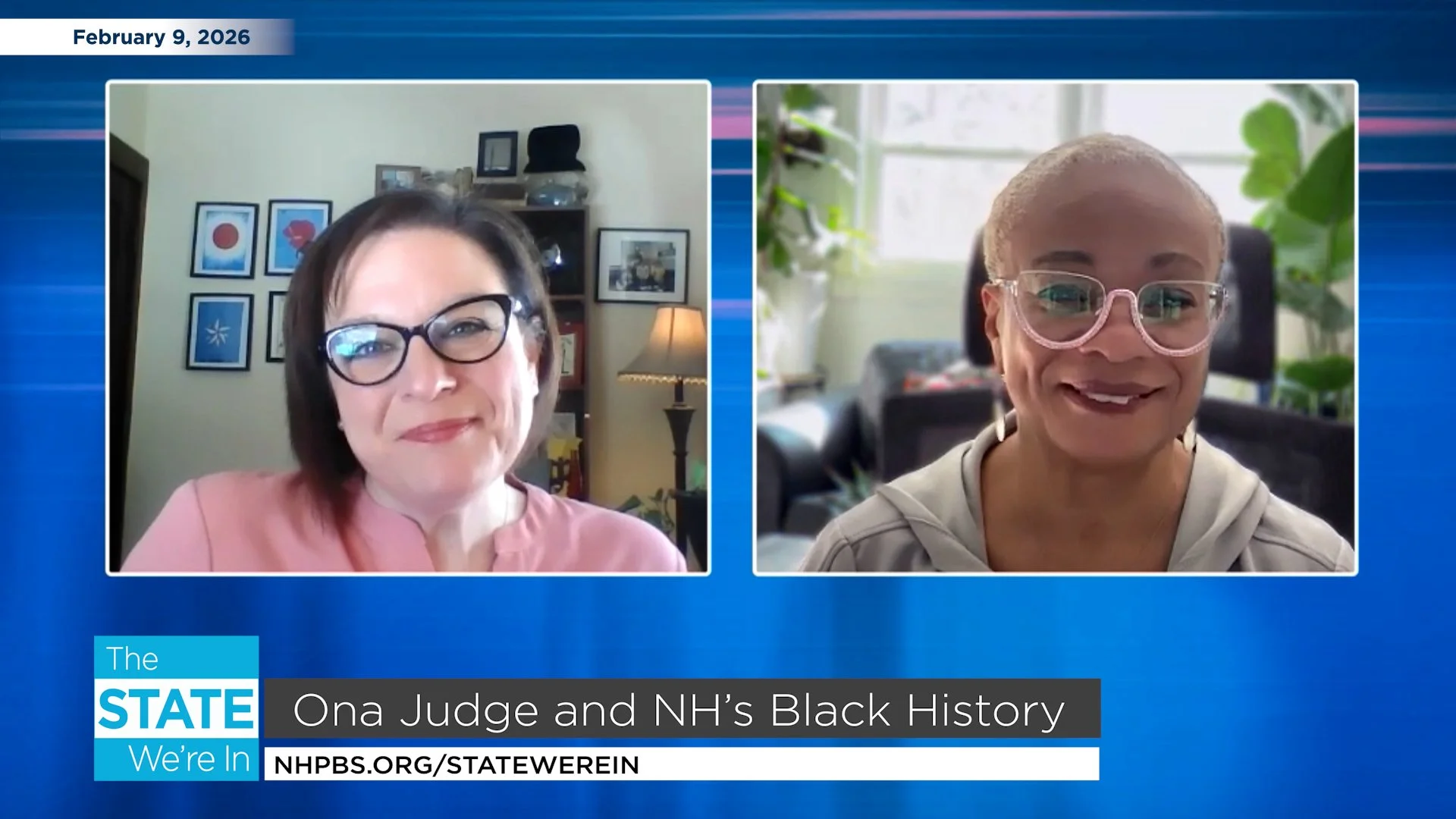
February is Black History Month, and we pay special attention to the subject. But recent events, in and outside of New Hampshire, are making that more and more difficult. On Jan. 23,, the Trump administration removed panels that discussed George Washington’s ownership of enslaved people at the President’s House Site in Philadelphia, Pa. (A federal judge on Feb. 16 ordered the Trump administration to temporarily restore displays as a lawsuit filed by the city of Philadelphia continues.) So can we hide from history? Here to discuss that and more is JerriAnne Boggis, executive director of the Black Heritage Trail of New Hampshire.
By Rosemary Ford and Caitlin Agnew
This article has been edited for length and clarity.
Melanie Plenda:
The Black Heritage Trail works to share New Hampshire’s connection to Black history, one of them being the story of Ona Judge, a young woman who escaped slavery to live in New Hampshire. Her story is depicted on one of the panels in Philadelphia. Can you tell us more about her and her circumstances?
JerriAnne Boggis:
What her story tells us is, first of all, that George Washington enslaved people. That's the first story that we look at when we think of Ona Judge’s story, especially here in New Hampshire, where she ends up living. The other story that it tells us is that the Washingtons knew about a law in Philadelphia, that an enslaved person, after living there for about six months, could petition for their freedom. What the Washingtons did to sidestep that law, to be unlawful, was to cycle out their enslaved people every six months so that they wouldn't have a chance to petition for their freedom. So it was on one of these moments when the Washingtons were cycling out their enslaved people that she decided that she would leave. She left the household, and with the help of the black community, the Underground Railroad, she ended up in Portsmouth.
We know her story because on several occasions, George Washington ran an ad saying that she was a runaway. At the time, the Fugitive Slave Act was in place, and an enslaver could then have them return to that institution of slavery. On several occasions, he tried to get back what he saw as his property, and he did it under the radar, because at the same time, he's talking about gradual emancipation and getting rid of the institution of slavery.
These stories complicate George Washington at a time when we want to say a myth of the “great valor of this man.” It just shows a much more complex human being who really believed in the institution of slavery and held enslaved people himself.
Melanie Plenda:
What were your thoughts about the removal of information concerning Judge and other enslaved people from the President’s House in Philadelphia?
JerriAnne Boggis:
I think we do our country a disservice by telling the mythology of America instead of really looking at telling the story truthfully and responsibly. I think we lose so much. We localize these stories in creating a myth of our country.
We have the Declaration of Independence, which we're celebrating the 250th anniversary this year – the thing that defines America, that we are a place of liberty and justice for all, that we all have the right to pursue our happiness. But when we look at these stories, especially when we look at the story of enslavement black history, it is removed from American history. Because it doesn't fit that narrative of equality and justice for all. It allows us to then remain looking at people in a stereotypical way that the other story tells us, instead of looking at a fully formed human being with desires, pursuing their happiness, work, and courage to be taking a stand for democracy. Democracy is endangered when we don’t have informed people. We are bound to repeat our mistakes if we don’t understand history.
Melanie Plenda:
In June of 2025 you joined us to discuss the Juneteenth celebration, and how the Black Heritage Trail of New Hampshire was faring in the current political climate. How are things now? Has anything changed?
JerriAnne Boggis:
We are in a good place. First, people wanted to know how we got where we were, and that has continued to be. On a federal level, we struggled when grants were withdrawn. Now in the environment we're in, where a lot of our sponsors are paying attention to basic human needs that have been stripped – clothing, shelter, well-being, health, schools – we see a decline in some things.
The biggest change that we've seen since then is really our ability to talk about this history in schools. That's where we see some pushback because the teachers themselves are at a risk of losing their own jobs. So we have to be careful. We have to find alternative ways of getting this information to our students, to our younger ones. That's where long-term change happens.
Melanie Plenda:
How have you been able to address that? How have you been able to reach out to school-age kids if the schools aren’t necessarily an avenue for that anymore?
JerriAnne Boggis:
There are some teachers that will take the risk. There are some school districts where teachers are supported. So what we do is find the like-minded people so we get the information out.
We’ve also looked beyond the schools to look at community organizations, churches. We’ve created really strong partnerships with the Episcopal Church and the Unitarian Church so that we can gather youth groups, community organizations, to really get this out, And we are really relying on our tours so that they can actually be out of the classroom and see this information right in their backyard.
Melanie Plenda:
Can you tell us about the Ona Judge mural and the importance of the “History Through Art” initiative and continuing to tell the history of Black Americans?
JerriAnne Boggis:
Art has the ability to disarm people. Looking at something beautiful – looking at something someone created, that touch, that feel, invisibly seeing it raises that curiosity. We're fortunate that Manny Ramirez from Positive Street Art is our local artist. He is from Nashua, a young man of color who is creating the piece for us.
There's no picture of what Ona Judge looked like, so like what we did with the Harriet Wilson statue, we had to create this for what story we're telling. We do know Ona Judge had freckles, and she had curly hair. But exactly what she looked like, we don't know.
So we did the research on what she could have worn. She was the body servant to Martha Washington, and that said she was well-dressed. So that gives us an opportunity to break stereotypes of what black women look like, creating a well-dressed 18th century woman. So we have this really nice, powerful image of this woman standing tall, just tasting freedom, by her choice, here in New Hampshire, and what possibilities that await her.
Melanie Plenda:
In honor of Black History Month, every Sunday in February, the Black Heritage Trail hosts the series, “The Elinor Williams Hooker Tea Talks,” showcasing New Hampshire Black history and featuring panelists presenting on the importance of cultural expression. Why is it so significant to illuminate specifically, the importance of African American oratory, especially right now?
JerriAnne Boggis:
When we decided on doing the series, – we try to plan them a year in advance – we knew we were coming up to the 250th anniversary, and we started getting all the talk about erasing Black history. We can't talk about it in school, can't read this book – all the things that we can't do. Thinking of the 250th, of this whole voice – the First Amendment right of freedom of speech – and then we looked at our Black history, the importance of the oratory just came to mind. It is that power that's in the voice.
We wanted to examine right where we start, right where our independence starts – with the voice. In doing so, to look at what Black oratory is, the role the pastor played not only in spiritual life but secular life. The power of the pulpit, what Black women have done throughout America's history in using their voice to speak to social justice issues, and what our young people are doing today. How has oratory changed? What form has it taken? How are they protesting? How are they using their voice for social change? So that's what we wanted to examine with this series, where it starts with the voice.
Melanie Plenda:
Last year you wrote an op-ed for the Union Leader about using social media to project Black voices when books and curriculum are being censored. How do you think these Black influencers can make an impact, as history is being torn down right in front of us?
JerriAnne Boggis:
This new platform of social media – all of the different avenues, whether it's above ground, underground or right in the middle. These stories cannot be hidden. Instantly, all over the world, somebody has this information. Those platforms are so powerful in getting messages out that they open many doors for Black influencers to tell the story and tell the truth. We as the recipient of these stories, have to be discerning as to who we listen to or find the knowledge for ourselves. But you can't hide it so easily anymore, and that's the beauty of the platforms that we have.
Melanie Plenda:
Last year, the Trump administration restored a statue of Confederate general and KKK member, Albert Pike in Washington, D.C.. Now, as they remove vital pieces of Black history from sites across the nation, what is going on here? And what kind of impact do you think this will have?
JerriAnne Boggis:
This is one of the things that we're always afraid to say: This is a power move to maintain white supremacy. It's a power move to create a narrative that we already knew was false. We had gotten to a point in telling the history of our stories very openly. There were all these projects coming up that were looking at America without rose-colored glasses. We were looking truthfully at our story, and we were creating these pockets of understanding and of crossing that bridge of networking with each other to create a break. If you are in a power position, you are scared about that, because once the majority moves away from that, then that power structure has to fall, and something else has to take its place. But I want to be hopeful that it's not the majority of the country that thinks that way. I have to be hopeful that we moved further along that ladder that we thought we did.
Melanie Plenda:
Thank you JerriAnne for joining us today. We really appreciate it.
“The State We’re In” is a weekly digital public affairs show produced by NH PBS and The Marlin Fitzwater Center for Communication at Franklin Pierce University. It is shared with partners in the Granite State News Collaborative, of which both organizations are members. For more information, visit collaborativenh.org.