By Rosemary Ford and Caitlin Agnew
This article has been edited for length and clarity.
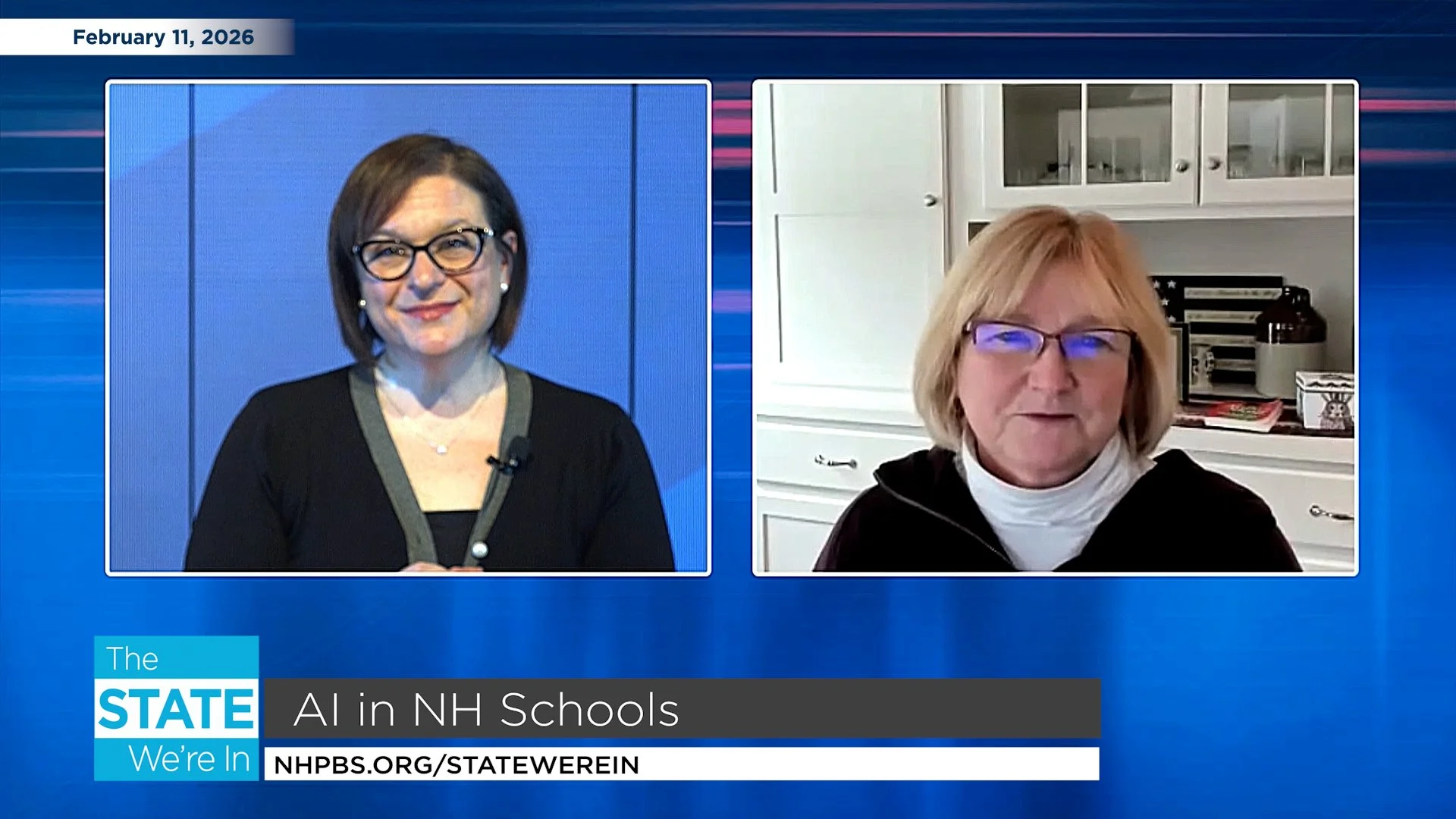
Artificial Intelligence is continually changing and shaping the way we live our lives. As AI continues to become more common, it’s important that students understand how to use it to enhance learning. But what are safe ways to use AI in school settings? The N.H. Learning Initiative helped to create a guide that outlines a way to standardize AI usage in schools across the state. Here to discuss that is Ellen Hume-Howard, executive director of the N.H. Learning Initiative.
Melanie Plenda:
The N.H. Learning Initiative worked to create the N.H. AI Education Collaborative. This collaborative, made up of school districts and administrators, wrote the AI guidance for schools framework. Can you tell us more about the framework, and what went into making these guidelines?
Ellen Hume-Howard:
We're very lucky in New Hampshire — we have a very collaborative environment with the professional associations, the principals, the superintendents, the school board, and all the technical organizations in the state. We all were sharing that we thought collaboratively we would be able to maybe get on paper — a little bit of a practical guide for districts. All of our national organizations were sharing with us really great information, so we decided to work together and put our heads together and to create a roadmap for New Hampshire educators and school systems so they'd have a little bit of a starting point.
Melanie Plenda:
Why did the New Hampshire AI Education Collaborative feel it was important to create this document?
Ellen Hume-Howard:
Lots of times in education, we tend to be a little bit behind the curve when new technology is introduced. There have been many times with different things — computers, internet, calculators — there’s sort of like this hesitation, this waiting to see what's going to happen.
In the case of AI, though, it was coming pretty quick, pretty fast and pretty rapidly, and like the internet and phone use in the last several decades, kids were really out ahead of it — more than the educators in the system. Our intuition was telling us, “Let's see what this is going to look like. Let's see what the safety aspects are.” Because as educators, that's one of the things you're always thinking about — how safe is it? We had to find a middle-of-the–road approach to this, where we were providing guidance but also being very cautious about what the tools were like.
Melanie Plenda:
In what ways can artificial intelligence help both students and teachers?
Ellen Hume-Howard:
I think that AI can be incredibly helpful in multiple ways. One of the things that's really key is that, when it comes to students, having adults guide the process and creating conditions within schools where you can control the AI tools that students have access to really can enhance what education looks like.
Ultimately, AI doesn't replace human beings, right? So that's still a major factor in education, but what AI can do is provide a little bit of a roadmap for students in regards to getting feedback for their learning in multiple ways. Teachers, on the other hand, can find tools within AI that help them with tasks where they need feedback, also designing some lesson plans, doing some things that are often time-consuming that can be quickly done.
Melanie Plenda:
How do these guidelines in the framework help to ensure that AI is being used responsibly within schools, and which parts of the guidelines have been helpful to schools so far?
Ellen Hume-Howard:
Right out of the gate, one of the ways that we were able to cull together the different national picture and the different tools that we were sharing was the idea of what policy needs to look like. Oftentimes, with things like this, when any kind of change happens, lots of times policy is slow to catch up with what the practice needs to be. We wanted to get out ahead of it really early to help districts put in place policies that could help them guide and be able to be flexible, because this is the type of technology that changes and has changed significantly since we even published our guide last spring.
That was a big piece — where do we start with some of these policies? What do they need to look like? What's fair? How do they align with what the state of New Hampshire requires in an educational setting, things like student privacy, all of those pieces? We built starting points for policies and gave districts sort of a springboard that, “this is how other districts are doing it.” Ultimately, we created a network thinking about this, and I think that really helped. We had some districts that were way out ahead, and they were part of this group.
As we built the guide, we tapped into what they would recommend — here is a good place to start; this is the way that you can build your technology infrastructure so that kids have access to AI but you can protect them. There were multiple things happening as we built this, and it really was reflective of the expertise of this entire committee, and we tapped into people beyond just even the committee — any kind of resources we could find and experts that weighed in and gave us some feedback.
Melanie Plenda:
Why do you think AI literacy is important to teach in schools from a young age?
Ellen Hume-Howard:
One of the things you're responsible for as an educator is to prepare students for the world they're living in and for the world that's going to be coming — making sure that we have sensible learning progression experiences for students where they can learn to be literate, they can learn to understand, and how to use these things. We did that when we first introduced the internet.These are all things that come into play in being digitally literate and also just AI-literate, which I think is the new literacy component that all schools need to make adjustments to.
Melanie Plenda:
What would you say to parents who may be skeptical about AI being used in the classroom?
Ellen Hume-Howard:
I think they just need to ask questions, and they need to be part of the conversation and to share what they're worried about and to have communication at the school level to demonstrate how they use AI and what it really looks like.
We don't have to keep anything a secret about how we're going to use it. One of the things that I was most impressed with early on with AI was the idea that the school system could control what AI students had access to in school. Students have had access to lots of different AI for years, but it's been in different forms. So the control in the school, I think, is probably more strict than maybe what they find when they leave the walls of the school out on their own and what they have access to with other apps.
I think having the conversation with parents because there are things that they would really benefit from — about how the schools lock down things, advice on how parents can lock down information. I think the conversation needs to be pretty fluid and pretty open and transparent, and no one needs to be worried, because we can have control over some of these things. What we need to be is cautious. We need to be good consumers of these types of advancements.
Melanie Plenda:
These guidelines were released in June of 2025. How has the implementation of these guidelines played out differently for schools across New Hampshire?
Ellen Hume-Howard:
We accomplished the policy baseline pieces, which I think have been really effective. But over the last several months we've got lots of feedback from districts. We've had suggestions on how to talk to parents about AI, about different ways to vet apps that students would have access to. We built this guide on our own, but what's happened is that everyone's starting to contribute. So one of the things that we'll do as we get closer to the spring is just relook at every section and update it and edit it based on our learning and take a little dip into where the national conversation is going.
Melanie Plenda:
How can Granite Staters learn more about how to use AI in an effective manner? Does the New Hampshire Learning Initiative have more resources for understanding AI?
Ellen Hume-Howard:
Looking at the guide has been helpful to some parents — the guide is available on our website. I think maybe just one of the things that we've encouraged teachers to do is to navigate what type of AI workshops are good for them based on their content area. Also, for community members, they're welcome to come and learn some things. There's lots of different AI training going on everywhere, from the University of New Hampshire to the community college system. So there's lots of opportunities where people, all members of the community, are welcome to learn.
Melanie Plenda:
Thank you Ellen for joining us today.
“The State We’re In” is a weekly digital public affairs show produced by NH PBS and The Marlin Fitzwater Center for Communication at Franklin Pierce University. It is shared with partners in the Granite State News Collaborative, of which both organizations are members. For more information, visit collaborativenh.org.