By Rosemary Ford and Caitlin Agnew
This article has been edited for length and clarity.
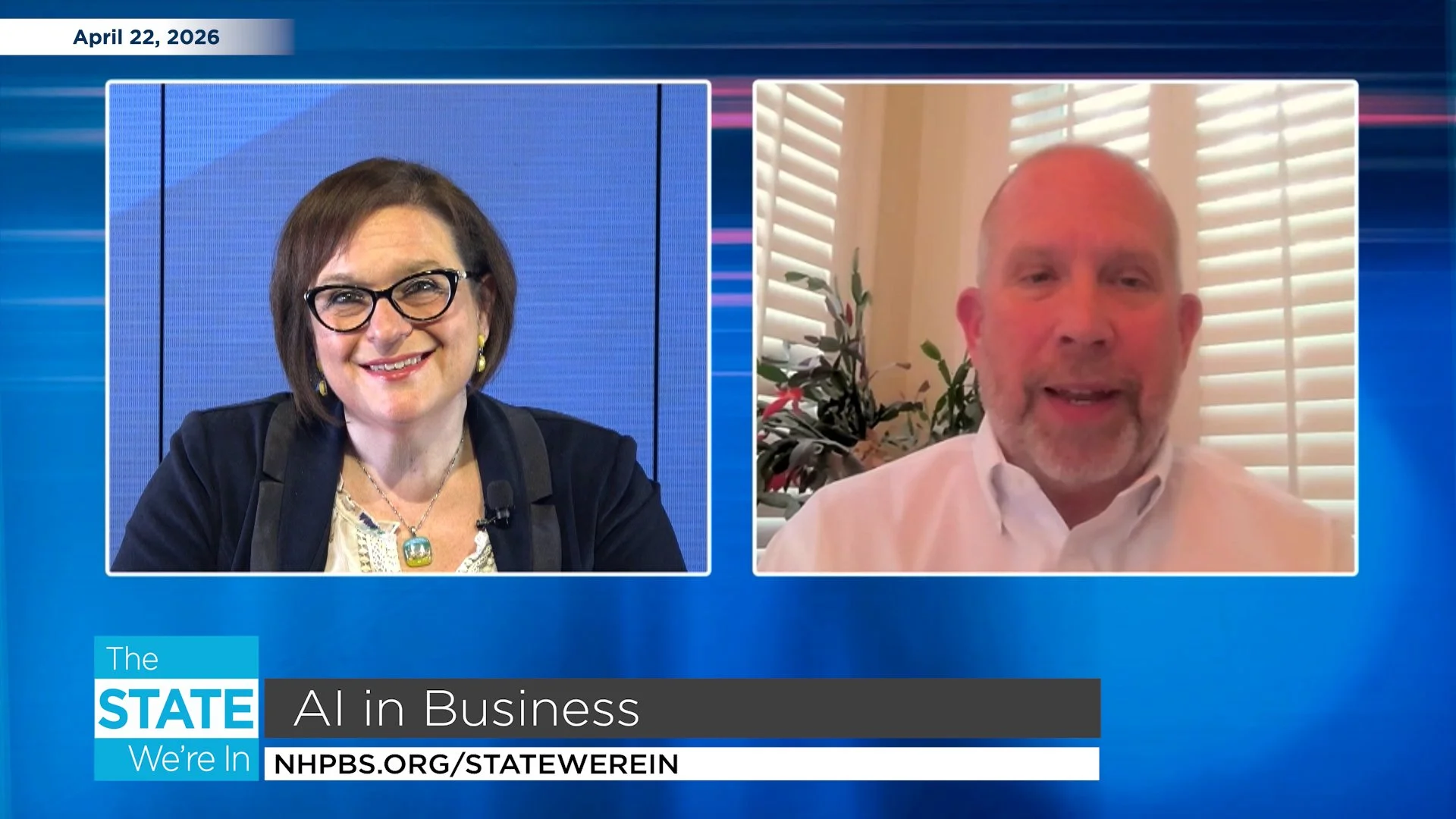
Embracing and understanding AI is becoming essential for businesses that want to continue to prosper and innovate in this new era of technology. While many fear AI will lead to widespread job loss, others say its use in business settings can transform jobs and allow for workers to be more efficient. So what does this look like? How are businesses adapting? Philip Magnuszewski, founder of the think tank D!srupt AI and the nonprofit AI in NH as well as co-chair of the NH AI Task Force.
Melanie Plenda:
For people who are unfamiliar, what is AI and how might it be used in a business setting?
Philip Magnuszewski:
AI has been around for well over 70 years now. It's gotten kind of a recent plug on the marketing front over the past half a decade or so, but artificial intelligence has just kind of always been a way to kind of replicate how the brain works in a programmatic way, leveraging software. What it does, in essence, is enhance our capabilities. It allows us to potentially look at larger amounts of information, more quickly synthesize those things, and better understand our world or our businesses that we're involved in.
Where we see it specifically helping businesses or employees that are working in businesses is in helping them get maybe better and more in-depth insights to what their customers are doing, helping them do market research and understand where their products might be tweaked in order to better address the market, and to make operations a little bit more efficient, leveraging the technology as well. I think the best way to think about it is really to look at it as a collaborator, a tool — a co-pilot, if you will — that you can use to be more efficient or to even think differently, or rethink things a little bit in terms of how the organization operates.
Melanie Plenda:
How could that impact the New Hampshire economy, or the economy at large?
Philip Magnuszewski:
We're going to see it impact the economy in a huge way from a productivity standpoint alone. We always hear the term “Do more with less,” and I think that's definitely the case with what we're seeing today.
I think New Hampshire is a very unique state. We have a lot of things going for us. The ecosystem is more collaborative across the board. It's easier to access individuals across the state, and we have an opportunity to look at the state as a living lab. These changes that we're seeing seem to be happening quickly. Obviously, the tool sets are changing quickly, but the actual impact requires us to experiment, to use the technology for those kinds of things. I'm seeing there's a desire to understand how it works, and how do I use it to impact either my community or my organization at large?
Melanie Plenda:
Tell us about D!srupt AI and AI in NH.
Philip Magnuszewski:
I do a number of different things. Most of my day is talking and working with organizations to leverage the technology in a way that helps them bring their business strategy or vision to life. I think this technology, artificial intelligence, gives us an opportunity to rethink and reimagine the world around us, and we can produce impacts. We can produce results that are 10 times or 100 times what we're seeing today. So it's an opportunity for me to engage with individuals and organizations that are looking to really have impact in areas that are of importance to us, either at a community or a societal level.
Melanie Plenda:
What is the NH AI Task Force?
Philip Magnuszewski:
The NH AI Task Force is a group of individuals — we’re closing in on about 20 individuals — driven and hosted out of the N.H. Tech Alliance. We cover about eight different sectors across the state, and the whole intent is to really understand how the technology is being used today, where there are gaps in terms of understanding or resources, and then making recommendations to the state Legislature, to the governor's office, in terms of the things we need, and also being able to provide some of those resources to the state here as well.
We're trying to understand how it's being used, specifically here in the state. What are some of the best practices, what are some of the recommendations that we can make going forward?
Melanie Plenda:
Tell us about the NH AI Task Force Survey.
Philip Magnuszewski:
What we're trying to do is gather some empirical data points. We had surveys go out to eight sectors. We also have working group roundtable discussions, typically one or two a quarter for each of those sectors, where we're getting additional context.
We'll have a full report coming out in October. The idea is that as we get that information we will share it with the public so they can understand how their organization rates against other organizations in a particular sector or industry. That will help us create those best practices, blueprints, those things that can help an organization accelerate the usage of artificial intelligence.
Melanie Plenda:
Earlier this year at an AI in NH event, you introduced Granite Staters to Google’s NotebookLM, which you referred to as one of the most underrated AI tools. Could you describe what this tool does and why it is so powerful?
Philip Magnuszewski:
I would say it's underrated because I don't think it gets the hype or the marketing prowess that Open AI or Anthropic has, but it's a Google product, and it's available to most users for free at some level.
It allows you as an individual to aggregate information, which just means kind of pull information. So if you're interested in a specific topic, you can pull videos, you can pull documents, and store those in a way that allows you then to ask questions about it, to synthesize information. I encourage everyone to use it for personal purposes, but if you wanted to get a better understanding of what was historically happening over in Iran, for example, you could have it do research on a particular topic, which would say what has happened over the course of the last five or 10 years, and you can look at it from different perspectives. You can pull different types of sources — press releases, videos, etc. — but it allows you then to get it in a format where you can better understand, get a summary of what's going on.
I think one of the really awesome things about it is it will also put together output, which could be a presentation, an infographic, an explainer video — it could be a number of different things. It really helps accelerate the learning process for any subject that you're interested in, which is why I say it's incredibly powerful. For students in particular — if you're trying to get a better handle on a particular top topic or subject area, I think it's an incredible tool.
Melanie Plenda:
We’ve talked a lot about the helpfulness and possibilities for productivity with AI. Yet, when people mention AI, concerns always come up. One of them is about job loss. How would you address that?
Philip Magnuszewski:
I think it's a very real concern. I think it would be just disingenuous to say that there aren't going to be jobs that are lost as a result of this. I do think — and I use this term quite a bit — I think we have agency around it. I think, as business leaders, we can decide where, how and at what pace we're going to introduce the technology. I think on a personal level, we have agency in terms of just exposing ourselves and getting engaged with it as well.
It's not all doom and gloom, though. I think what we've seen historically with the introduction of any new technology is that while some jobs will go away, other jobs will replace those. I even think that some of the early examples of organizations who have let thousands of individuals go in specific departments because of AI are actually bringing people back now, because the technology doesn't exactly give them what a human can do, or what a human brings to the table. So I think the fear there has some legitimacy to it, but I would just say we're in an era where we all have to remain agile, flexible and kind of try to figure things out as we're going through this together.
Melanie Plenda:
What about AI’s use of intellectual property to learn and adapt? How would you address concerns about that?
Philip Magnuszewski:
I think that there's a couple of pieces to that. I am not a fan of how these initial large language models were built. I think that there are some lines that were crossed in terms of capturing or taking content from creators. I don't know what's going to happen with that. It's one of those cases where I think the law is still trying to catch up to the technology itself. I think that's a challenge.
Going forward, in terms of intellectual property in general, organizations are doing a better job of understanding where their data might be used to train these models, and actually leveraging their own data to better improve the models or what the models can provide from an outputs perspective as well.
Melanie Plenda:
As AI continues to evolve and develop, in five years, what impact will all of this have on New Hampshire businesses? What could that landscape look like?
Philip Magnuszewski:
Trying to extrapolate five years out with this technology is tough. There's a wide range of things that can happen as a result of it. We could see everything from the dystopian view to a utopian view. I think we're going to be somewhere in the middle. I think we're going to grind through the next few years and figure out where it fits and how it looks. But I think that there is an opportunity — again if we do it responsibly — for businesses to operate with less friction internally. I think that there's an opportunity to kind of rethink and reimagine.
Melanie Plenda:
One of the goals of the non-profit AI in NH is to encourage curiosity about AI and to empower residents to engage with artificial intelligence. Why is curiosity important when learning about AI?
Philip Magnuszewski:
I think if you're curious, you're engaging with it, you're learning about it. I think that helps deal with some of the fears you might have, and it allows you to understand where and how you'd like to use it as an individual — where it fits and where the limitations are. I think of the people that I know that are using it quite a bit or the folks that are benefiting the most from it — it's the folks that are just curious.
Melanie Plenda:
AI in NH recently hosted an AI Week with several events. Can you tell us more about some of the events and how they went? What do you have coming up?
Philip Magnuszewski:
We did it in partnership with the New Hampshire Tech Alliance. We had over 17 events over the course of the week, which was pretty intense. We had some folks up from Boston Dynamics talking about the future of physical AI, which is robotics. We had some kids attending there. We had hands-on workshops giving people a chance to explore what was possible and building things with it as well. We had organizations that were talking about how to build trust in an organization so your workforce is less resistant to the technology as well. We had students from Dartmouth and the University of New Hampshire that were showcasing some of the things that they built as well.
Melanie Plenda:
What are some other ways Granite Staters can improve their AI literacy outside of attending events like these?
Philip Magnuszewski:
There's a lot of resources out there today. There are podcasts. If you're interested in the technical side of things. I listen to a podcast that's called “Last Week in AI.” There are books and trainings from Google, Microsoft and all the major technology partners. And, frankly, you can't scroll a social media feed these days and not have a link to something that's going on with artificial intelligence. I think that those are all good resources. They give you a good chance to kind of understand what's going on as well.
But I'll go back to what I said before. The best way to learn and to understand what AI is, is to really just grab a tool — pick one, there are free versions for most of these tools. That’s the best way to get involved and to better understand
Melanie Plenda:
Thank you so much for joining us today Philip.
“The State We’re In” is a weekly digital public affairs show produced by NH PBS and The Marlin Fitzwater Center for Communication at Franklin Pierce University. It is shared with partners in the Granite State News Collaborative, of which both organizations are members. For more information, visit collaborativenh.org.