Report finds up to a nearly $17,000 disparity in tax bills for equally valued homes in different towns
By Kelly Burch-Granite State News Collaborative
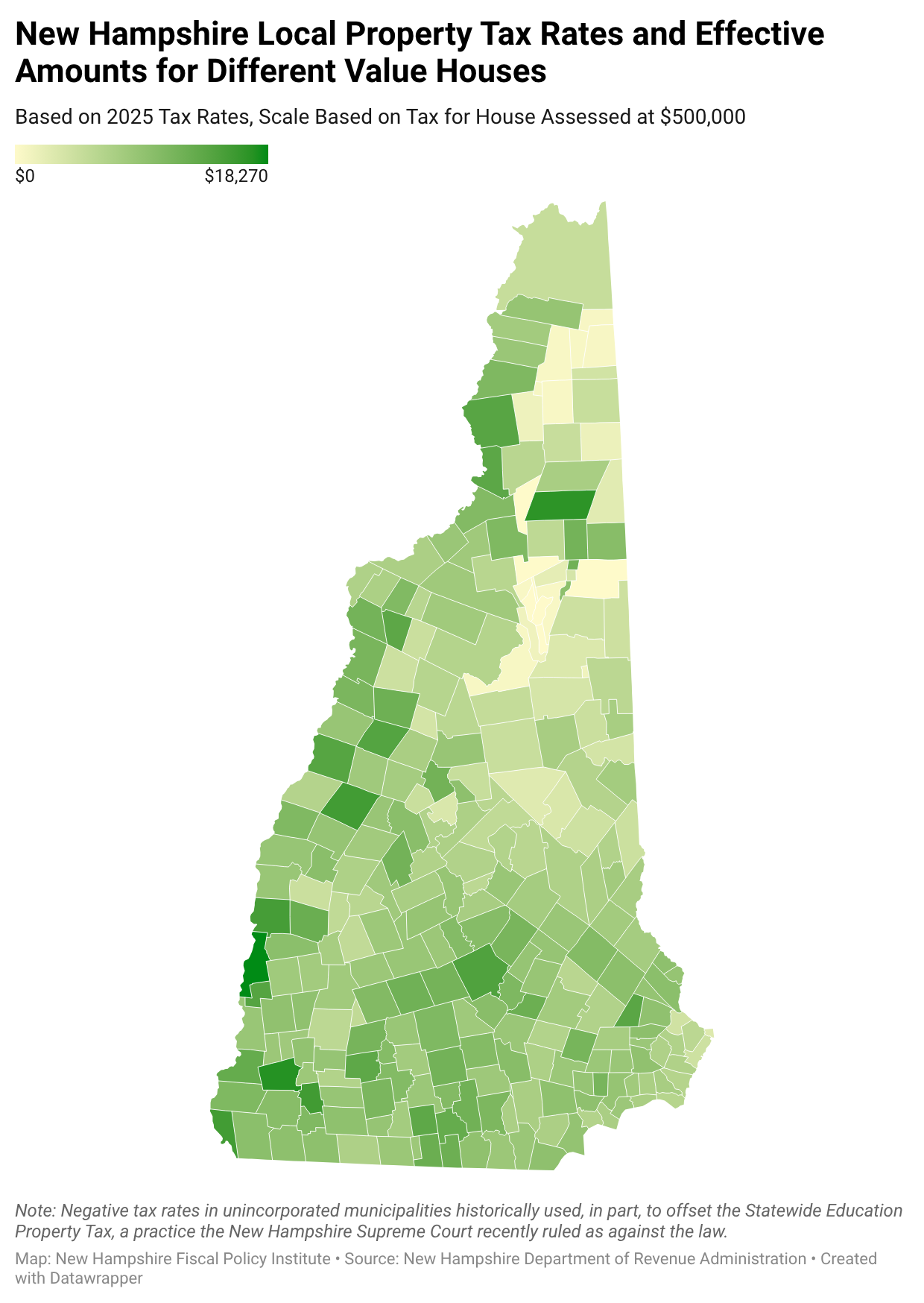
The annual tax bill last year for a $500,000 home in New Hampshire ranged from as low as $1,310 to as high as $18,270, depending on where the property was located.
That’s according to a new report issued by the N.H. Fiscal Policy Institute, which looks into an issue many Granite Staters have personal experience with: the huge disparity in property taxes across the state. The report found 2025 tax rates ranging from $2.62 to $36.54 per $1,000 of assessed value, with the state’s lowest-income families paying the greatest percentage of their income toward property taxes.
Even in neighboring towns, the difference in tax rates can be striking: In 2025, a $500,000 home in Lee would have a $13,805 property tax bill, while the same-value home in neighboring Nottingham would face a bill of about $6,600. Owners of a $500,000 home in Acworth would have to pay about $8,030 in property taxes, compared to $18,270 in neighboring Charlestown, which has the state’s highest tax rate of $36.54 per $1,000 in assessed valuation.
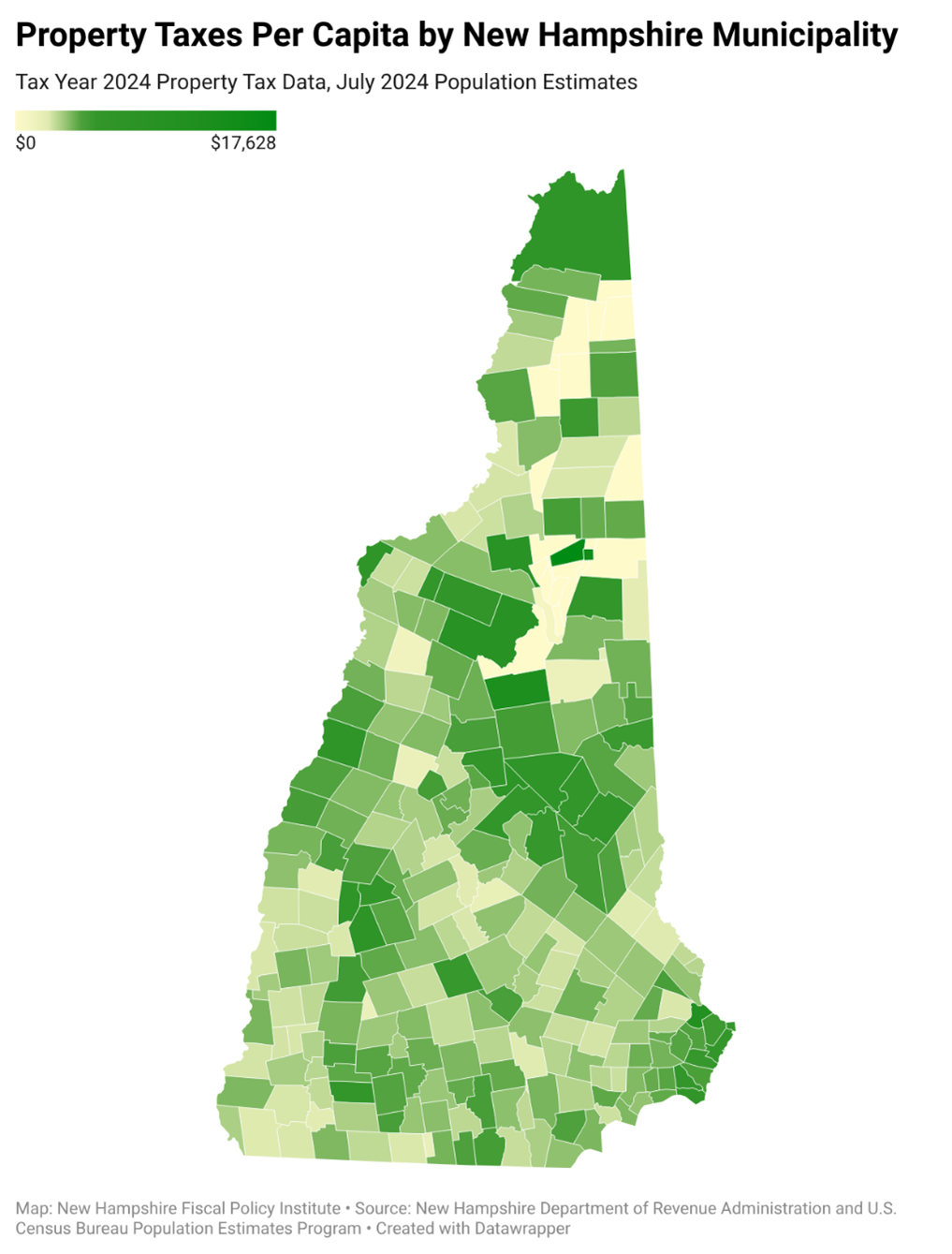
One commonality when it comes to property taxes across the state is that they’re rising: The report found a 12.1% increase in the amount Granite Staters pay in property tax over the past decade, adjusted for inflation. That affects not only homeowners and businesses that own properties, but also renters, said Phil Sletten, research director at the Fiscal Policy Institute and author of the report.
“People have noticed the changes … in their household budgets,” he said.
Limited revenue options
Two characteristics of government funding in New Hampshire come into play when discussing property taxes, according to John Orcutt, professor at the University of New Hampshire’s Franklin Pierce School of Law.
First, the New Hampshire Constitution puts strict limits on the types of taxes that can be levied in the state. Because of that, the Granite State “is more reliant on property taxes than any other state,” Orcutt said. The percentage of total local public revenue coming from property taxes is higher in New Hampshire, at 61%, than in any other state, according to the Fiscal Policy Institute report.
Since property taxes are one of the only revenue streams available to local governments, they are “more likely to backstop a local budget in the face of increased revenue needs,” Sletten said.
The second policy that contributes to the variation in tax rates is that New Hampshire funds education at the local level. In 2024, 70% of school funding came from local property taxes, according to the N.H. School Funding Fairness Project.
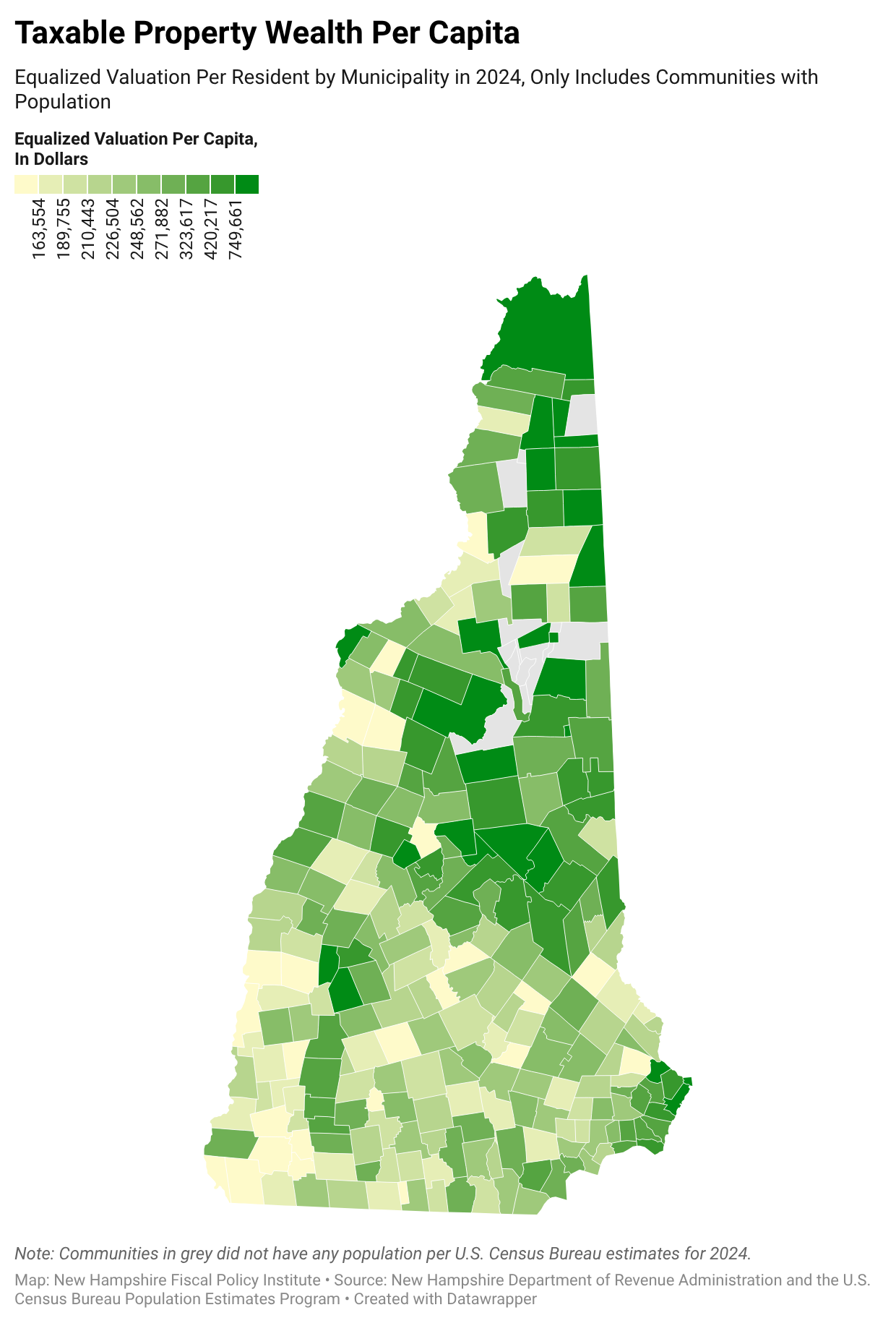
To cover the costs of public education, cities and towns with lower overall property value must “place a higher burden on local property local taxpayers … compared to communities that have higher levels of wealth,” explained Bruce Mallory, senior research fellow at UNH’s Carsey School of Public Policy.
Mallory, who was project manager for the legislative Commission to Study Public School Funding — which issued its report in 2020 — described the inverse relationship between property wealth and tax rate as the “core issue in terms of equity for students and for taxpayers.”
Progressive vs. regressive tax policies
Property taxes everywhere are regressive — a technical tax term meaning they put a higher burden on people with lower incomes, according to Orcutt. That’s different from federal income tax policy, which is progressive, meaning higher earners pay more tax, he noted.
That is true even if the tax rate is consistent. In New Hampshire, the variation in property tax rates, with higher rates in lower-income areas, makes the regressive nature of property taxes even more pronounced, Orcutt said. An analysis in the NHFPI report shows that low-income families pay three times the share of their income toward property taxes, compared with high-earners (5.9% vs. 2%).
For Mallory, this comes back to the issue of paying for education.
“In a nutshell, New Hampshire school-funding policy is essentially regressive,” he said.
Other issues compound the inequities. National research shows that property assessors tend to overvalue (and thus overtax) less expensive properties, while undervaluing and thus under-taxing higher-value properties, Orcutt pointed out. This phenomenon is known as property tax assessment regressivity.
In addition, high property taxes can drive down the value of homes in a city or town, Sletten said. Many homebuyers set their budget based on the monthly payment — a combination of their mortgage, insurance and property taxes. Because that cost drives the market, “there are going to be lower prices for homes in higher-property tax communities,” he said. With lower property values overall, the municipality may need to tax at a higher rate to meet its funding needs.
All of this likely affects where Granite Staters live. Property taxes can be seen as a way of “investing in services” that a municipality provides, Sletten said. Communities with higher tax rates are seen as having a higher cost of those services, which could contribute to people opting to live in communities where taxes are lower.
More equitable solutions?
Granite Staters pay the second-highest per-capita amount in property taxes in the country.
However, New Hampshire is one of only two states — along with Alaska — that has no income or sales tax, which is why it’s “difficult to compare” the average tax burden in New Hampshire to states that have a very different tax structure, Sletten said.
The clearest comparison is to look at the revenue raised per capita by various states, from both tax and non-tax sources. There, New Hampshire ranks 40th.
The report finds that New Hampshire’s local governments “do not appear to be collecting a disproportionately large amount of revenue per capita.”
While Granite Staters pay more property taxes, it’s unlikely they’re paying significantly more tax overall than residents in other states, Orcutt said.
For New Hampshire residents to experience more equitable taxes, the state would likely need to make changes in how schools are funded, experts say.
The school-funding study that Mallory oversaw didn’t make policy proposals, but it did examine what has worked in other states. Making the existing statewide education property tax the primary source of educational funding — as other states have done — is one possibility. That policy would collect local property taxes at a more equal rate, and redistribute them as education funding around the state. That “would achieve the kind of equity this commission felt was a goal,” Mallory said.
More recently, a group of New Hampshire residents, including three Democratic state representatives, introduced a plan that would set a uniform $3 property tax, coupled with a 3% income tax, to fund education. The plan was immediately denounced by Gov. Kelly Ayotte and both Republican and Democratic legislative leaders.
In addition, any efforts to introduce an income tax would face “very significant constitutional hurdles,” Orcutt said.
In the meantime, the differences in property taxes — and school funding — contribute to a “huge variation in communities,” Orcutt said.
“This is not a state where … there is relative equality in each community,” he said.
After studying the issue for 50 years, Mallory said he still doesn’t understand why generations of New Hampshire policymakers have been “unwilling to confront the challenge of inequitable tax policy and inequitable student outcomes.” Other states, he emphasized, have proven solutions that address the regressive nature of relying on property taxes to fund education: “It’s not like we don't know what to do.”
These articles are being shared by partners in the Granite State News Collaborative. For more information, visit collaborativenh.org.