Answers to ‘complicated problem’ include more programs, resources, judicial training
By Kelly Burch-Granite State News Collaborative
When Susan Carbon, a retired New Hampshire judge, thinks about her 36 years on the bench, it’s the family court cases that strike her as the most difficult — more than medical malpractice or even homicide.
“They are hard cases,” said Carbon, who is also past president of the National Council of Juvenile and Family Court Judges. “They’re emotionally laden. You can’t make things right for people. You can help them, but there’s no beginning, middle, end. … It’s really challenging.”
Carbon, who as a retired judge still sits as a judicial referee in New Hampshire courts, isn’t alone. The roughly 30,000 annual family court cases in New Hampshire are “among the most challenging and time-consuming work confronting New Hampshire trial court judges,” according to the N.H. Judicial Branch.
The very nature of family court cases — including divorces, child custody and support, and domestic violence protective orders — means there is rarely a black-and-white legal precedent that can be applied. Too often, that leads to frustration with the family court system, according to a committee assigned to look at New Hampshire’s family courts in 2023 and 2024.

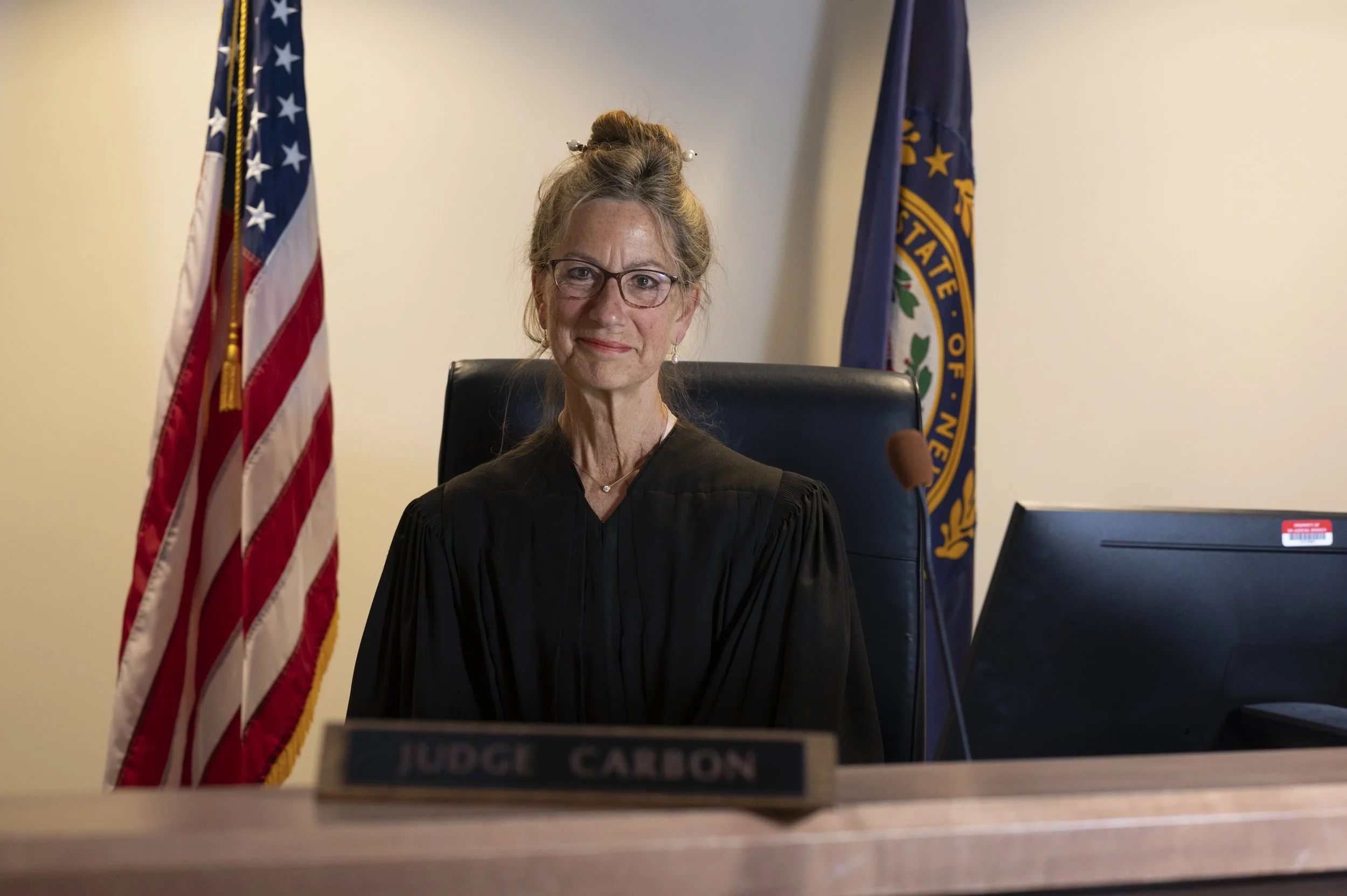
Retired New Hampshire Judge Susan Carbon sits on the bench in a courtroom at the 9th Circuit Court of Appeals, in Manchester, on May 7, 2026. Carbon now acts as a sitting referee and part-time judge, residing over family cases once a week. Credit: Daniel Sarch / Granite State News Collaborative
While it would be virtually impossible to satisfy everyone who came through family court, experts say structural adjustments — such as simplifying forms and ensuring a family sees the same judge throughout their case — that could make the system in New Hampshire function more efficiently, and perhaps reduce widespread frustrations.
“We have a complicated problem in front of us,” said Rep. Mark Pearson, R-Hampstead, who chaired the Special Committee on the Family Division of the Circuit Court. “How do we do [what’s] best for all?”
Progress, but a ways to go
The committee, which issued its final report in 2024, found through public hearings that there was a widespread sense that family court was unfair. Members of the public expressed their concern that there was a lack of due process; that the system was biased, including in how it admitted evidence; and that the court process was difficult to understand. They noted it took a long time to hear cases as well.
Since the report was issued, the Judicial Branch has made efforts to address some of those concerns, according to a statement that the branch sent to the Granite State News Collaborative in response to an interview request. It has made adjustments in the guardian ad litem program (which appoints someone to advocate for the best interests of the child in family court cases). It has hired a person to oversee the Office of Mediation and Arbitration, and it has required both mail and electronic notifications for changes in a child’s guardianship.
Two pilot programs have also been established — one in Concord Circuit Court that allows litigants with limited English to speak with court staff via a remote interpreter, and another in Salem Circuit Court that provides people with a conference room and physical resources, such as a printer, to submit orders of protection.
Some of the most substantial changes, according to experts, have focused on helping people understand the court process. That’s critical in family court, where most people do not have lawyers: About 85% of circuit court cases (including family court) involve parties who are representing themselves, according to the N.H. Bar Association.
In part due to feedback from the special committee, the Judicial Branch simplified many of the forms used in family court, Pearson said. The court has also posted a number of educational videos on its YouTube channel, on topics such as “Navigating Your First Family Court Appearance” and “How to Fill Out a Parenting Plan.”
“There are things we do really well, [like] forms and videos,” said Carbon. However, she would like to see more educational programs.
Explaining how court works helps address concerns about bias and delays, experts say. Family court parties “file far more motions and request more hearings” than other court litigants, according to the Judicial Branch, in part because the cases are highly emotional and bitterly contested.
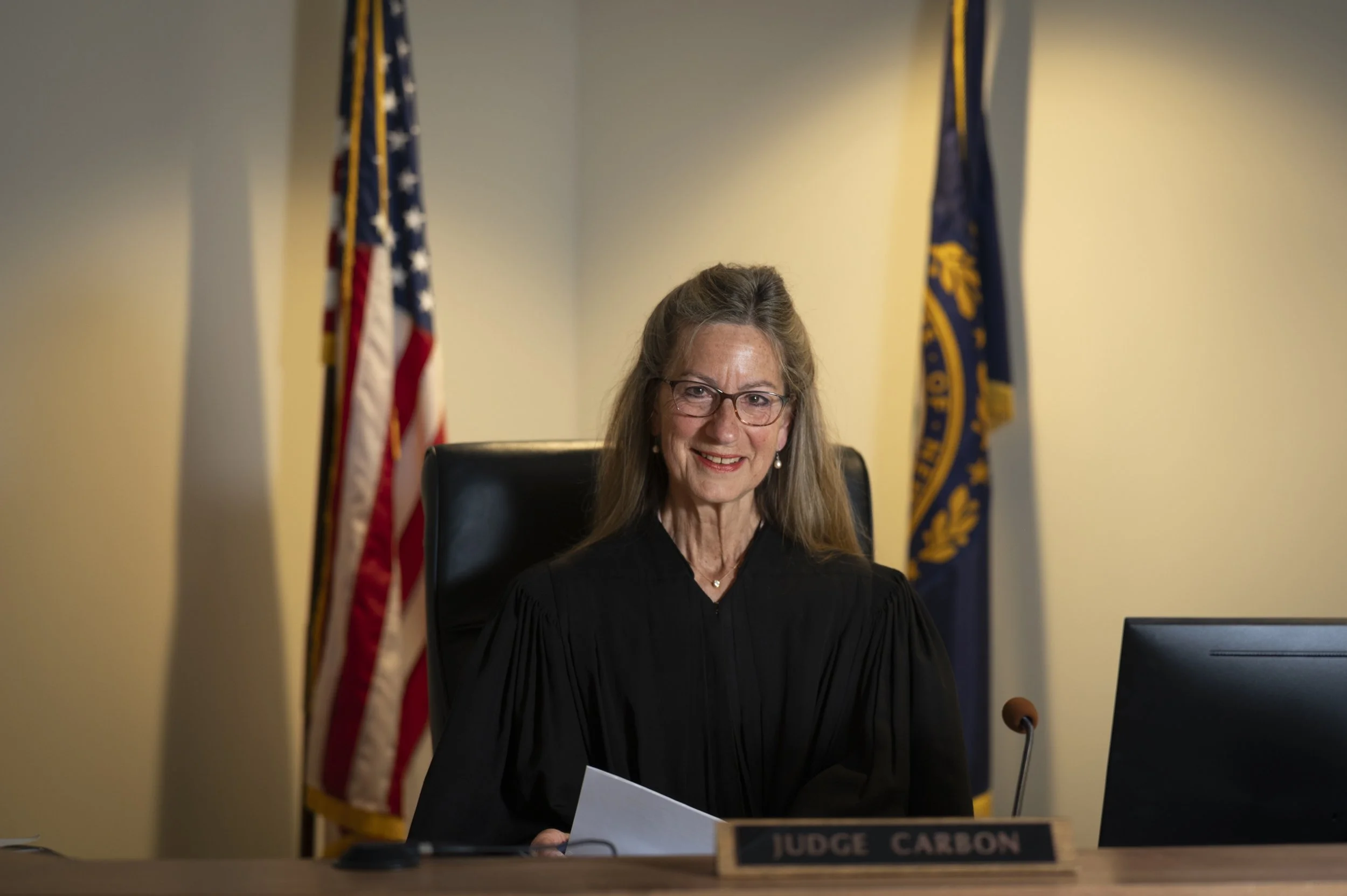
Retired New Hampshire Judge Susan Carbon sits on the bench in a courtroom at the 9th Circuit Court of Appeals, in Manchester, on May 7, 2026. Carbon now acts as a sitting referee and part-time judge, residing over family cases once a week. Credit: Daniel Sarch / Granite State News Collaborative
Lawyers often help explain to their clients why the court acts as it does, Carbon said. Yet, since most people in family court don’t have lawyers, they often think decisions they don’t understand are unfair. While judges may try to explain a decision, “we have very little time to give to them,” Carbon said.
Sometimes, Carbon ventured, people complain about judges “because they think that’s the way to get the decision changed.”
Yet, when people understand why a judge acted in a certain way — such as not admitting a piece of evidence — they’re more likely to be satisfied with the court, even if the ruling isn’t in their favor, she said. “If they feel they were treated fairly, they’re more likely to accept your decision,” Carbon said.
Compounding frustrations
The statute that establishes family court in New Hampshire (RSA 490-D:1) calls for a single judge to follow a family throughout their time in family court. That is also considered a best practice by the National Council of Juvenile and Family Court Judges.
“The judge is going to understand the parents, the children and that family to make better decisions for that family,” said Kathleen Quigley, an Arizona judge who is president of the council.
Yet the special committee found this typically doesn’t happen in New Hampshire. Instead, families often have multiple judges overseeing their cases, according to the committee report, which matches what Carbon has seen during her time on the circuit court.
“We don’t really have one judge, one family,” Carbon confirmed. She believes that’s largely due to scheduling concerns. “We don’t have enough bodies to do the work,” she said.
The Judicial Branch did not respond to questions about this policy.
That gets to a second major issue that the committee’s report calls attention to — that circuit court (which includes family court) is vastly under-resourced. In 2022, the Judicial Branch worked with the National Center for State Courts to audit staffing needs for circuit court. The audit found that the system needs 66 full-time judges and 338 full-time staff — a substantial increase from the 48 current judges and 314 full-time staff.
But last year, because its budget was cut by the Legislature, the Judicial Branch announced a hiring freeze in April 2025.
“Like every branch of government in New Hampshire, the judicial branch must live within the State’s means,” the Judiciary said in a statement.

Retired New Hampshire Judge Susan Carbon stands in a courtroom at the 9th Circuit Court of Appeals, in Manchester, on May 7, 2026. Carbon now acts as a sitting referee and part-time judge, residing over family cases once a week. Credit: Daniel Sarch / Granite State News Collaborative
However, Pearson emphasizes there are cost-effective ways to support family court, including by adding law clerks — which the Supreme and Superior Courts have. In circuit court, “judges often spend considerable time doing tasks which could also be done by law clerks who are paid significantly less than judges,” the report read.
When compared to the Supreme Court and Superior Court, circuit court is “by far the least resourced of the three courts in our state,” Carbon said. That puts a strain on judges, she said, and also means that New Hampshire can’t offer programs that family courts in other states offer, everything from supervised visitation sites to family rooms at courthouses.
“We just, across the board, don’t spend much money on families in this state,” Carbon said. “It shows in the court environment.”
‘Much more’ judicial training needed
Unlike criminal and even civil cases, which are adjudicated based on the law, family court relies heavily on a judge’s decision-making. According to New Hampshire law, the family court is a “court of equity” — a longstanding legal concept meaning that decisions are issued to try to achieve fairness.
Having fixed rules in equity cases can be harmful, Pearson said, so “the judges in family court are given wide latitude.”
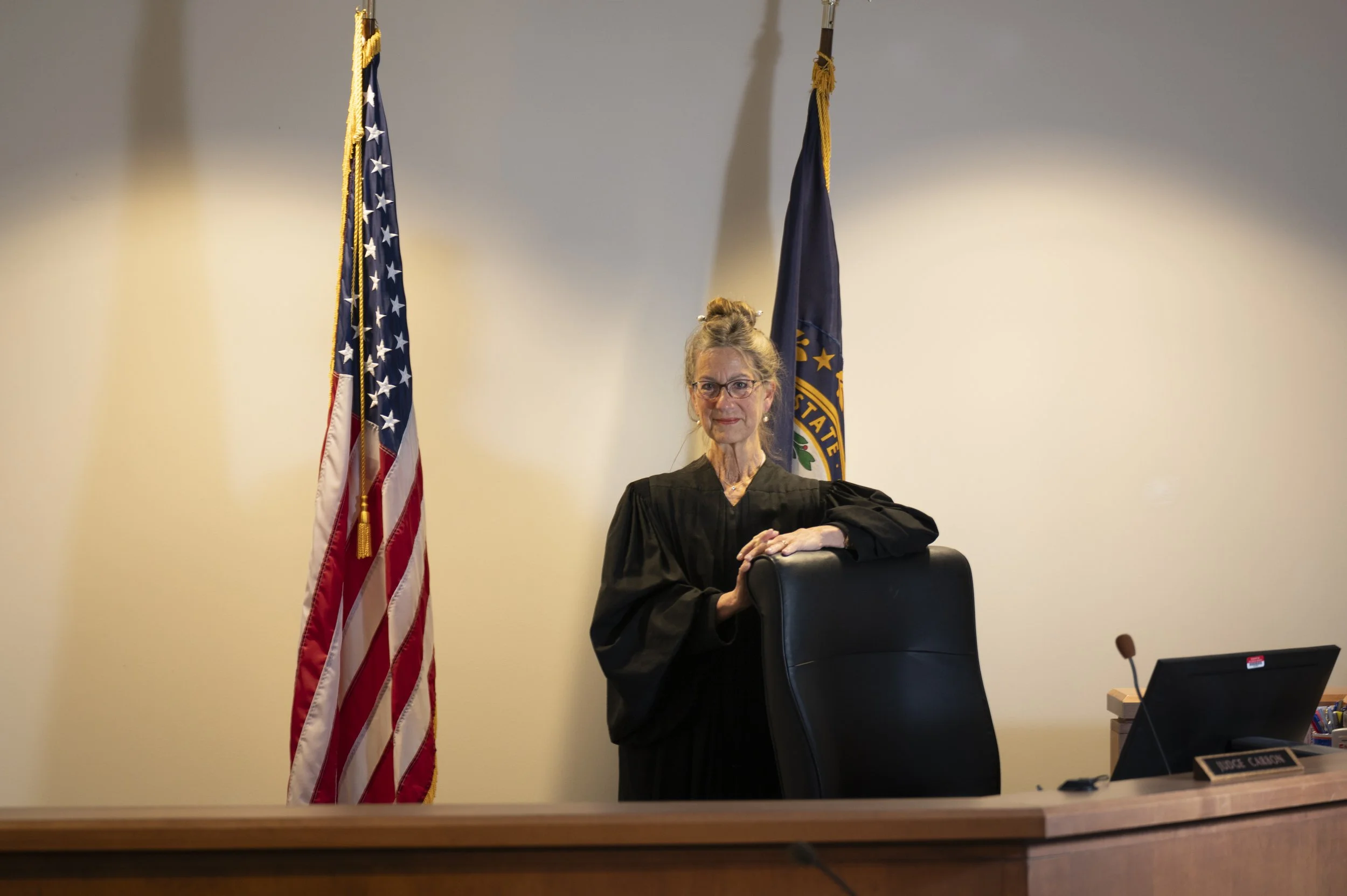
Retired New Hampshire Judge Susan Carbon stands in a courtroom at the 9th Circuit Court of Appeals, in Manchester, on May 7, 2026. Carbon now acts as a sitting referee and part-time judge, residing over family cases once a week. Credit: Daniel Sarch / Granite State News Collaborative
Because of that, the importance of ongoing training for family judges “can’t be overstated,” said Quigley. Family court judges need to be well-versed in topics ranging from child development and the impact of trauma on parents to challenges facing military families, she said. In addition, best practices, and laws, change over time, so ongoing training is critical.
New Hampshire circuit court judges do six weeks of training prior to starting the job. The Judicial Branch holds quarterly in-person trainings, as well as remote learning opportunities, and recently conducted a daylong training on domestic violence and sexual assault cases. (The branch did not comment on whether those trainings are mandatory).
“We have pushed for the Judicial Branch to have much [more] training in family matters,” Pearson said.
Recently, a dozen judges and staff from New Hampshire attended a conference of the National Council of Juvenile and Family Court Judges, learning about aspects of domestic violence, parenting and other issues.
Talking to other judges — locally and at national conferences — can also help judges understand best practices and talk through difficult cases, said Quigley. In New Hampshire — especially in rural courts, where there may be only one judge — that’s difficult, Carbon said. She noted that judges do use an email list to connect with each other.
“You just try to support judges the best way you can,” she said.
These articles are being shared by partners in the Granite State News Collaborative. For more information, visit collaborativenh.org.