By Rosemary Ford and Caitlin Agnew
This article has been edited for length and clarity.
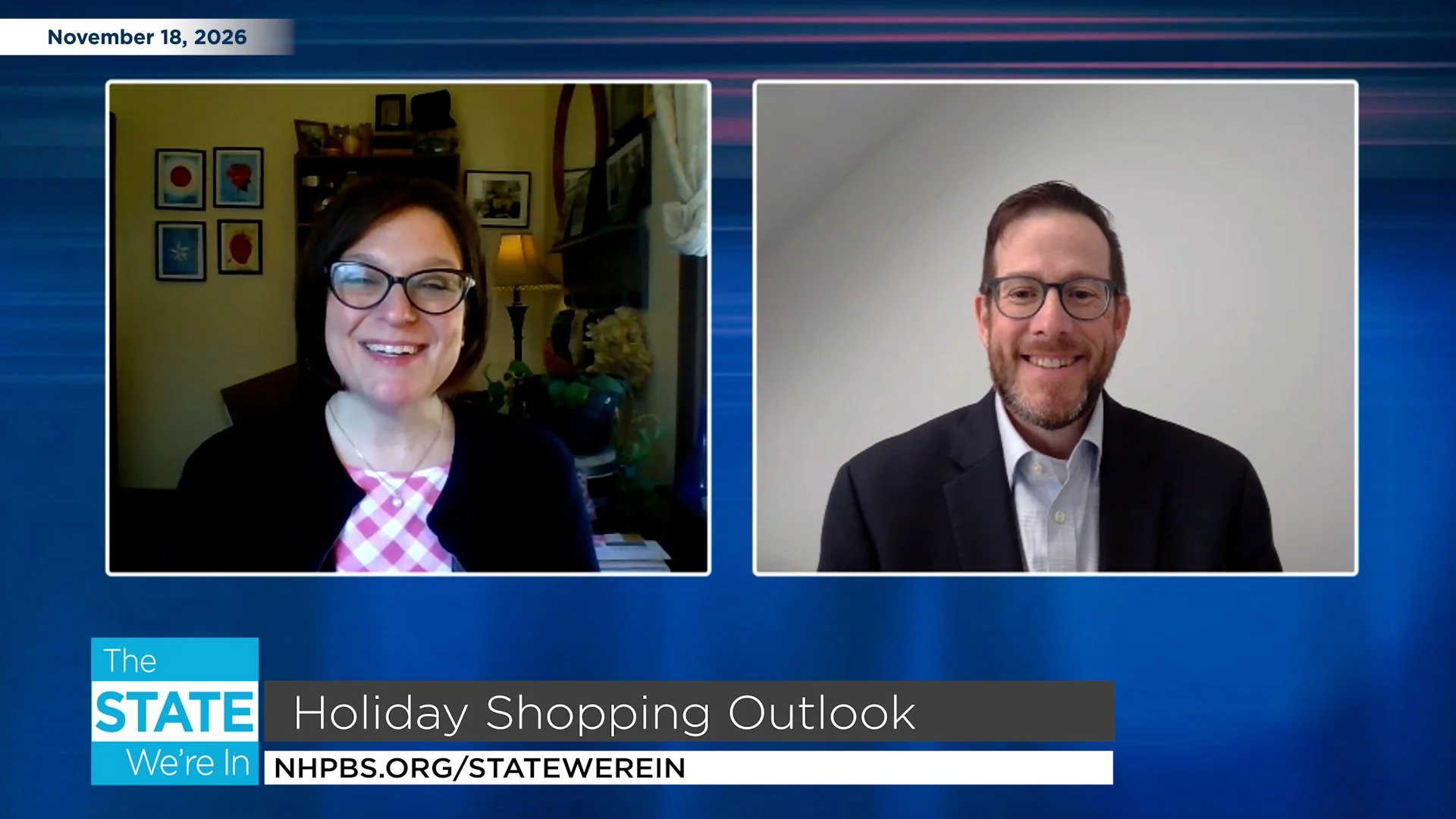
You may have noticed that the holiday season’s retail marathon has already begun. What does that mean for New Hampshire consumers and retailers? Here to answer that question is Curtis Picard, president and CEO of the N.H. Retail Association.
Melanie Plenda:
How does the New Hampshire retail landscape look for the holiday season?
Curtis Picard:
We're hoping for a rosy landscape this holiday season. Our national partner, the National Retail Federation, does an annual holiday shopping prediction every year, and they usually do a pretty good job of predicting how the national trend plays out after the holiday shopping season. This year, they're predicting a 4.3% increase. I would say, traditionally, New Hampshire has tried to follow the national trend as well.
There are other factors involved, and while 4.3% might sound really rosy, and it's very encouraging, I do take it with a grain of salt because there are other factors at play, like inflation and consumers just paying higher cost of goods for similar items.
Melanie Plenda:
What impact can we expect economic conditions —like tariffs or inflation -- to have on holiday shopping?
Curtis Picard:
It's really multidimensional. Inflation is the obvious one. Everybody's been talking about affordability of things like groceries. We feel it every day when we're going to the grocery store, filling up our gas tank or, especially in the Northeast, those of us that have already filled up our oil tanks this year know that close to $6 a gallon is putting a real strain on household budgets. I do factor in all those things.
Tariffs are still an issue, but maybe not as much as a year ago. Still, they are obviously impacting prices that consumers are paying.
Melanie Plenda:
Are there any other challenges?
Curtis Picard:
One of the things I always say about being in the Northeast is, for better or worse, we rely on the weather. It’s two factors. One, you want a little bit of snow and cold weather to put people in the holiday spirit. You don't want one of those brown Decembers where there's no snow. But conversely, you also don't want a big ice storm or a huge snowstorm either Black Friday weekend or the last weekend before Christmas. Those two usually compete to be the biggest sales weekends, and weather can really impact those, especially the one right before Christmas.
Christmas falls late in the week this year, so you have a little bit of that cushion. But in other years, when Christmas falls on say like a Monday or a Tuesday, if you lose that last weekend right before Christmas, it can really change how the overall forecast goes.
Melanie Plenda:
How many people work in retail in New Hampshire? Is that pretty constant over the last few years?
Curtis Picard:
It's stayed fairly constant. It's maybe come down a little bit. Around 89,000 New Hampshire people work in retail. Almost one in four jobs is directly tied to retail, so it is a very significant employment sector. It has stayed fairly consistent over the years, though with the rise of things like e-commerce and other efficiencies that retailers see. It's probably come down a little bit, but it's still a very significant number.
Melanie Plenda:
What kind of impact does that have on the state?
Curtis Picard:
It's a huge impact. Retail employment is one of the largest private employment sectors in the state. We often emphasize how many career opportunities exist within retail. I think most people really think about the frontline clerk that you're dealing with in the store, but retail is so dynamic. You have logistics and supply chain and warehousing and IT, especially any retailer of any size has an omni-channel experience, which is both an in-store and online presence. So there's really a dynamic and robust retail career industry there beyond what you would typically think of as retail jobs.
Melanie Plenda:
How are New Hampshire's stores faring in this age of online shopping? I would imagine that the lack of a sales tax means a huge boon for some.
Curtis Picard:
We call it the New Hampshire advantage, and it is absolutely huge, especially now, with people being challenged on price. If you're traveling from Maine, you're getting a 5.5% discount. You're getting a larger discount from Vermont, and an even larger discount from Massachusetts. For people that are looking to save a few dollars here and there, that really makes the New Hampshire advantage super-size.
It's really great that New Hampshire has that. Hopefully, it continues. I think it will, because it is really well-documented how important that sales tax advantage is.
Melanie Plenda:
Does that hold true for small businesses and big-box stores?
Curtis Picard:
We really started to see this before COVID, that consumers really appreciate and embrace the ability to shop locally and support their local businesses. Then it got a lot of focus during COVID , because they saw how difficult it was for their small and local businesses.
Consumers are fickle. They want what they want. They are going to shop on price. You have to be competitive on price. But still, there is space for both large and small retailers, and it has seemed to work well. There's not many silver linings from COVID, but one of them was that it really enabled small retailers to invest into their omni-channel experience and enable folks to have more of an online presence or buy online and pick up in-store. It wasn't just reserved for the larger retailers anymore.
Melanie Plenda:
Have you heard of any creative solutions to get people in stores?
Curtis Picard:
Retailers are also very good at marketing — and really, I always think about how Black Friday weekend is still all these years later such a thing for the holiday shopping season. We still look at it as the traditional kickoff of the holiday shopping season.
The reality is the holiday shopping season has been going underway for a number of weeks now. Retailers have successfully stretched the season so much sooner, into October, with early bird sales, and then they've stretched it on the tail end through January with gift cards and the ability to do it.
But I also think about the fact that when Thanksgiving falls is actually a direct result of retail. Back in the 1930s and ‘40s, Thanksgiving used to float more regularly, and it was the Macy's of the world and a lot of other prominent international retailers that went to President FDR back in the 1930s and said, "We need a solid date so we can market appropriately the holiday shopping season," which is why Thanksgiving now consistently falls on the fourth Thursday in November.
Melanie Plenda:
When can you get the best deals as a consumer to stretch your budget?
Curtis Picard:
Great question, and that's also going to evolve through the holiday shopping season as well.
Although the prediction is a 4.3% increase, I think we're all taking that with a grain of salt, as I said before. It does seem like people at the higher end of the economic spectrum are still feeling pretty good about the economy and still spending freely. But I think people in the middle and the lower ends are going to be a little bit looking more for value and deals, and retailers are very clued into that. They're going to try to drive the promotions of what customers are looking for. As things go on, if you start to see prices drop closer to Christmas, that may be a telltale sign of how the season is going as well.
Melanie Plenda:
Do you have any other tips to save this season?
Curtis Picard:
It's just, honestly, a wonderful time of year. Retail obviously is a year-round opportunity. We care about back-to -school sales and summer and our tourist season, bringing visitors to New Hampshire to experience everything that's great about the state. But there is something that's always special about the holiday shopping season, and I love seeing the emergence of Christmas markets and different promotions and events that get scheduled around the holiday season, and local organizations doing local craft fairs. It's just a wonderful time of year, and being able to take advantage of those types of opportunities is really great.
Melanie Plenda:
What about after-the-holiday shopping in January? What is that like for retailers? Is that a good time to spend those gift cards?
Curtis Picard:
Gift cards are one of the most popular gifts to give during the holiday season, without a doubt. It's always the right color and it's always the right amount. But we would strongly encourage consumers to use them as soon after Christmas as possible, because that's really when you're going to get the best deals and the best bang for the buck. The leftover inventory that's there is usually deeply discounted. So your $100 gift card can easily get $150 or even $175 worth of value after the holiday.
The other reality is, for the retailers that may not have a good holiday season there is a little bit of a danger that some of them may not be around in 2027. That happens every year. We see retailers open and close. Longtime retailers that were once the king of the hill, like Sears, which you don't see as much anymore — those types of things. That's the natural evolution of retail, but we advise people that, if you do get a gift card at Christmas, to use it as soon as possible. Don't put it on a shelf. Don't wait six months, because if that retailer does go out of business, it will be a real challenge for you. We don't want to see consumers lose out on that money either.
Melanie Plenda:
OK, now I am ready to go. Thank you Curtis.
These articles are being shared by partners in the Granite State News Collaborative. For more information, visit collaborativenh.org.