By Rosemary Ford and Caitlin Agnew
This article has been edited for length and clarity.
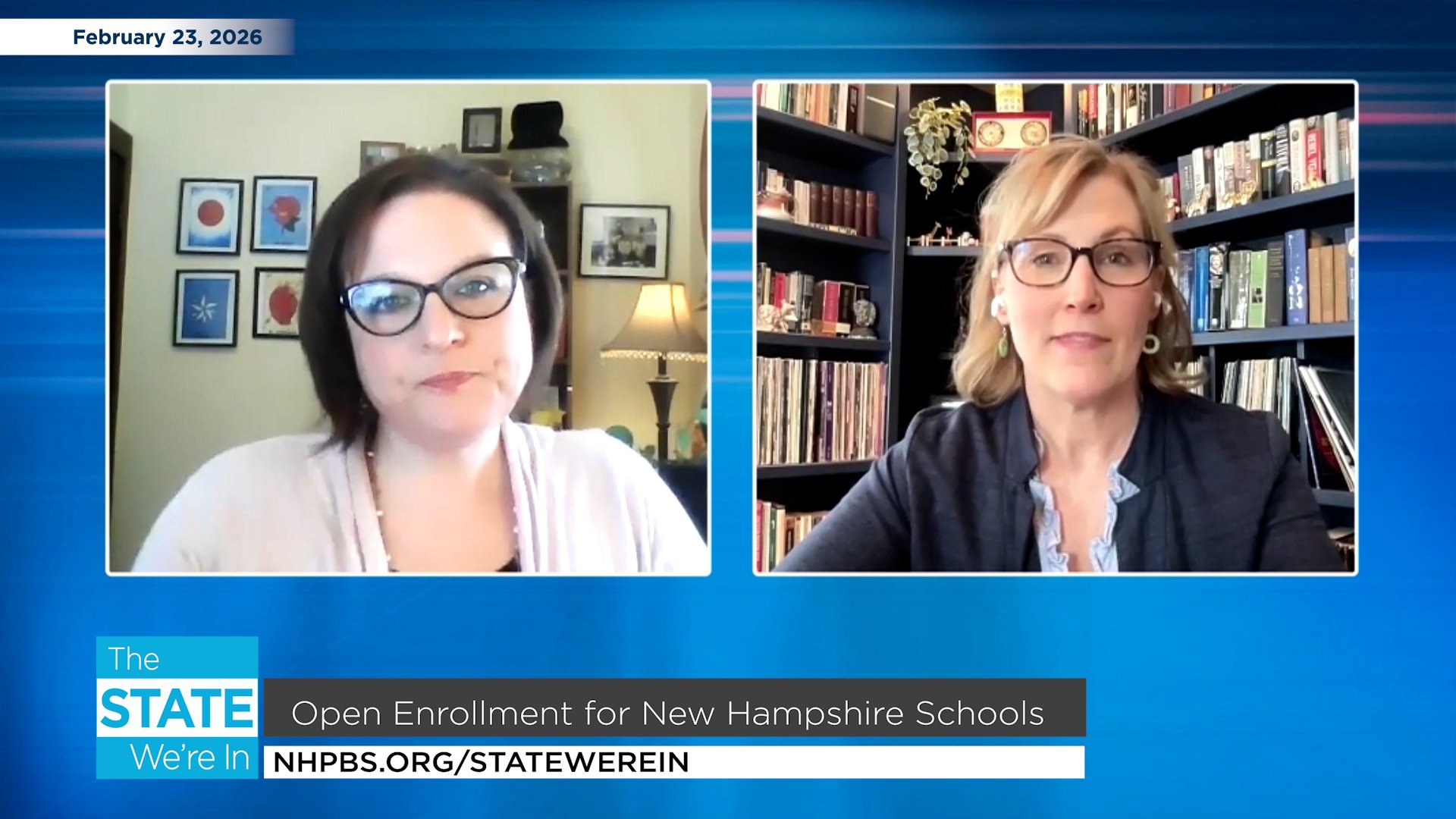
A bill in the N.H. Legislature that would change open enrollment restrictions for New Hampshire public school students is being fast-tracked by lawmakers and is expected to pass within the next few weeks. Here to discuss House Bill 751 is Annmarie Timmins, a senior reporter at NHPR who specializes in education.
Melanie Plenda:
To start, can you describe to us what is in this “open enrollment” bill and what changes it intends to make?
Annmarie Timmins:
The crux of this bill is that a student in New Hampshire could go to any public school in the state, and their sending district, or their home district, would have to send money with them and pay for their education wherever they chose. At its most basic that’s what open enrollment is.
Melanie Plenda:
Senate Republicans are fast-tracking this bill straight to the House, without hearings in either chamber. Why are they moving the bill at this speed and is it necessary?
Annmarie Timmins:
Republicans are eager to get this through for a couple of reasons. There was a Supreme Court ruling out of New Hampshire recently that changed the way open enrollment transfers would be paid, and so that has caused, in their mind, some confusion.
The second reason is that we're right now in the middle of the annual school budget and town meeting season, and at those meetings, districts have to adopt their budget for the next school year. So they wanted to get ahead of that, because budgets are built on enrollment, in large part. They're also aware that school districts are very quickly trying to set some boundaries around this open enrollment, to manage their budgets and their enrollment. So they really wanted to get ahead of school district meetings.
Melanie Plenda:
You recently wrote an article for NHPR on this bill and its impact if passed. According to your reporting, how are different school districts feeling about these potential changes?
Annmarie Timmins:
They're largely trying to, I would say, shut them down, or very much limit them. I've heard Republicans who support this, and we have seen people speak up for this at these district meetings, that this is about school choice. If your school's not working for you or your child, in their minds, you should have the right to go elsewhere. That sentiment is coming up when I've been to deliberative sessions, but primarily school district leaders and voters are trying really hard to limit this.
I looked at about 40 different communities, and each of those said no students may leave the district – and that's to protect their budgets. They don't want to send money away. Their frustration is maybe not open enrollment as a concept, but the way it's funded. On the other side, we're seeing limits put on who could come into a district, so some districts don't want to take any new students. Some have very specific limits, like two students could come in for kindergarten or for 3rd grade. And there are some districts who are struggling with declining enrollment, and they have seen open enrollment as a chance to fill some seats at a time when they really need students.
Melanie Plenda:
How would this bill impact lower-income school districts that can’t afford to lose large amounts of students to other districts?
Annmarie Timmins:
This is funded based on how school districts fund their schools. We know that every school district spends a different amount of money. Say a Manchester student wanted to leave and go to Bedford. Bedford spends more money than Manchester on a student. So when that student from Manchester comes, that might be a $17,000 so-called loss for Manchester. That student comes to Bedford, and while the bill tries to address this, a student is going to bring $17,000 with them, where Bedford spends $23,000 on its students. Are we giving them a tuition break to come over to Manchester? Will districts lose money if a student transfers? The supporters of this bill would say, well, you're also losing a student. But one student fewer, of course, doesn't change the light bill or the transportation budget — so that's the disagreement over why students should go somewhere else and why they shouldn't.
Melanie Plenda:
What about the higher-income districts? Will this have an impact there?
Annmarie Timmins:
They are anticipating seeing students wanting to come to them. If you spend more on education, maybe you have more programs to offer. Maybe you have smaller class sizes compared to a district with less money. So they're anticipating students coming into their district, and there's the spending discrepancy that I just described.
But also how do they control? If they can't set any limits on who can come in — which would be kind of disallowed, but there are limits on what limits they could set. So what if they have an influx of 10 to 15 students midway through the year? Their question is, “How do we budget for that?” So they're worried about that.
Melanie Plenda:
Sen. Tim Lang, a Republican from Sanbornton, who authored this bill, noted that the bill leaves it up to the school district to set the capacity for how many out-of-district students they can accept. Do you think, with the amount of pushback so far on this bill, that many districts will be doing this?
Annmarie Timmins:
I think we will see school districts definitely set the limits on what we've seen so far proposed. What Tim Lang's bill would do is let districts say what their capacity for students is. But the bill does not identify or explain how capacity would be determined. Is it just what you hope your student-to-teacher ratio would be? How do you factor in students who have far more needs in a year, or maybe a drop from 25 students to 23 is not really a drop in terms of resources that that classroom needs.
Critics of the bill will say this is one weakness of it that’s not clearly defined. While it sounds like they'll be able to set some limits, they're not quite sure what that would look like.
Melanie Plenda:
If this bill passes and goes into effect, could that impact town meetings, either this year or next year?
Annmarie Timmins:
It could. Right now we're in the SB 2 season, which means you have your deliberative session and then you vote in March at the polls — as opposed to what we think of as a traditional school district meeting. So what we're seeing early on are these districts adopting these caps. So if those pass, they'll be in effect.
But there's disagreement over what happens next. If this legislation passes, but doesn't take effect right away, then the school year would proceed, presumably, with these caps in place. If these caps are sort of set aside or overruled by this legislation because it passes and is signed by the governor quickly and takes effect immediately, there are just different views on what happens next. Some school district lawyers have said that just sets aside these caps; they're moot now. Others have said no, that would lead to litigation, and they would ask a court to keep them in place in the meantime. So it's one of the many unknowns of this legislation.
I should say that the governor has expressed some concerns about the timing of this bill, and so it's possible we might see a rewrite that does extend the effective date out to the next school year. But even if that happened, we're setting a budget right now for next school year. So it's unclear how much that would help.
Melanie Plenda:
Based on your reporting, what would be the long-term, lasting impacts of this bill for schools in New Hampshire?
Annmarie Timmins:
I think the long-term impacts of this are really unknown at the moment. If we only see a few students take advantage of this, what would the impact be? It might be quite minimal. If we see pockets of students sort of leaving a district and going to another district, a single district, that will have a big impact for that district.
I think we should look for what happens in communities where there are many school choices. If you live in central New Hampshire or the southern part of the state, you have nearby schools you could go to. So I think, geographically, it's worth paying attention to what happens if litigation ensues. School districts are locally funded, primarily. Critics say this is really the state taking over local control. So I think there's a lot of unknowns — and that's what's worrying school districts.
The other question here, in terms of impact, is school districts are urging the governor to sign an alternative open enrollment bill, which would study open enrollment for a year. Now, we're different from other states that have open enrollment because some states say school districts don't have to transfer money. The student can leave, but money doesn't go. I think that would resolve a lot of school districts' concerns. We're funded very differently from other states, so the impact here might not look like the impact that has been studied elsewhere. So school districts are urging the governor to sign this study bill instead of putting open enrollment in place now. That’s another unknown — if both bills reach her desk, which bill will she sign?
Melanie Plenda:
What other education bills are you currently following?
Annmarie Timmins:
There are lots of questions too about what school funding is going to look like.
Some lawmakers want to put more money into public education. Some want to reduce the scope of what an adequate education is, and thereby you'd be paying for less. Where does the Legislature end up in terms of the court saying, “You're not spending enough, but we're not going to give you a deadline for spending more or tell you what you should be spending.”
Also, I'm really interested in what happens with the University System of New Hampshire. Our public universities and colleges saw about a $30 million cut over two years, and students are telling us what that looks like for them — not only tuition increases but they're losing advisors, and they're seeing professors take early buyouts, so a class they need next semester to stay on track might not be offered until the following semester, and that could have long-term impacts. We have seen a bipartisan bill that would reinstate some of that money, at least for the next school year, and I'm watching that as well.
Melanie Plenda:
Thank you for joining us today, Annmarie.
“The State We’re In” is a weekly digital public affairs show produced by NH PBS and The Marlin Fitzwater Center for Communication at Franklin Pierce University. It is shared with partners in the Granite State News Collaborative, of which both organizations are members. For more information, visit collaborativenh.org.