By Rosemary Ford and Caitlin Agnew
This article is edited for length and clarity.
Winter is over —- finally. What kind of an impact did it have? What’s on tap for spring and summer weather? Here to fill us in about what to expect is New Hampshire’s state climatologist, Mary Stampone, who’s also associate professor of geography at the University of New Hampshire.
Melanie Plenda:
Let’s start with the weather that was. Mary, did our winter match predictions and expectations?
Mary Stampone:
The outlook for this winter of the National Oceanic and Atmospheric Administration, or NOAA, was largely based on forecasts for a week of La Nina’s pattern of the Pacific to start the season and transition to neutral conditions now. So the weak La Nina winters tend to be, but are not always, snowier across New England. Snowfall was above normal for southern and interior portions of New England this winter. Unfortunately, the snow was fairly dry, so we actually ended up below normal in terms of the amount of water we received despite the amount of snowfall.
Melanie Plenda:
Can you tell us more about how seasonal weather predictions are made? What is the process of collecting data and predicting for upcoming seasons?
Mary Stampone:
NOAA's seasonal outlooks are not intended to predict exactly how warm or cold a season is going to be, but instead, they are intended to communicate the likelihood or chance of a season being above, below or near what is normally expected for temperature and precipitation based on past conditions.
The chances of warmer or colder weather or drier than normal, are determined using multiple different model forecasts, called ensemble forecasts, as well as some statistical methods for identifying likely patterns in temperature and precipitation from combination of the long-term climate data sets that we have, as well as more recent data on a variety of environmental variables.
Melanie Plenda:
The Old Farmer’s Almanac released its long-term spring forecast last month, predicting warmer and drier conditions across New England, with slightly above-average temperatures in New Hampshire. Based on your research, how accurate are these predictions?
Mary Stampone:
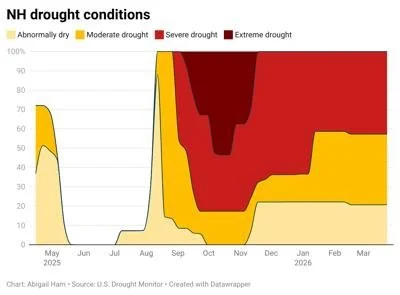
I can't really speak to the accuracy of the Old Farmer’s Almanac forecast. This isn’t really a resource that we use in our research, but overall, moisture conditions are really what we need to pay close attention to as we move into the warm season. So we still have not recovered from the lingering drought, so we're already starting drier than normal. And our snowpack is already largely gone, except for the far northern and higher elevation areas. So going into spring, we are relying solely on rainfall for both recharging the soil and the groundwater and to get us through this start of the growing season.
Melanie Plenda:
As you mentioned, this was a dry winter. And it seems strange with all the recent rain and snow. Can you tell us more about that? How does that work? According to NOAA’s research, this is the eighth-driest December through February since 1895.
Mary Stampone:
When it comes to cold-season drought, when temperatures are below freezing, plants aren't growing, and we're primarily concerned about groundwater levels. So what's happening below the ground, frozen ground limits the amount of water that can percolate down into the groundwater system. Plus, most of the precipitation we get just kind of sits on the surface, and so does the snow. So there really isn't much that can be added to the groundwater system until spring, which kind of locks in drought conditions from the fall through to the melt season.
Now, coming out of winter, we are still seeing precipitation deficits — that's the difference between normal and what we thought those deficits are — due to, again, the dry fall conditions that we had and the fact that despite heavy snowfall the winter the snow we received this winter was drier than normal, so it didn't contain as much water as we expected. Those two factors are why we have yet to see any improvement in our conditions.
Melanie Plenda:
What do you think this will mean for the rest of the spring and summer?
Mary Stampone:
It's really not unusual for it to take more than a year for the groundwater in our system to fully recover from drought. Back in 2016, it took two years for groundwater levels to recharge. We want to see enough rainfall compensate for the water needed, but not too much. We always need to be careful about what we wish for with rain, because too much can lead to flooding, but with enough rain, we can get through the start of the growing season without drought conditions worsening.
But drought conditions are expected to persist through spring across southern parts of the state. Keep in mind, any combination of a dry spell and warmer-than-normal conditions leading into summer could spell some trouble for us.
Melanie Plenda:
That was my next question. How will New Hampshire’s agricultural and gardening community be impacted by this drought?
Mary Stampone:
The general drought impacts include water stress on plants and animals, impacts on soil quality, as well as additional cost to bring water in when water resources dry up. But it's also worth keeping in mind that to a lot of farmers in this area, this is not our first drought, and they have been investing over years in more sustainable practices that reduce water use. So do plan on supporting your local farmers over the course of the summer.
Melanie Plenda:
How much of the causes of this drought are a result of climate change?
Mary Stampone:
We can link some of these impacts directly to the warming that we're seeing with climate change. First, the warmer temperatures increase the atmospheric demand for moisture, which is evaporated from the surface, drying off the soils and lowering surface water levels. That moisture is then added to the atmosphere, and eventually that has to come out in the form of precipitation. Usually, nowadays it comes in these larger precipitation effects. So we have bigger, heavier rainfall, with longer, drier, warm periods in between, leading to a lot more variability than we used to see — even in an area where variability is kind of the name of our game here.
Melanie Plenda:
Is this the new normal for New Hampshire? Will the state be dryer from now on?
Mary Stampone:
Actually, we overall are getting wetter, but the differences are kind of what happens in between.
We've always been vulnerable to both floods and drought, but the extremes are getting bigger. With summer temperatures increasing, we're not seeing any kind of change in precipitation that could compensate for those increased temperatures. Our vulnerability to drought during the warm season is increasing, but we’re overall getting wetter, and that heavier precipitation is shifting more toward that winter season. This is kind of a combination that is again increasing our vulnerability to both flood and drought, so it’s how we manage the water. We're going to have enough water overall, but it's not going to be evenly distributed. How we manage those resources will be really important in the coming years.
Melanie Plenda:
What else should New Hampshire residents know about spring and summer weather? Especially as it relates to their gardens and local wildlife?
Mary Stampone:
The big thing to keep in mind is that drought here can develop very rapidly at any point during the warm season. Think about last summer —- we started with really wet conditions and ended up with severe drought conditions. So even if our summer starts wet, any dry spell combined with extreme hot temperatures can lead to drought. Water conservation, even during the wet times, really is key here, and anything we can do to reduce our water use will make us more resilient to the variability that we expect to have always had here, but expect to get even worse over time.
Melanie Plenda:
Thanks for joining us today, Mary.
“The State We’re In” is a weekly digital public affairs show produced by NH PBS and The Marlin Fitzwater Center for Communication at Franklin Pierce University. It is shared with partners in the Granite State News Collaborative, of which both organizations are members. For more information, visitcollaborativenh.org.