By Rosemary Ford and Caitlin Agnew
This article has been edited for length and clarity.
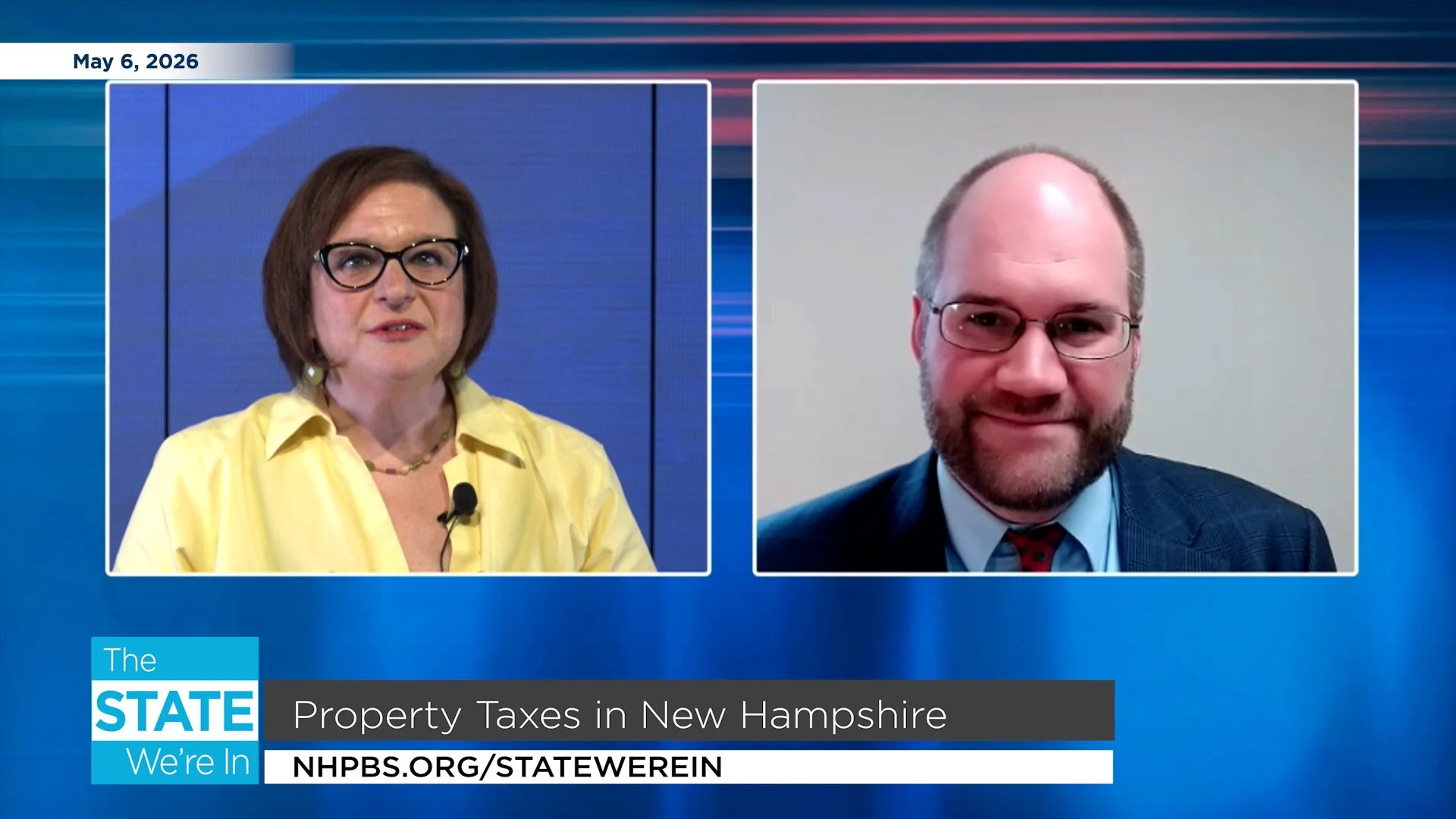
New Hampshire famously has no state income tax and no sales tax. So where does the government get the money to operate? Primarily property taxes. In New Hampshire, property taxes pay for roughly 61% of local government revenue — the highest percentage compared to any state in the country. Phil Sletten, research director of the N.H. Fiscal Policy Institute, talks about the ins and outs of property taxes in the Granite State.
Melanie Plenda:
Generally, how do property taxes work in New Hampshire?
Phil Sletten:
In New Hampshire, property taxes are based on an assessment of the value of the land and buildings on the land that's owned by a person or a company. Some states will tax other types of property, but in New Hampshire, it's the assessed value of that land and those buildings. The state requires that properties be assessed every five years at least. That usually happens with a city or town contracting with an agency to perform a physical site visit that determines what is the actual value, particularly the market value of that property, or what could the market value of that property be.
The rates themselves are determined by the taxable property value within a city or town and the expenditures for local governments that cover that community. That includes municipal governments, city and town governments, school districts, county governments and any village districts or other governments that have a special taxing authority or expenditures within that community.
The property tax rate is set after all of the other revenue sources for that community are determined. That could be state or federal grants, motor vehicle registration fee payments, county nursing home fees, parking meter and parking ticket payments, money paid for school lunches — all that information goes to the state, and then the state evaluates, based on that and the assessed property values in the community, what the tax rate would be. It layers on the statewide education property tax as well, then approves that overall tax rate for that community.
Melanie Plenda:
What do property taxes fund in New Hampshire?
Phil Sletten:
They're not a dedicated revenue source for the most part. There are two state-level property taxes. There's the statewide education property tax and the utility property tax. Those are both state taxes. Those are dedicated to funding public education and go to the state's Education Trust Fund.
The rest of the property taxes in the state depend on which local government is needing a certain amount of money for certain services. At the county level, property taxes might help pay for the county nursing home. At the school district level, property taxes might help pay for the expenses that school districts face, whether that's, special education costs, transportation costs, funding teacher salaries — that all goes into that education budget. At the municipal level, for city and town governments, it's for police and fire services, for upkeep of roads, trash collection, plowing roads — all of those things that cities and towns do on a regular basis.
Property taxes, in general, in New Hampshire are raised by local governments, and that property tax bill comes through on the municipal side, because those municipal borders matter a lot for what the property tax base is in a community. Those property tax bills — those aren't dedicated to funding one particular service or another beyond those different levels of government that they go to, whether it's counties or school districts or cities and towns.
Melanie Plenda:
Why do these taxes vary so much from town to town, sometimes even between neighboring towns?
Phil Sletten:
I think it's important to remember that there's a couple of different parts to this equation. One is the expenditures that communities have. Different communities have different levels of need, different amounts of infrastructure that they need to take care of, in terms of the resources available within those communities and other revenue sources that those communities may have so that can affect property taxes. A lot of those decisions are made by voters locally: What quality of education are we providing there? What are the infrastructure needs? Do we have fire trucks that are running as well as we want our fire trucks to run? Those are all community-level decisions, so that's on the expenditure side.
Even if all communities decided on exactly the same set of expenditures, the property taxes would vary because the property tax base matters a lot, and the amount of taxable property value within a community matters quite a bit. So some communities may have those higher expenses, but even if expenses were the same, the revenue picture would look different because of how communities are constrained by what's in their property tax base, and that affects the amount of money that's raised on a per-household or per-person basis.
What do I mean by property tax base? I mean what can be taxed — what’s the taxable value of land and buildings within that community. And, based on that, if there's a higher amount of property that is taxable, then there's a lower tax rate. Or if there's a higher amount of taxable property per resident, then there may be a lower tax rate as well.
Melanie Plenda:
How does having a focus on property taxes — without something like sales or income tax — impact the state?
Phil Sletten:
We do have some forms of sales tax — for example, the meals and rentals tax. When you go out to eat at a restaurant, you're paying a sales tax on that meal, if you're renting a hotel room or renting a car or if you're buying a pack of cigarettes or buying or selling property in the state, they're all forms of sales taxes that are within the state's tax system. However, we don't have a broad-based income tax or a broad-based sales tax — we're one of two states that don't have either a broad-based income or broad-based sales tax. The other is Alaska.
In New Hampshire, we rely on property taxes, and disproportionately on local property taxes to fund public services. That local focus is, I think, a particularly important component here, because that means that since we're relying on property taxes, and since we're relying on local property taxes to fund services — more than, on average, any other state in the country — that means that the value that happens to be in your community in taxable property value relative to its service needs can be very deterministic as to what you are paying in property taxes relative to the resources that you have or relative to the investments the community is seeking to make in itself. That can be very different depending on your income level.
For households with lower incomes, it tends to be a higher percentage of income that goes to property taxes in New Hampshire than households with the highest incomes. It's lower- and middle-income households that pay those higher effective tax rates based on property taxes in the state, whether it's passed through to renters or whether it's homeowners paying them directly. Those effective tax rates tend to be higher for lower- and middle-income households than for the highest-income households in the state.
Melanie Plenda:
Can you give us an example of what percentage of income property tax might be for someone who is lower income?
Phil Sletten:
We can look at modeling from the Institute on Taxation and Economic Policy. They did an evaluation of all states back in 2023 using 2023 incomes. If we look at those income levels, the bottom 20% of tax units — that’s individuals’ or family incomes — were $35,000 a year or less in tax income. If we look at those households that have that $35,000 a year or less in 2023, property taxes accounted for about 5.9% in the ITEP modeling. About 5.9% of income went to pay for property taxes in New Hampshire.
Again, that can vary substantially by town, and that does assume a certain amount of pass-through to renters. Renters are disproportionately more likely to have lower incomes — median household income for renters in New Hampshire is about half what it is for homeowners. So that 5.9% is for those lowest-income households.
The next highest places that we see are in the middle 20% and then the fourth 20% — that’s the group between the middle and the highest 20%. For those middle- and upper-middle-income households, about 5% of income, on average, goes to pay for property taxes in New Hampshire.
If we look at the highest-income households, particularly the top 1% of income households — in 2023 that was $721,000 a year or more — their effective property tax rate was about 2%. That’s about a third of what it is for for the bottom 20% — those $35,000 a year or less.
Melanie Plenda:
This also affects people who don’t own property, yes?
Phil Sletten:
If you're a renter, those property tax bills that your landlord has, or the property owner has — those still have to get paid somehow. There may be different strategies that different landlords have to pass those costs on, or to absorb those costs, but it likely increases rent for everyone who's renting, because it is a cost to owning a property in New Hampshire.
Those figures that I just spoke about — the 5.9% of income going to property taxes for a household with $35,000 a year or less in 2023 — that is including the assumption of how much is passed on in terms of property tax cost to renters. It's not assuming all of it, but it's assuming much of it is passed on to renters — and that assumption, if we look at what the cost of renting versus owning is, again, depends on which community you're in, and it depends on which year you're looking at. But property taxes effectively raise the cost of maintaining all properties in the state, because it's an additional bill associated with owning that property, owning that wealth, owning that building, etc.
Melanie Plenda:
What’s the solution here?
Phil Sletten:
It depends on what your goal is. When it comes to ways that property taxes could be, for example, alleviated for lower-income households, there are states that employ property tax credits or homestead exemptions that will help households with low and moderate incomes afford property taxes and be reflective of what their incomes are.
In New Hampshire, we have the low- and moderate-income homeowners property tax credit. It's a relatively small rebate that the state provides relative to the statewide education property tax, although it was expanded relatively recently — and actually for people who are interested in signing up for that, the window to sign up is open until June 30.
There are other ways. Sometimes they're called circuit breakers by people who are in the policy and economic world that are trying to make property taxes a little bit more reflective of the resources that people have, or if it's a primary home versus a secondary home. Now, every state is different in terms of what's permissible under the state constitutions. New Hampshire does have a clause in its constitution that has been interpreted to mean that there can't be graduated tax rates for similar types of taxation on similar economic activity. So there are then legal questions around what some of those solutions would look like in New Hampshire that I think complicates what is a transferable solution from other states.
There are other ways that the state could raise revenue or permit local governments to raise revenue. There are proposals at the state level to allow local governments to put either a surcharge or some other add-on to the meals and rentals tax, particularly the hotels portion, to raise money from people who are renting hotel rooms that are within those municipalities’ borders. That money would then stay locally, as opposed to going to the state and then, in some cases, being redistributed by the state to local governments. Those are the sorts of mechanisms that have been proposed in the past to help offset some local property taxes and to even out what may be the municipal share of funding services.
Melanie Plenda:
You recently published an analysis of the disparities in how property taxes affect residents in different towns, and produced an accompanying podcast on the issue. Where can people find this podcast or more information if they are interested?
Phil Sletten:
I'd encourage folks to again look at the full report at nhfpi.org. We have interactive maps to let people examine what's going on in their local community, unpack some of the details of these issues and more interstate comparisons as well. Our regular podcast, “New Hampshire Uncharted,” can be found on Apple podcasts, Amazon Music, Spotify, YouTube, Podbean and iHeartRadio. I hope everyone is able to download it and enjoy listening.
Melanie Plenda:
Thank you for joining us, Phil.
“The State We’re In” is a weekly digital public affairs show produced by NH PBS and The Marlin Fitzwater Center for Communication at Franklin Pierce University. It is shared with partners in the Granite State News Collaborative, of which both organizations are members. For more information, visit collaborativenh.org.