By Rosemary Ford and Caitlin Agnew
This article has been edited for length and clarity.
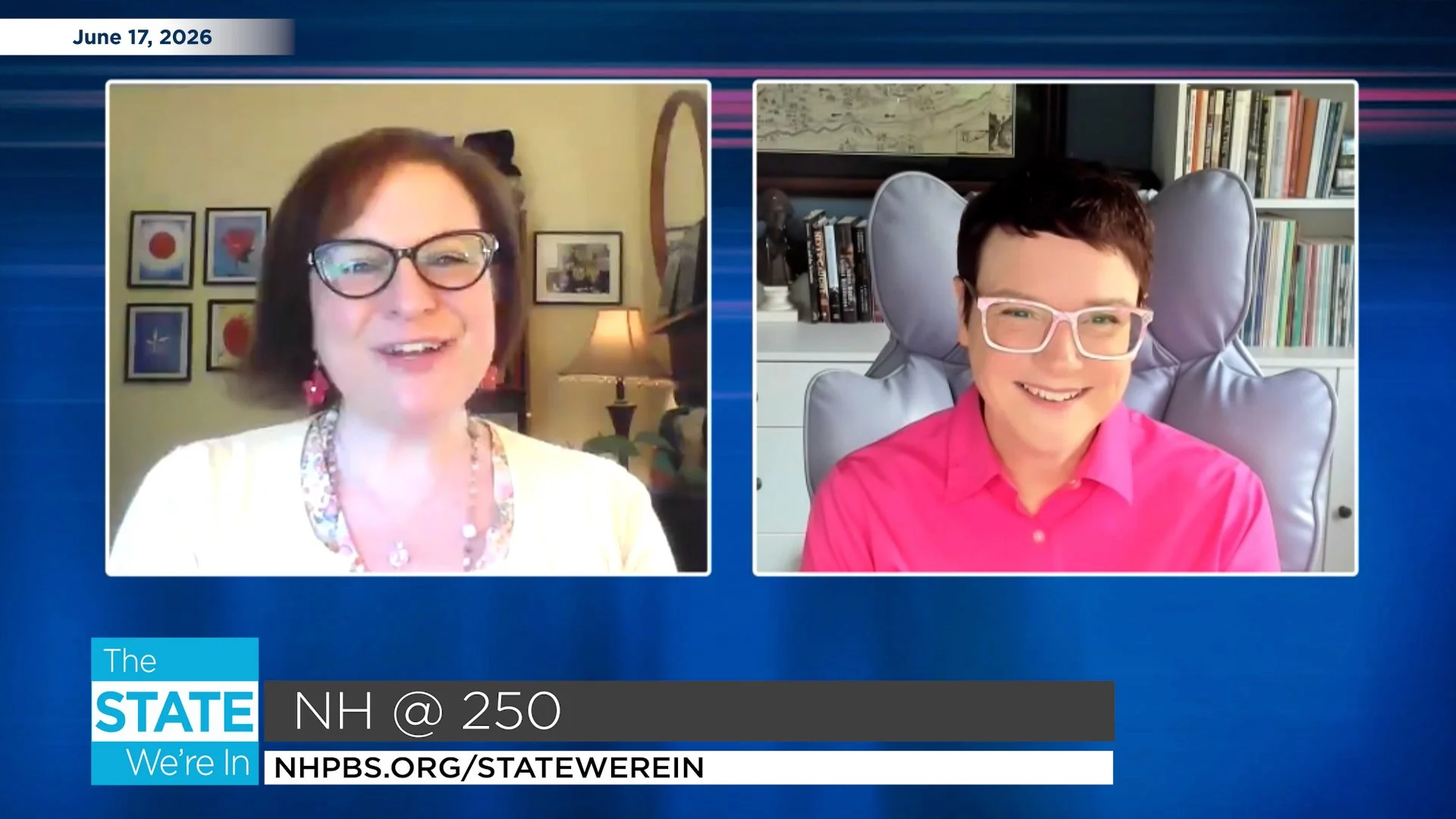
Communities across the Granite State are planning to observe the nation’s 250th birthday with all kinds of events and activities, many of them focused on New Hampshire’s role in the American Revolution. Mary Adams, the N.H. Historical Society’s homeschool program developer and museum educator, who has been travelling around the state with a presentation called “Redcoats and Rebels,” provides a historical perspective.
Melanie Plenda:
Not everyone knows that New Hampshire was the first colony to declare independence from Britain. How did that come about?
Mary Adams:
In January of 1776, we had a problem on our hands from the previous August. John Wentworth, the royal governor, had abandoned the colony. He was under increasing threat from the patriots of Portsmouth, who had wheeled a cannon up to his front door and threatened to blow the door off his house if he did not comply with them.
By August of 1775 he had moved to Fort William and Mary on Newcastle Island, and eventually sailed to Britain and abandoned the colony. So the provincial congress steps into this void, and they take matters into their own hands and create a new form of government. They called it a constitution, but it looks very, very different from the constitution that we have today. There's no separation of powers, there's no checks and balances at all, and there's actually even no governor — there's just a legislative system and a judicial system.
Melanie Plenda:
The Pine Tree Riot happened years before the first official battle of the revolution — what was it and why was it so important.
Mary Adams:
It’s one of my favorite things to talk about, because it sounds a little quirky. It's a “fight over trees,” is how I've kind of heard other people describe it. But I think it gets down to the heart of what the revolution is really about. Who has the authority over these gigantic pine trees? Is it the king, thousands of miles away across the ocean? Or is it the people who live on the land, work the land, and need the trees for their own homes, bridges and their livelihoods?
Essentially what happened is the people in Goffstown and in Weare were fined because they had been cutting up the king's pine trees in their mills. In Goffstown, the people were compliant — they paid their fines, they got on with life. But in Weare, the people really refused to pay those fines. So in comes the sheriff to enforce the law, and the people take it into their own hands. They riot into the sheriff's room where he was staying, early in the morning, and they beat him. The intention was to beat him one lash for every tree for which they were being fined, and that was about 270 pine trees. So they beat him, they took him outside, and they put him on his horse — had also done some things to the horse, like they had cut its tail and cropped its ears to make it not sellable or desirable, and they send him riding out of town.
Of course, the end of this is that when they do finally go before a judge, one of those judges is Meshech Weare, who ends up becoming the president of New Hampshire eventually. But the fine is just so extraordinarily light that it really sends this message through the communities that it's not just the people of our local communities that are feeling this strength of rebellion, that it really is also being supported even in a small way from our leaders in New Hampshire as well.
Melanie Plenda:
Let’s talk about the Battle of Bunker Hill and the role of New Hampshire residents in that.
Mary Adams:
I love it because we think of it as a Massachusetts battle, but truly two-thirds of the soldiers that are fighting there are New Hampshire soldiers who have walked from New Hampshire.
I think of Isaac Wyman in Keene — we have his musket on display at the Historical Society. It’s the musket he carries from Keene down to Bunker Hill, and he's there along with about 1,000 other New Hampshire soldiers, many of them under the command of John Stark. The Massachusetts soldiers total about 500. They're also bringing down with them some gunpowder that they had raided from Fort William and Mary in December 1774, so they're adding to this fight in a huge way.
The Battle of Bunker Hill is so fascinating, it's this kind of first big mashup. It is such a surprise to the British. They know they have the upper hand with superior weaponry. So when they attack this left flank that John Stark and his men are behind, they are shocked because on the very first volley about 70 British soldiers were killed. The Americans repel them two more times, and finally John Stark decides it's time to exit the battlefield, but instead of his men just sort of abandoning the battlefield and running off, he has them very carefully, very methodically, leave, and they're providing covering fire for the rest of the battlefield as well. This is where he loses 15 to 17 men in the fight.
This catches the eye of George Washington when he comes to visit the battlefield, and he hears about the battle and John Stark's decision not to just have his men willy-nilly abandon everything, but instead provide covering fire, and this is when he realizes that John Stark really needs to be in the Continental Army.
Melanie Plenda:
Let’s talk more about Gen. John Stark — one of the most well known figures of the American Revolution. He coined the phrase “Live Free or Die.”: His story is kind of complicated.
Mary Adams:
He's born in New Hampshire, he's Scots-Irish — a group of people ll known for their resilience and hardworking spirit. John Stark ends up fighting with Rogers’ Rangers during the French and Indian War. It’s guerrilla-type warfare. They are not walking through an open field in straight, clean lines and bright clothing. They are hiding behind trees and stone walls, and they're circling around, attacking from behind. So he ends up bringing all of this knowledge, this battlefield knowledge, when he arrives at Bunker Hill.
I think that what really resonates with so many people when they learn about John Stark is that he's actually not in the army for any kind of fame or fortune. He did not want to play the political game that was required of him to sort of maintain his rank and to achieve higher rank. He's really there because he just continues doing what he believes is the best thing to do. If something is not right, he is fair, he's honest, he's just, and he's going to try to right the wrongs, and so this is really so much of his heart behind fighting.
There's an event that happens between his time in the Continental Army and the Battle of Bennington, which is when he comes back to New Hampshire. He's on a little bit of a respite trip, and he finds out that Enoch Poor, another man from New Hampshire, has been promoted above him to the rank of brigadier general, and this is pretty insulting to him, and he actually resigns from the Continental Army, and says that he will not answer to orders on the battlefield again from someone in the Continental Army.
But when the plea from Vermont comes, and they are asking for help — the British have sent British and Hessian soldiers to come to Bennington to raid storehouses, and there's this plea from Vermont to please help. So New Hampshire answers this call, and they call on John Stark. They give him the rank of brigadier general to command New Hampshire's militia.
Melanie Plenda:
On July 4th, the Historical Society will host an Independence Day open house. Can you tell us what visitors can expect?
Mary Adams:
You can expect short talks, crafts for kids, and there are guided tours. I'll point you to one of my favorite things in the building, which is that we actually have two of just 32 Revolutionary War flags left in the entire world. They're displayed on our grand staircase. They're remarkable for a few things. They are the only pair of flags left in the entire world from the Revolutionary War. As far as we knew in New Hampshire, the flags had actually been burned with some boats in 1777. But in 1908, we got a letter saying they were hanging at Sandhurst, the military academy in Britain. It kind of sparks a series of events and we end up getting those flags purchased for us by our benefactor, Edward Tuck, and they have been on display in our building ever since.
Melanie Plenda:
For families and anyone looking to have an adventure this summer, the Historical Society is hosting the “603 History Hunt.” What is it and how can people participate?
Mary Adams:
I feel very attached to this event, because I have written all 200 clues. This event will be on an app. People can register, and then we give them all kinds of different things for them to do. So you can be celebrating a woman in Weare who heard that the British were coming, so she made her kids eat all of their maple syrup products in one day because she didn't want the British to take them. You'll make a bowl of Count Rumford's soup, which saved Bavaria from a famine. There's an opportunity to take a hike to a remote New England glasswork site, which started in the 1780s but it's staffed by German POWs that were captured during the war. There's countless graveyards to explore, and tons of opportunities for selfies with different Revolutionary War heroes — so it's all going to be amazing fun.
Melanie Plenda:
Many thanks to Mary Adams for this engaging conversation. To learn more about New Hampshire in the American Revolution visit the NH Historical Society at nhhistory.org
To find Mary’s recorded New Hampshire History Minutes for NHPBS visit. To find a location for one of Mary’s upcoming “Redcoats and Rebels” presentations, visit nhhumanities.org
And New Hampshire Humanities, in partnership with NHPBS, is hosting “The Big Watch” in communities across the state where you can watch a short excerpt from “The American Revolution,” a new film directed by Ken Burns, Sarah Botstein and David Schmidt, followed by a community discussion. Learn more at nhhumanities.org
Finally, there are a couple of online calendars available to help you find New Hampshire 250 events near you. One website is visit.gov/250th and newhampshire250.org/.
“The State We’re In” is a weekly digital public affairs show produced by NH PBS and The Marlin Fitzwater Center for Communication at Franklin Pierce University. It is shared with partners in the Granite State News Collaborative, of which both organizations are members. For more information, visit collaborativenh.org.