By Rosemary Ford and Caitlin Agnew
This article has been edited for length and clarity.
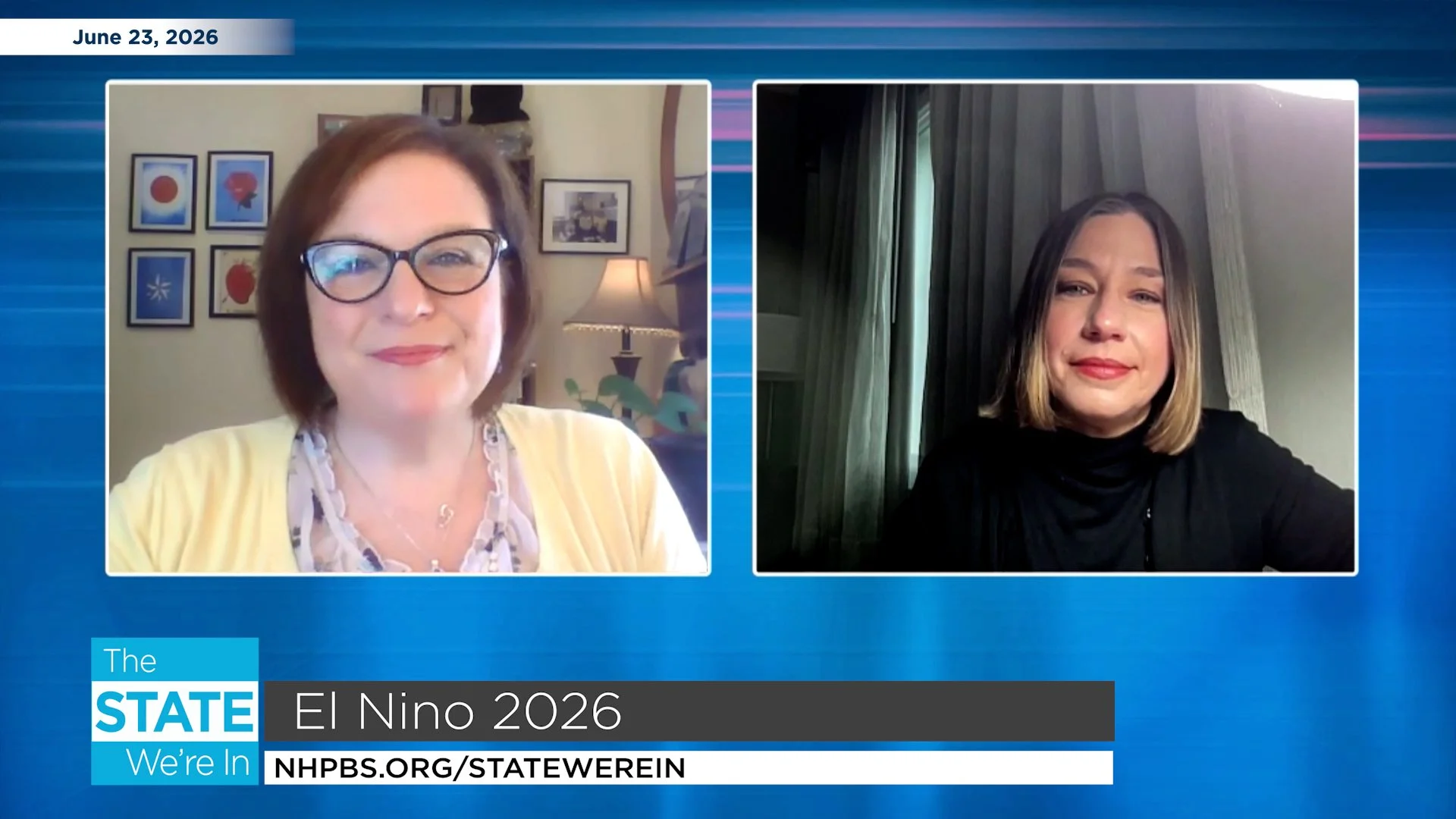
The El Niño climate pattern is here. The National Oceanic and Atmospheric Administration, or NOAA, predicts that it has a 63% chance of increasing to a very strong intensity, meaning our own weather patterns could be due for a change. Mary Stampone, New Hampshire’s state climatologist and associate professor of geography at the University of New Hampshire, discusses what that means for New Hampshire.
Melanie Plenda:
First, what is El Niño is, and how does it work?
Mary Stampone:
El Niño is the warm phase of the Southern Oscillation, or ENSO. It's characterized by warmer-than-average sea surface temperatures in the central and eastern equatorial Pacific Ocean. It was first observed by fishermen off the coast of South America, who recognized its periodic occurrence right around the Christmas holiday and named it El Niño, or “little child,” in Spanish. Meteorologically, these warmer ocean temperatures are connected to air pressure and wind patterns across the equatorial ocean that have kind of a global ripple effect.
Melanie Plenda:
What is the global ripple effect?
Mary Stampone:
It can affect rainfall and temperature patterns all the way into North America, not just South America. It can impact monsoon patterns in Southeast Asia and also have an impact on the rainy seasons in equatorial Africa
Melanie Plenda:
How does NOAA predict the strength of El Niño?
Mary Stampone:
NOAA has a really extensive buoy network that monitors ocean and atmospheric conditions within those El Niño sectors of the Pacific Ocean. Then they aggregate this data into what's called an Oceanic Niño Index, or ONI. This accounts for the difference between the measured sea surface temperatures and the average for those areas within the Central Pacific. It's a three-month running average, and then when these values hit .5 degrees Celsius for five consecutive overlapping periods, then they classify it as being an El Niño. Then the strength is determined by how far above the average sea surface temperatures we are.
So we start with that week's El Niño at .5 degrees Celsius, but we can strengthen through moderate, strong and up to very strong phases for Oceanic Niño Indices over 2 degrees Celsius. Of course, the impacts from the El Niño tend to increase as the strength of the event increases.
Melanie Plenda:
NOAA released an El Niño advisory on June 11, stating that there is a 63% chance that El Niño this year would be one of the largest El Niño events since 1950. What does this mean especially for the weather this summer?
Mary Stampone:
El Niños do tend to be strongest during northern hemisphere winter months or cool seasons — and, true to form, this El Niño pattern isn't expected to peak until later this year, so it's still kind of ramping up, but the impacts are usually strongest through October-November.
But in the summer, the stronger upper-level winds that are common during El Niños can suppress Atlantic hurricane development. So this is why we have a forecast for a less active hurricane season this year. Then. of course, in New England we actually tend to be more humid, and this is due to more tropical air coming into the region. With greater humidity comes greater precipitation, which could provide some beneficial rains as we recover from last summer's drought, but also increase the risk for flooding.
Melanie Plenda:
You mentioned October and later this year, so what about the weather this fall and winter?
Mary Stampone:
During the winter season is when the storm track dips further south during El Niño winters. This leads to pretty predictably wetter conditions across the South. We here in the North tend to be warmer than usual during the winter. It's important to know that every El Niño winter is a little bit different, especially in the Northeast, because we do have other patterns. We can still get some really cold air, especially January-February.
Melanie Plenda:
If El Niño does reach the predicted very strong intensity level, how would that impact New Hampshire specifically?
Mary Stampone:
Winters, again, across El Niños tend to be warmer than average across the northern U.S. Fun fact: the last time we were in a very strong El Niño was the 2015-2016 winter period, and that actually ranks as the second warmest winter here in New Hampshire. Second only to the winter of ’23-’24, which was a strong El Niño winter.
So I think one of the things we can be fairly certain of is that it will probably be one of the warmer winters this year. Precipitation is really variable, sometimes that storm track stays to our south, so areas of the Mid-Atlantic - New York, New Jersey, Pennsylvania — get all of our snow instead of us. But depending on some other factors, that storm track could actually bring more new nor'easters to our region. Whether that translates into more snow will depend on temperatures. The amount of snow will depend on how warm we are.
Melanie Plenda:
Does global warming have an impact on the intensity of El Niño? Should we expect El Niño to be more intense in coming years as the ocean temperatures rise?
Mary Stampone:
That's a fantastic question, and that is an area of active research, but what we do know is that global warming and the impact on warming sea surface temperatures can amplify the impacts of El Niño. So with the increased energy that's in the ocean water as well as in the atmosphere can amplify extreme weather events, especially heat waves and heavy rainfall.
Melanie Plenda:
What are some of your other predictions for the summer's weather?
Mary Stampone:
Overall, climate prediction center outlooks call for a warmer-than-average summer, which tends to be the case. We've had several warmer-than-average summers recently, but hopefully the outlooks for a potentially wetter summer, especially toward the end, for coastal New England will hold. That will lead to improved drought conditions for southern parts of the state.
We have already seen some improvements in the North Country, which has been fantastic. We still have some lingering severe drought in southern areas, but with greater humidity and hopefully some more precipitation. We look to have an improved, if not removed drought by the end of the summer.
Melanie Plenda:
Do you have any advice for gardeners and farmers this year?
Mary Stampone:
My advice is always to be prepared for drought — even if we're wet, still be prepared for drought. I think last summer was just a really good example of how quickly our conditions can change during the summer. We started out very wet last year, and then quickly, with a heat wave and an extended dry period, ended up with a flash drought that lasted through the winter. Do anything you can do to be more efficient with water — use less water-intensive plants and vegetation. Do those things that can make your property more resilient to drought, even if it's wet.
Melanie Plenda:
Thank you, Mary.
“The State We’re In” is a weekly digital public affairs show produced by NH PBS and The Marlin Fitzwater Center for Communication at Franklin Pierce University. It is shared with partners in the Granite State News Collaborative, of which both organizations are members. For more information, visit collaborativenh.org.