By Rosemary Ford and Caitlin Agnew
This article has been edited for length and clarity.
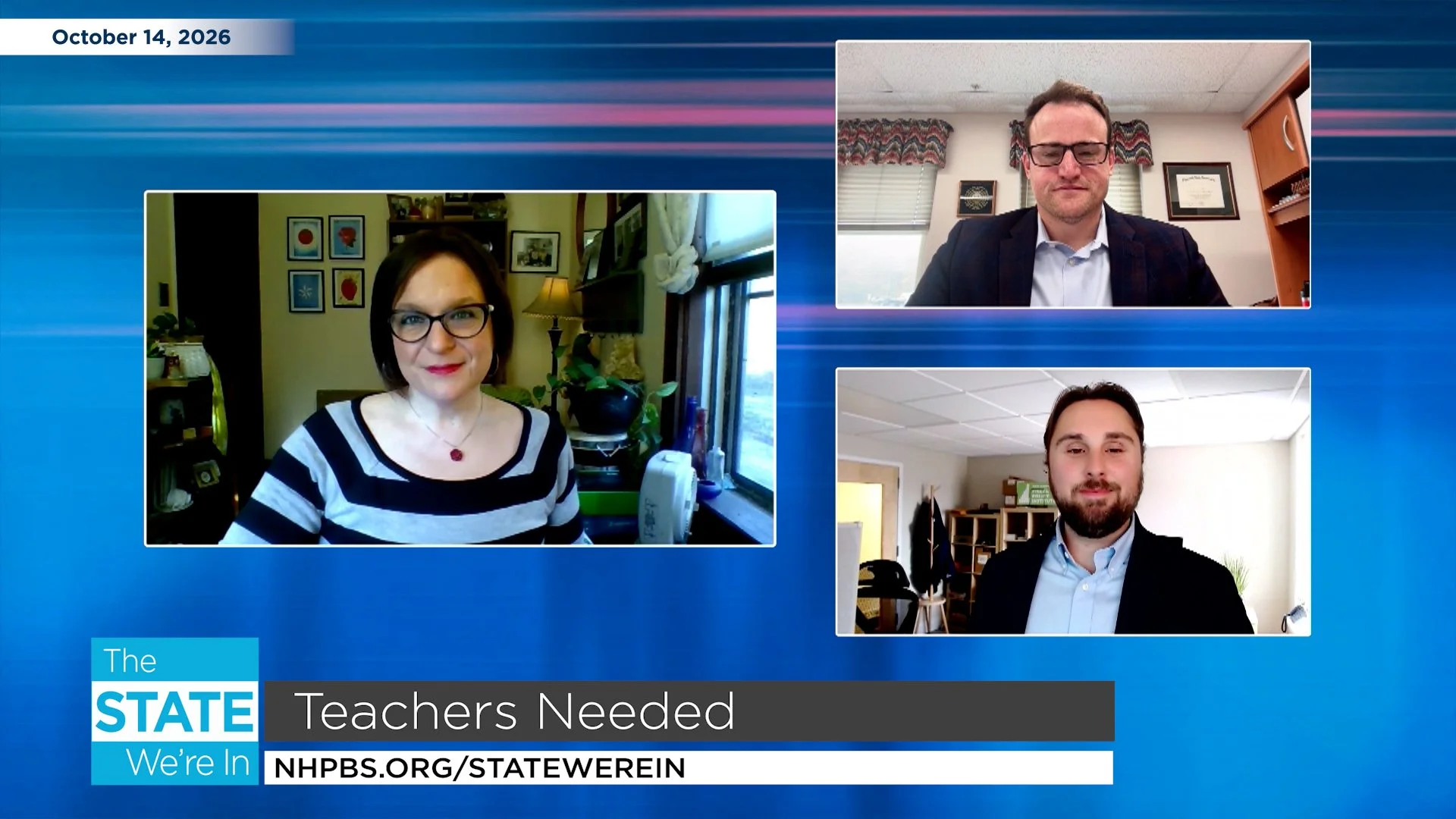
Teachers are essential to our school system, but what happens if there aren’t enough of them? A new study from the N.H. Fiscal Policy Institute sounds the alarm about the difficulty some New Hampshire schools already have in finding qualified teachers. According to the study, that difficulty will only get worse in the coming years. Discussing the report and its findings are its author, Ben Reynolds, a senior policy analyst at the Fiscal Policy Institute, and Michael Whaland, superintendent of schools in Moultonborough.
Melanie Plenda:
Ben, what was the reason for the study?
Ben Reynolds:
New Hampshire is in the midst of many conversations about the future of public education, especially with this upcoming state budget. We really want to make sure that when we're having these conversations that part of them is talking about how to attract and retain the educators who really make our schools work and help our kids learn.
Melanie Plenda:
What kind of data did the fiscal policy institute look at?
Ben Reynolds:
We used a variety of national and state sources, specifically from the N.H. Department of Education, N.H. Employment Security, the U.S. Census Bureau and some federal higher education data as well. It's important to note though that we know we have a lot of quantitative data, but Mike can really speak about the qualitative portion of how teachers are actually feeling in the classroom.
Melanie Plenda:
Can you sum up the key findings?
Ben Reynolds:
New Hampshire schools may face growing challenges for recruiting and retaining teachers in the year ahead. Despite the declining enrollment, New Hampshire schools will still need about a little bit over 1,000 teachers per year over the next decade.
About 95% of that drive is both from exiting labor force, such as retirements, but also from teachers leaving the teaching occupation and switching to other careers. At the same time, we're seeing that the teacher pipeline in New Hampshire is dwindling, with fewer New Hampshire college graduates getting less education degrees.
There are other challenges too for New Hampshire to attract educators. In terms of pay, New Hampshire ranks 42nd nationally for average starting teacher salary, with starting pay below comparable salaries in Maine, Vermont, and Massachusetts. At the same time, high housing costs as well as child care costs are not also helping as well.
Melanie Plenda:
Michael, I would imagine none of this is shocking to you, as you see what’s going on in your own district as well as others. What are you seeing?
Michael Whaland
These findings align directly with what we're seeing as school leaders on the ground daily. Rural school districts are facing a double squeeze with geographic isolation as well as tighter budgets that make it harder to compete with other school districts that may have more resources and a larger tax base. We're seeing smaller applicant pools for just our general roles in particular and as well as our higher need fields, such as science, mathematics, special education, etc.
Additionally, young teachers brought into rural communities often struggle to find affordable housing that leads to turnover and teacher churn. So it's that in combination with less students going into higher ed that also compounds as there's less teachers coming into universities and colleges as graduates.
Melanie Plenda:
Michael, you also wrote your dissertation on teacher attrition and retention in New Hampshire rural schools. Can you briefly tell us more about that?
Michael Whaland:
My dissertation was on teacher retention and attrition in New Hampshire rural schools. When I initially began my curiosity on this subject, I started as an administrator in the North Country and started wondering why all my colleagues were leaving me. I wanted to dig deeper into this subject matter, and really, what the question that folks often ask is why are our teachers leaving? I wanted to flip that narrative and talk about why our teachers are staying.
I looked at three different areas: working conditions, which focused more on salary and benefits; job satisfaction, which focused on climate and culture; and engagement with the community. What my study yielded, essentially, is that our educators will forego salary increases as long as you're competitive within your region. But the things that mattered most to our teachers were that they were valued, that they had a sense of autonomy and a sense of engagement with their community.
Melanie Plenda:
So why are fewer people interested in becoming teachers? What’s at play here?
Michael Whaland:
I think the perception of the profession has shifted significantly as we've identified potential educators looking at the high cost of stress and higher education costs. We've seen that the average starting teacher salary is around $44,000. That has not kept up with the costs of higher education and the housing costs. I think that the school climate — the expanding non-instructional workloads, and public education becoming more politicized has dissuaded our teachers from entering the field. I think in rural areas specifically, our potential teachers worry about geographic isolation and limited career advancement pathways. So, if you're a beginning educator and you would like to be an administrator, those jobs are few and far between.
Ben Reynolds:
Following Mike's analysis, we found that half your teachers earn about a third less for each week worked than comparable college graduates in other professions. That's a pretty big pay gap, especially in an expensive state. When someone in college or university is looking for “what do I want to major in?” that's obviously going to take into account, and they're going to say, “I am doing all of this work, but my peers who are doing the same amount of work are going to be making a lot more money" — that makes that decision to get into education a little bit more difficult.
Melanie Plenda:
Ben and Michael, what would you say is the most immediate problem when it comes to addressing the attrition and retention of teachers? How can it be addressed?
Ben Reynolds:
One of the immediate challenges that we identified in New Hampshire is affordability. Even when schools can recruit qualified educators, high housing costs and child care costs can make it difficult for them to afford to live and work there, particularly early in their careers.
New Hampshire's median single-family house sale price increased more than 71% between 2019 and 2025, and center-based child care for an infant and four-year-old increased 33% between 2017 and 2025, to about $30,000 annually. At the same time, as Mike mentioned, teacher salaries aren't rising anywhere close to those rates, and addressing these key affordability issues will not only help to recruit teachers but ensure that they can stay there for the long term.
Michael Whaland:
I think the immediate problem we're looking at is burnout, isolation and having supportive leadership and culture. I believe salary is what gets our teachers in the door, but working conditions and job satisfaction dictate whether they stay or not. I think that we can address this problem through a multifaceted approach, looking at administrative and peer support, building strong mentorship programs for our new teachers, finding ways for our teachers to cultivate positive school cultures based on trust, looking at their ability to have autonomy in the classroom, and community integration helps educators feel anchored in their community.
One of the most intangible items I find in hiring in schools is fit. What I mean by that is that if you're hiring an individual that's never worked in a rural area, that's going to be a culture shock to them. So if they're exposed — whether it's through vacation, sports, recreation — they’re more apt to stay if they have some of that, as I call it, fit.
Melanie Plenda:
What happens if these issues aren’t addressed? What will our schools look like?
Michael Whaland:
I fear that if these issues are not addressed, that we could be looking at communities that do not have, especially in our rural areas of the state, their local schools. The elementary school is the heartbeat of their community. It's where social events happen, basketball games, voting happens — a sense of community that happens there. Without having that, I fear that that will erode the sense of community, that once was a vibrant area could in fact just be tumbleweeds. I hate to put it bluntly like that, but that's a fear.
Ben Reynolds:
In the report, we really wanted to make it a point about explaining why teachers matter. The research shows the impact that teachers have both in student success inside and outside the classroom, and we've also highlighted the impact of having experienced teachers, not only on students but also on newer teachers in terms of staying longer, in terms of being able to professional development and teaching. That's really why these recruitment and retention challenges are so important to address.
If a school struggles to fill positions, this may increase class sizes. They may have to offer fewer courses or rely more heavily on less experienced teachers. When positions go unfilled, remaining teachers often have to take on more work and additional responsibilities. That can make an already challenging job even harder and potentially push more teachers to leave, and make it even more difficult for schools to retain the educators they need.
Melanie Plenda:
Thank you both for joining us.
“The State We’re In” is a weekly digital public affairs show produced by NH PBS and The Marlin Fitzwater Center for Communication at Franklin Pierce University. It is shared with partners in the Granite State News Collaborative, of which both organizations are members. For more information, visit collaborativenh.org.