By Rosemary Ford and Caitlin Agnew
This article has been edited for length and clarity.
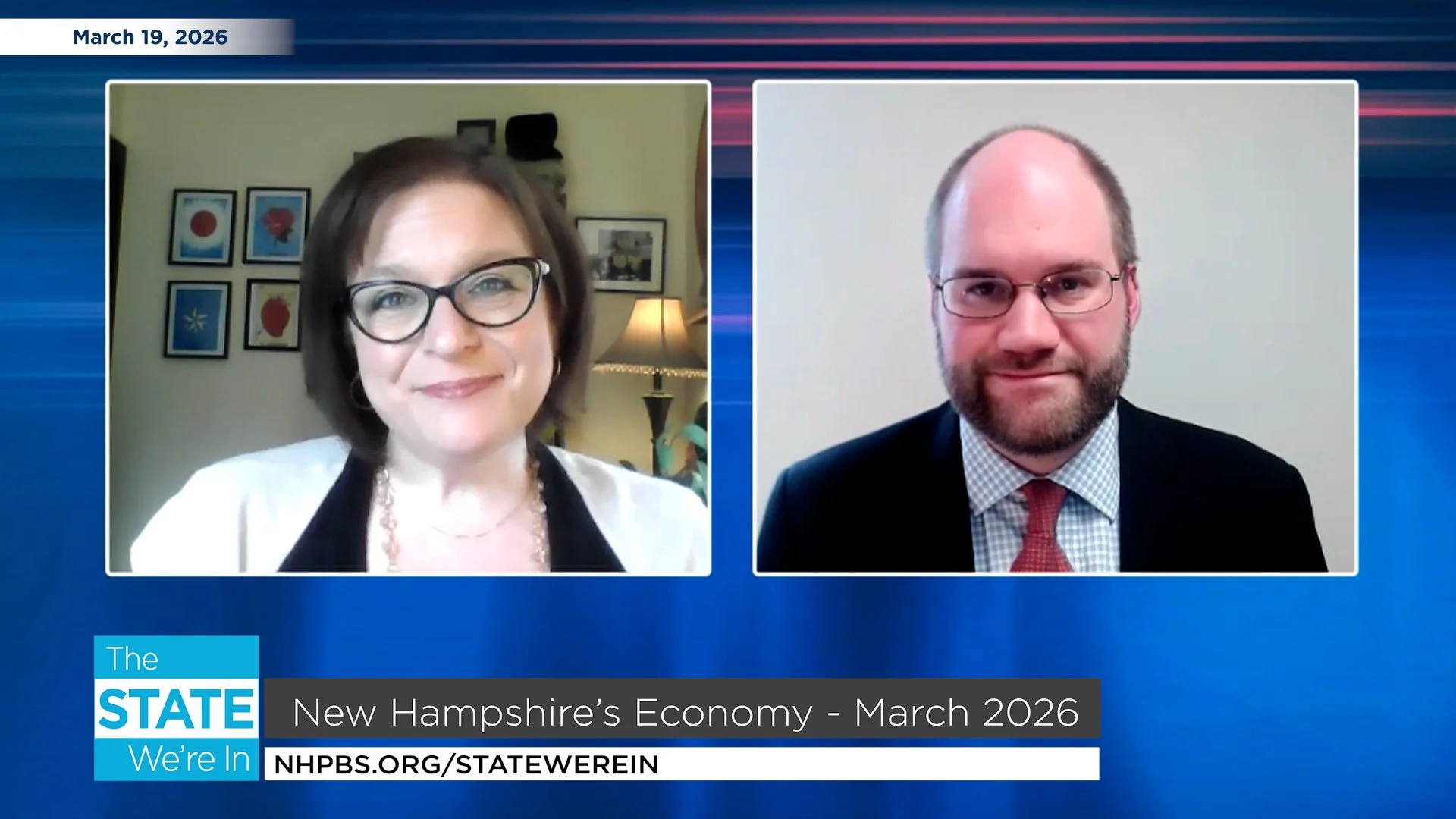
Every day, the national and state economies seem to be in flux. What does that mean for you and your wallet? LPhil Sletten, research director of the N.H. Fiscal Policy Institute, talks about what’s going on, what you can expect, and what you might think about when it comes to stretching your finances.
Melanie Plenda:
Let’s start with a broad overview. In your opinion, what’s going on with the economy nationally? What are some of the challenges there?
Phil Sletten:
If we look at some of the key forecasts going into this year, they were actually relatively favorable. So in February, the U.S. Congressional Budget Office expected that the overall economy would grow about 2.2%. in 2026, and that's above their trend line. They generally expect that in the future years it'll be about a 1.8% average growth rate. They also projected the unemployment rate would rise a bit, but still be relatively low, at about 4.6% nationally. That's higher than what we see in New Hampshire, but it's still a low figure for the nation overall.
There were still some headwinds that they expected, such as trade and tariff policies adding to some friction or cost in the economy, particularly regarding the flow of goods and immigration policies. They said those would limit labor force growth, and they probably also limit consumer demand as well.
Now, we've had some key economic changes in the last few weeks or, following the beginning of the conflict between the U.S. and Israeli forces and Iran. That's led to some price changes, particularly in energy prices, because of Iran's control over a key oil shipping route, and that could actually destabilize some economies around the world that are more dependent on those particular trade routes than ours — not just for oil, but also for food, fertilizer and other goods. That could lead to some broader economic troubles that could affect the global economy.
The U.S. Federal Reserve Bank said in their most recent statement that economic activity has been expanding at a “solid pace.”. But they did note that job growth was low, inflation remains elevated, and there's a lot of uncertainty about the economic output input outlook, in part because of the conflicts in Iran in the Middle East.
Melanie Plenda:
What about the state economy? What’s going on there?
Phil Sletten:
The uncertainties are similar, but the story continues to be labor force growth challenges and the costs for basics -- the rising costs for those essentials of living, including housing and health care costs, as well as child care costs for folks who have young children. We continue to rely on immigration for population growth in the state as deaths continue to outnumber births in New Hampshire, so the cost of living is important for attracting new residents and in retaining residents as well.
If we look at the data that we have for 2025, the number of people surveyed who say that they are working in New Hampshire was actually a little bit lower at the end than it was at the beginning of 2025. When we look at the employer survey data, we see that that's a relatively static figure too. So at least in the preliminary data we have so far throughout 2025, it looks like the employment picture has been pretty static in New Hampshire.
Melanie Plenda:
Let’s dig a little deeper and talk more about some of the key factors in the state economy — housing prices, gas prices and heating fuel prices. What’s going on there, and what impact will that have?
Phil Sletten:
Housing has been for a long time and continues to be probably one of the largest constraints on the economy overall, particularly the price of housing. I think it's important for folks to remember, if you're paying more for housing than you were for the same housing 10 years ago, that’s a percentage of your income that can't go to other things. You're getting the same product, but you're not able to engage in other parts of the economy in the same way. So the price of housing isn't just a factor in terms of how much of that particular line item is, it affects all the other line items as well.
The median single-family house sale price in New Hampshire in the last 12 months was about $540,000, so we're now solidly above the half-million dollar mark. And that's the statewide figure. Part of the reason we're in this problem is that we have been basically under-building housing in New Hampshire for the last 20 years. It's not just demand. It's also a lack of supply being added. We did see some data from the state showing that more multifamily permits in particular were generated in 2024. That doesn't necessarily mean a one-to-one addition of housing, and there's different timelines for when that housing would come online, but it's still more. Housing production is relatively low, but it is the right direction in terms of adding housing supply.
Some of the things that I'm watching on the housing front as well are what happens with interest rates — which, of course, affects people's ability to borrow for housing, because most people have to borrow to buy a house or condo.
We saw faster price increases during the COVID-19 pandemic. We saw the price of a single-family house, for example, in Coos County, more than double over the five years straddling the pandemic. We saw that as well in Sullivan County. So in rural northern and western parts of the state, we're actually seeing the price pressures decrease the most. What I mean by that is the prices are not going up as fast, and in some cases they're even flat over the last several months, depending on which comparisons you're looking at.
Those are some of the counties that have the highest poverty rates in the state. So there's not a lot of spending power in those communities. It could be that we're seeing the post-pandemic increase in housing prices overshoot, and now there's a little bit of a correction. What does that mean for the rest of the housing market in the state? I don't know. It's hard to say that it could be just a pandemic-related phenomenon, but there is still a significant undersupply throughout the state, and I don't expect that that portends prices will be flat going forward, unless there were some really significant change in the economy.
Melanie Plenda:
Another thing that also has an impact on the state economy is the state budget. The Fiscal Policy Institute is gearing up for presentations about it across the state. Can you tell us more about that?
Phil Sletten:
We're trying to help people understand how state fiscal policy works. True to our name, we're here to explain and provide facts and information about how governments function and where the money flows. It's a lot of information that we have — the sense that we have of how our town governments and city governments work, how our state governments work — that is passed along, verbally shared from one person to another, and people have a sense from that of how things work. But we really want to help people understand more of the concrete details and most-up-to date information about how money flows.
Melanie Plenda:
There have been small but steady increases in unemployment in the New Hampshire labor market as of late 2025. What’s going on there?
Phil Sletten:
From December 2015 to not very long ago — except for the spike in unemployment during the COVID-19 pandemic — New Hampshire had an unemployment rate below 3%, and it rose above 3% in roughly the last year or so. That 3% benchmark is substantially lower than what we see nationwide. It is a little bit of an easing of the labor force constraint that we saw, especially in 2022 when there were many more job openings than there were unemployed residents. So we're seeing maybe a little bit more of a return to the economy that we saw, in terms of labor force anyway, about 10 years ago.
However, one measure I think is important to remember is that the underlying factors feeding into that measure are probably quite different than they were 10 years ago. One of the key changes is that over the last year we've seen this sort of low-higher and low-layoff environment. There may be more people entering the labor market — particularly younger people entering the labor market — who are then having trouble finding jobs, or maybe having trouble finding job opportunities. They would have been snatched up very quickly by employers who were really looking for workers and were under-resourced in terms of labor supply.
There are other discussions as to how much artificial intelligence is affecting this. I don't know that we're actually seeing that on a large scale at this point. I just haven't seen data to support that, but that's a possibility. But I think that more likely right now, tariffs and now energy prices are likely generating economic uncertainty that makes businesses a little more hesitant to hire. That being said, I wouldn't expect there to be a substantial excess labor force going forward.
Melanie Plenda:
With upcoming changes to the Medicaid Enhancement Tax, what will this mean for New Hampshire’s economy, patients and providers?
Phil Sletten:
The Medicaid Enhancement Tax — and my colleague Jess Williams, did some research on this over the last month — actually the fourth-largest state tax revenue source, but not very many people have heard about it because it only is paid directly by hospitals in the state. That money collected from hospitals is then matched with federal Medicaid dollars. So it has a 50-50 match, roughly, from the federal government. That match generates more money for Medicaid, which is health coverage, generally, for people who have relatively few resources or specific qualifying health conditions.
Those Medicaid Enhancement Tax dollars are also used to reimburse hospitals for costs that they have, for uninsured patients who show up at hospitals and need care, or Medicaid patients who are at hospitals and need care. Typically, Medicaid has lower reimbursement rates than Medicare or private insurance does. So that's part of the payment mechanism to those hospitals to fund that so-called uncompensated care.
The One Big Beautiful Bill Act, which passed back in July of last year, limits the amount that states can charge hospitals in taxes like the Medicaid Enhancement Tax over time. So it lowers the tax rate that the states can charge. What that means is that the state government in New Hampshire is going to have less revenue coming in from the Medicaid Enhancement Tax — and we're talking hundreds of millions of dollars, especially if you include the federal matching dollars that the state is going to have to find in each subsequent year.
That means the state has to either find some other source of revenue to fund these existing Medicaid services, or the state has to reduce the amount of services that it pays for through the Medicaid Enhancement Tax, and that could include those hospital budgets and right aid to hospitals for that uncompensated care.
We don't exactly know how the state government is going to respond. The government has a little bit of time to respond, but it's a significant amount of money. Even though it sounds arcane, it could have an impact that cascades through many parts of the state budget, and could impact hospital budgets, which in some cases — particularly for rural hospitals — are relatively constrained. It could impact hospital budgets as well going forward, depending on what state policymakers decide to do.
Melanie Plenda:
What other challenges are you keeping an eye on when it comes to the state economy?
Phil Sletten:
One cost that we haven't mentioned very much so far is child care. I'd say child care costs continue to increase. One of the things that we've seen that's positive on that front is there are more child care slots available in 2025 than there were in 2017. That's a positive sign. However, that added supply does not cleanly translate into an easier time for everyone to get their child to a child care center, for example.
Because more family-based providers are closing or have closed over that time period. So more small and large providers and more center-based providers have added slots, and in general, the smaller ones have not done as well on that front. So it probably means that there's more drive time for parents to get their children to child care, and that may become more expensive.
Even if the price isn't directly more expensive, which we've seen prices be relatively high in New Hampshire, but we also see that it may be more difficult to access in other ways, even if there is a slot available because of that increased drive time and increase in gasoline prices.
Another factor that I think is important in the part of the economy that is most concerned with accessing child care is the child care scholarship program may be running out of funding by the end of the biennium. So there is a program that allows people to access resources to help pay for child care. It also provides resources to the child care providers themselves and for eligible students, this is targeted at families with low incomes.
This is a program the state expanded in 2023, however, there may not be enough money to avoid a wait list for accessing the child care scholarship program by the time we get to the end of next fiscal year, in June of 2027. Because child care not only is important for the family individually, but enables more people who otherwise might be out of the labor force to remain engaged in the labor force, particularly if it's worthwhile and affordable for them to access child care.
Melanie Plenda:
Do you have any advice for people navigating these chaotic times?
Phil Sletten:
Nearly a quarter of New Hampshire households did not have at least $2,000 in emergency savings in 2022. Meaning that there were a fairly large number of households in the state that didn't have that sort of basic buffer in non retirement savings for there to be some sort of financial or economic shock to their budgets. These savings can be critical in times of job losses or spikes in the cost of necessities such as fuel or food. The more folks that have these savings, the more resilient Granite Staters can be in the face of external economic shocks like the one we're experiencing now. But it can be very hard for households with low incomes to save for these for the future, when it's so difficult to cover costs in the present on a day-to-day basis — especially those core living costs, such as housing, child care and health services, which have risen substantially over the last 10 years, and food has risen over the last five years.
Now, I'm not a financial advisor, but in times of need or unemployment, knowing where you can get help in advance – whether it's from friends or family or municipal human services offices or charitable organizations, programs such as the Supplemental Nutrition Assistance Program or Medicaid or unemployment compensation and having a plan for that, even though it's maybe not fun to think about, can make it easier to navigate hardship, especially if you spent that little bit of time learning about them beforehand.
Of course, there could be public policy responses, depending on the size of an economic shock as well. But I think, for individuals seeking to navigate this, knowing where the resources are that you might need, especially in advance, and ideally, having them in your hands in advance is probably the best thing that we can do in the midst of these large scale and very distant but very acute economic shocks.
Melanie Plenda:
Thank you for joining us today, Phil.
“The State We’re In” is a weekly digital public affairs show produced by NH PBS and The Marlin Fitzwater Center for Communication at Franklin Pierce University. It is shared with partners in the Granite State News Collaborative, of which both organizations are members. For more information, visitcollaborativenh.org.