By Rosemary Ford and Caitlin Agnew
This article has been edited for length and clarity.
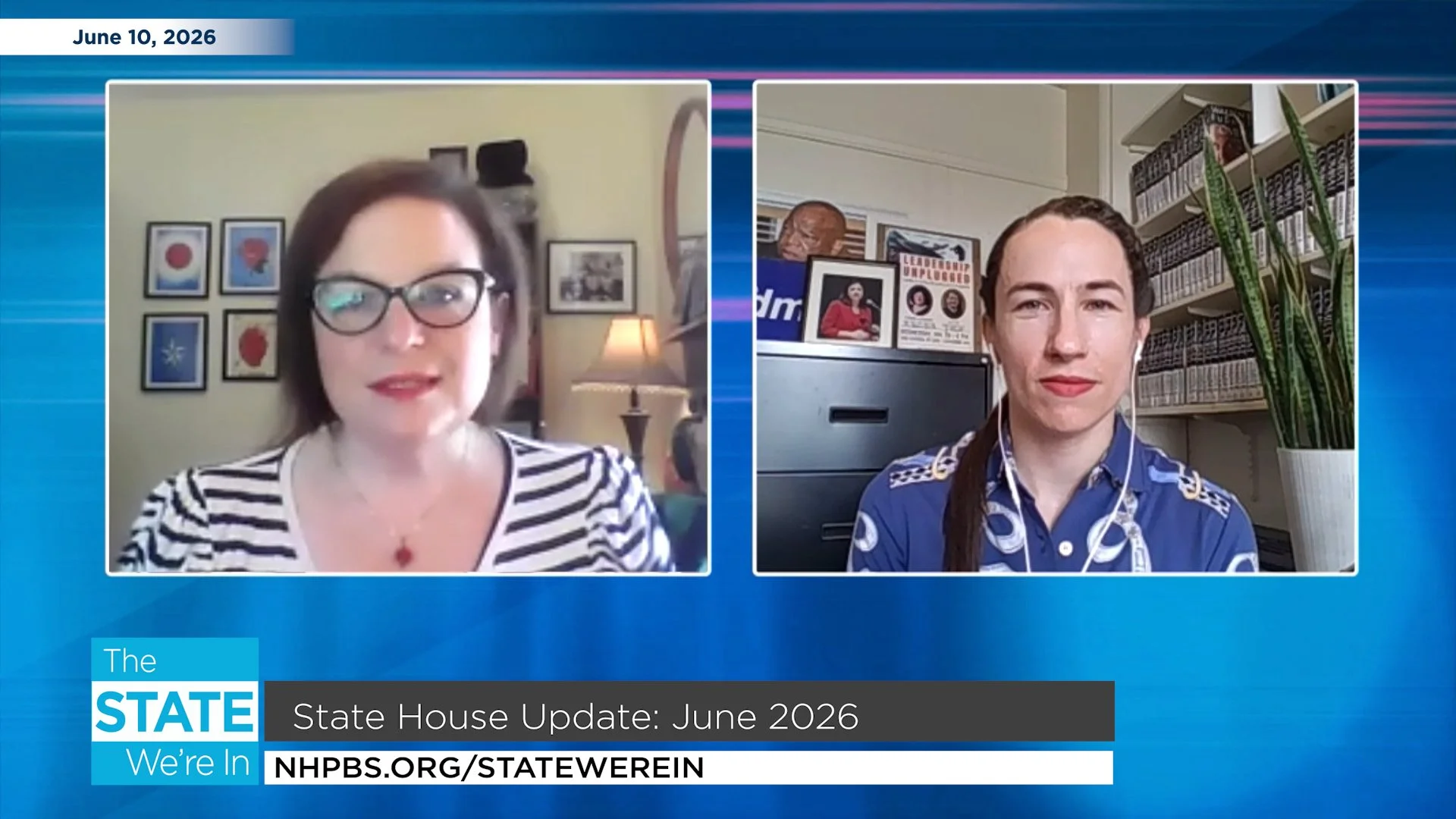
The New Hampshire legislative session has ended. What bills passed? What didn’t? What comes next? Here to discuss what’s been going on in Concord is Anna Brown, executive director of Citizens Count, a nonprofit and nonpartisan organization dedicated to educating voters about the political process, as well as executive director of the Warren B. Rudman Center for Justice, Leadership and Public Service at the University of New Hampshire’s Franklin Pierce School of Law.
Melanie Plenda:
In broad strokes, can you tell us about some of the things the Legislature tackled this session?
Anna Brown:
There was definitely a trend related to social issues. So, for example, the CHARLIE Act, named for Charlie Kirk, sought to restrict how schools address gender, sexuality and race. Well, that bill was defeated. But the Legislature passed several other bills looking to revise anti-discrimination laws to allow segregation based on biological sex. Now, those have faced vetoes from Governor Ayotte so far, but there's still another one making its way to her desk as of the time that I'm speaking.
There were also lots of debates about spending, particularly local school spending. Early in the session, the House rejected a bill that would establish a statewide cap on how much local school districts can increase their budgets, but by the end of the session, the Legislature did pass a bill that would require every city and town to vote on a local tax cap in both 2026 and 2028, at the general election.
Melanie Plenda:
Let’s start drilling down on a few bills. One that came up is the business enterprise tax. Can you tell us a bit about that?
Anna Brown:
House Republicans originally wanted an outright cut to the business tax. They had come in on this issue, said it was in the mix, but they were in a bit of an uncertain budget situation, and decided to wait until the next budget cycle. They instead proposed raising the threshold before a small business has to pay those taxes. So the final compromise bill does raise that threshold, and it sets up a trigger for future business tax cuts if there is a very large revenue surplus. It's enough of a big surplus trigger that I'm thinking probably Governor Ayotte will sign this bill, but we'll have to wait and see.
Melanie Plenda:
The Legislature also tackled some housing bills to address the state’s shortage. How did those bills fare?
Anna Brown:
The legislative session started with a lot of proposals to actually repeal housing changes from last year. Those didn't move forward. Legislators really wanted to stick with that forward progress — getting rid of red tape and limiting zoning at the state level. So we saw some changes that were sort of clarifying or expanding on what passed last year.
For example, there's a bill that clarifies the law about residential development in commercial zones. Another bill makes clear that you can build an accessory dwelling unit in an existing nonconforming structure — meaning that it's a building or a garage that's already not in compliance with zoning laws, but was probably grandfathered in. Now they're saying just because it was non-conforming doesn't mean you can't build an ADU there.
Then there's House Bill 1681 which establishes statewide standards for “innovative housing” — so we're talking tiny houses, tiny houses on wheels and yurts. It passed, it's on its way to Governor Ayotte, and she's been very much in favor of all of the housing legislation that has come across her desk, so I suspect that this will become law.
Melanie Plenda:
Another thing lawmakers tackled was what to do with the proceeds from the sale of the notorious Sununu Youth Services Center. What happened there?
Anna Brown:
The Sununu Youth Services Center is a youth detention center in Manchester, and there are huge lawsuits about child abuse that happened at this center, so the state wants to sell this center. They are already building an alternative somewhere else in the state, but it's a bit of an odd property, and we're not sure when the sale is going to go through or how much it will sell for. This is about what happens with the money when the sale does actually happen.
The House wanted any proceeds to go to the general fund of all tax dollars, basically an open pool of money that could be spent on just about anything the state needs to. The Senate was more interested in specifically putting the proceeds towards the settlement fund, paying for these victim lawsuits, and so on. So, ultimately in the compromise, the Senate agreed to the House position, and any money from the sale will go into the general fund of all tax dollars. That being said, the state will probably need to consider the settlement fund as part of next year's state budget anyway, because we know that there are still a lot of lawsuits that are moving through the courts.
Melanie Plenda:
Voting laws have come under scrutiny lately. What happened in that realm?
Anna Brown:
Earlier in the spring, the governor signed HB 323, which requires a government-issued ID to vote. Really, the difference here is we're getting rid of student IDs as an allowable voter ID in New Hampshire. To be clear, you could never register alone with a student ID — you still had to have other documentation, but now you can't even just use that for your picture to say, “I am who I say I am.”
Arguably, the more significant developments related to voting happened outside the Legislature. A federal court recently struck down New Hampshire's new requirement for citizenship documents — a birth certificate or passport when you're registering to vote, instead of signing an affidavit or something similar. That court ruling is probably not the final word on that issue, so expect more debate in the courts and the Legislature about what documents you need when you're registering to vote.
Melanie Plenda:
There seemed to be a lot of bills related to education finance — mostly related to school budgets or transparency, not actually funding the state’s obligation to students. Can you tell us more about those and where they stand?
Anna Brown:
When the legislative session started in January, there was a lot of attention on Claremont, in particular, which was facing a major school budget shortfall, so a few of these bills are in response to that. HB 1816 allows the Department of Education to intervene in the administration of a public school district if the state Board of Education finds that the school district is in a “financial emergency,” — basically additional state oversight in situations similar to Claremont in the future. Also, Senate Bill 586 requires school districts to be audited by an independent public accountant at the end of the fiscal year, and for those results to be made public.
Those bills, as I said, are in response to Claremont, and as you noted, aren't really changing the school-funding formula — that's a big issue. There was a court ruling last summer that said the state is not fulfilling its obligation, but the court ruling did not say how the legislature should resolve it or when they need to resolve it.
This session the Legislature actually pushed back and passed HB 1815, which has already been signed by Governor Ayotte. It specifically states that how the state and its local governmental entities choose to raise, allocate and spend financial resources to implement this integrated public education system is a political policy matter reserved to legislative and executive judgment and control. It's interesting because that's more or less a statement of opinion from the Legislature. It doesn't just negate the court ruling that happened, but it's a clear indicator that they want to push back on that court ruling and that they support the governor's actions to appeal that judgment.
Melanie Plenda:
There were also bills related to nuclear and renewable energy. Where do those bills stand?
Anna Brown:
There were some interesting bills on the margin that I would love to note. There was a bill that adds portable solar devices to state law, so basically tiny little plug-in solar panels. Then there was a bill that adds energy storage systems — batteries — to the state net metering law. Those are always some interesting, innovative changes.
On a larger scale. I want to note HB 1775, which is on the way to Governor Ayotte. I’m not sure how she's going to fall on it, because this bill has been a little bit of a debate in the Legislature. It would allow utilities to invest in natural gas or nuclear power, so long as it was below a certain threshold — I think it was 10% of the total power that they're generating. It's small, but it is really a huge change from the decoupling we saw in the 1990s, when lawmakers said a utility can't own power plants and deliver electricity. This is going back on that, and supporters argue that this is an important way to bring more electricity to New Hampshire — more nuclear power, innovative energy development and to bring down electricity costs. Opponents are concerned that it's just going to be that vertical integration we saw in the past, where there's not as much competition.
Melanie Plenda:
Did anything else come up this session that you found surprising or interesting?
Anna Brown:
As a political nerd, one thing that was very interesting to me was how much the House and the Senate disagreed on some really big issues. I mentioned the CHARLIE Act, and that was also one of the most popular bills on the Citizens Count website, in terms of so many people going to read it and see what was happening with it. It was a huge priority for the House, but the Senate completely stripped it down, partly due to concerns about overreach or lawsuits.
There were two other notable issues that the House Republicans were really pushing for, and the Senate, even though it's also a Republican majority, said no thank you. One of those initiatives would remove immunization requirements for kids, and another one looked to end the refugee resettlement program in New Hampshire, and they were both rebuffed by the Senate. The moral of the story here to me is just because someone belongs to the Republican or Democratic party doesn't guarantee how they're going to vote on all issues, how they're going to govern. Yes, the parties are very polarized right now, but it is really important to get to know your local candidates.
Melanie Plenda:
Looking ahead, look into your crystal ball — is there anything you are looking at for next year?
Anna Brown:
One thing we haven't touched on was the concept of open enrollment. There was a big debate — should public school students be allowed to enroll in any public school in the state? Governor Ayotte was one of the reasons this bill didn't go forward. She said that it's not totally sorted out how this would work with funding and so on, but there were multiple attempts to push that forward. So I definitely expect that debate to continue.
Melanie Plenda:
Fascinating as always, thank you for joining us Anna Brown.
“The State We’re In” is a weekly digital public affairs show produced by NH PBS and The Marlin Fitzwater Center for Communication at Franklin Pierce University. It is shared with partners in the Granite State News Collaborative, of which both organizations are members. For more information, visit collaborativenh.org.