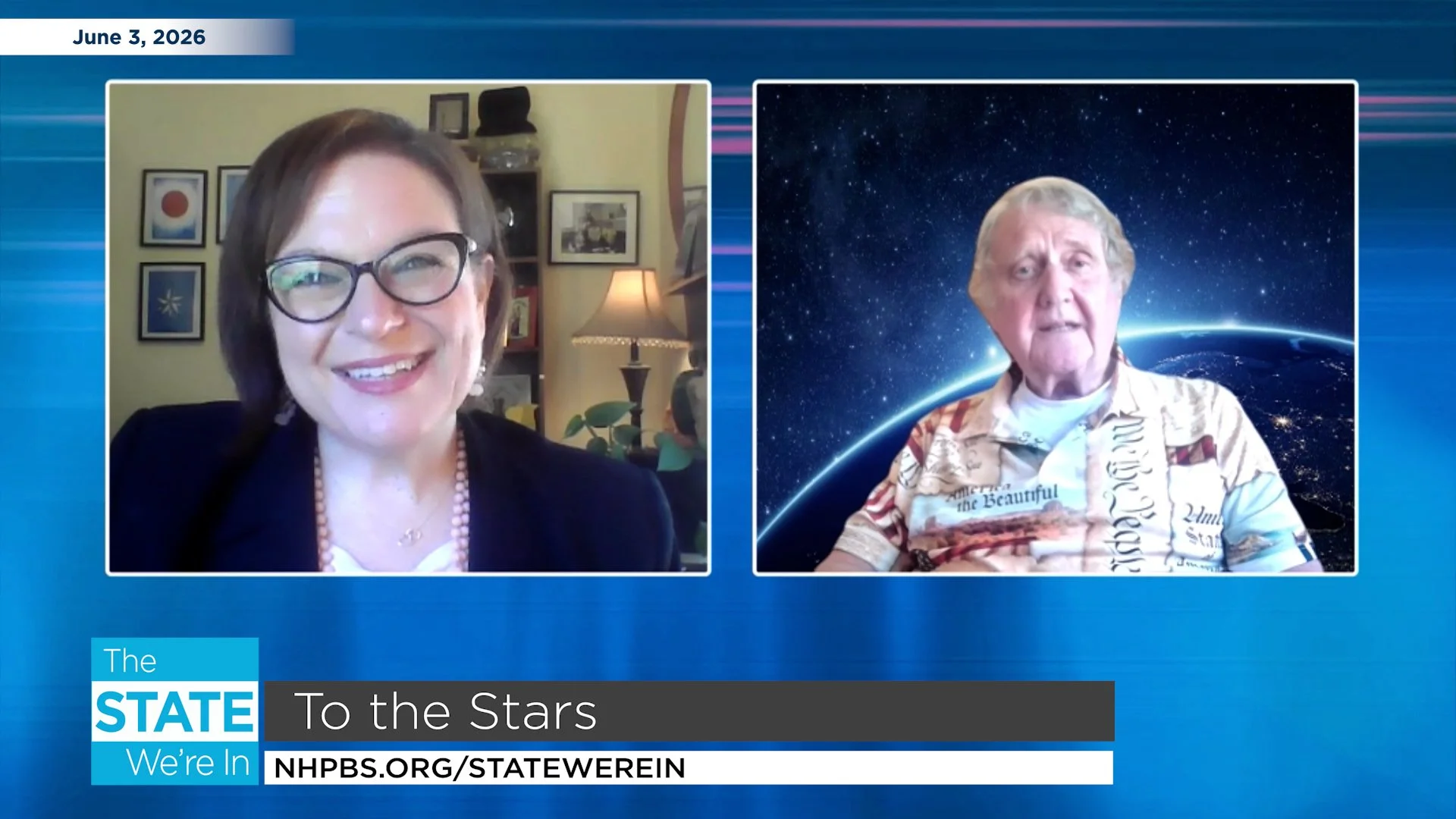
What can the stars tell us about our past, present and future? More than you think. The skies are a fascinating place, full of many, many wonders. Sometimes those wonders even make their way to Earth, as we saw in the recent explosion of a meteor over New England. David McDonald, an astronomy teacher and Astronomy Club adviser – among many other things – at Belmont High School, has been studying the stars with his students and will share his insights with us.
By Rosemary Ford and Caitlin Agnew
This article has been edited for length and clarity.
Melanie Plenda:
Tell us about the astronomy program and the Astronomy Club at Belmont High.
David McDonald:
I have about five students in my astronomy class, and I have about five students in my Astronomy Club. The club meets after school, and then we also have special events that we put on in astronomy class. It is a study in astronomy, from the nucleus of an atom to stars, black holes, and everything in-between. The Astronomy Club puts on different events for the public so that they can come and look through telescopes or be educated in some way.
Melanie Plenda:
What sparked your own interest in astronomy?
David McDonald:
I became interested in astronomy when I was in the 7th grade and came across a book in the library called, “Point to the Stars.” I picked it up and started thumbing through the pages and some transparency paper, traced some of the information and star shapes and constellations that were in the book, and went out and tried to find these things. Then, in the 9th grade, for Christmas, my parents bought me a telescope, and so now I'm looking at the stars with my eyes, finding constellations and stars and I'm hooked. I've been interested in it ever since.
Melanie Plenda:
The Astronomy Club recently did a project about stars 250 light years away, in celebration of our nation’s independence. First, explain what a light year is exactly.
David McDonald:
A light year is how far light travels in a year. The speed is 186,000 miles per second. So, if we could flatten out earth — and this is not to say I'm part of the Flat Earth Society — a light beam would go around the circumference of earth seven and a half times in one second. From here to the moon, it takes about one second and a quarter. In a year, a beam of light travels about 580 billion miles in a year.
Melanie Plenda:
Tell us more about that 250 light years project. What did it entail?
David McDonald:
Our project was to find stars that are about 250 light years away. One of the things we want to do is to be able to bring those stars to your backyard. So you can actually find these stars — and we found several that are bright enough to be easily found. What that means is when you go out in June and July, and you look at these stars today — the photons that are reaching your eyes are registering the light that left those stars 250 years ago when we were declaring our independence.
Melanie Plenda:
Was your club tracking the meteor that fell on May 30, or did that catch you all by surprise?
David McDonald:
I think it caught everybody by surprise, for sure. There's a website that I recommend to visit called Spaceweather, and as you scroll down a couple or three pages worth, you'll come to a place where it talks about near asteroids and meteors, and this one, which was about five meters in diameter was not even on the list for Saturday. So it literally came out of nowhere, and I think it surprised everybody, including astronomers. This was going like 42,000 miles an hour — which is like 60 times the speed of sound — and when you break the sound barrier, that's where you get that sonic boom happening, which was heard for many miles around. And it broke up around 30 or so miles up in the atmosphere, fragmented. The good news is nobody got hurt, and it landed around Cape Cod.
The bad news is nothing landed in New Hampshire, which is sad, because you may or may not know, there's never been a meteorite found in New Hampshire. So if this thing was maybe 60 miles or so further north, and went in the ocean off Hampton Beach — because again, we don't want anybody getting hurt — maybe a fragment or two might have landed on the beach or something, and we could see the first meteorite found in New Hampshire.
Melanie Plenda:
What can amateur astronomers look out for if they check out the stars this summer?
David McDonald:
It's a great summer sky to look at, and so visually we have what's called the summer triangle, which are three stars. Vega is kind of in the overhead position, very bright white and bluish. Then there's a star called Deneb and at the tail of Cygnus the Swan. Then there's another star called Altair, which is in the constellation of Aquila the Eagle, and those three bright stars make up what we call the summer triangle.
Vega is in the constellation of Lyra the Harp, and there's like a quadrilateral there that you can see. Vega’s the brightest star, but right nearby, right near to the bottom two stars in the middle, what's called the Ring Nebula, and it is the remnants of a star that exploded a lot of years ago. With a large enough telescope, you can see in the middle there's a faint little dot, which is the white dwarf — the remnants of the star that exploded.
Then watch out for the Perseid meteor shower, and Aug. 12 and 13 are generally the high points. You want to go out at night — the better time is after midnight — and one thing you have to do is get your eyes adjusted, because a lot of people, they go out in their porch, they go out of their driveway, they look up for 10 minutes, don't see anything and they go back inside. Your eyes aren't even adjusted yet to the darkness, so you want to go out for at least a half-hour. Somewhere between midnight and 4 o'clock in the morning, I would suggest you get your lawn chair out and sit back, look up and tell your neighbors to turn their lights out and enjoy the show, because the Perseid is generally a very active shower, where you may see 1520 meteors in the course of an hour.
Melanie Plenda:
David McDonald, astronomy teacher and club adviser at Belmont High, thank you for joining us today.
“The State We’re In” is a weekly digital public affairs show produced by NH PBS and The Marlin Fitzwater Center for Communication at Franklin Pierce University. It is shared with partners in the Granite State News Collaborative, of which both organizations are members. For more information, visit collaborativenh.org.