By Rosemary Ford and Caitlin Agnew
This article has been edited for length and clarity.
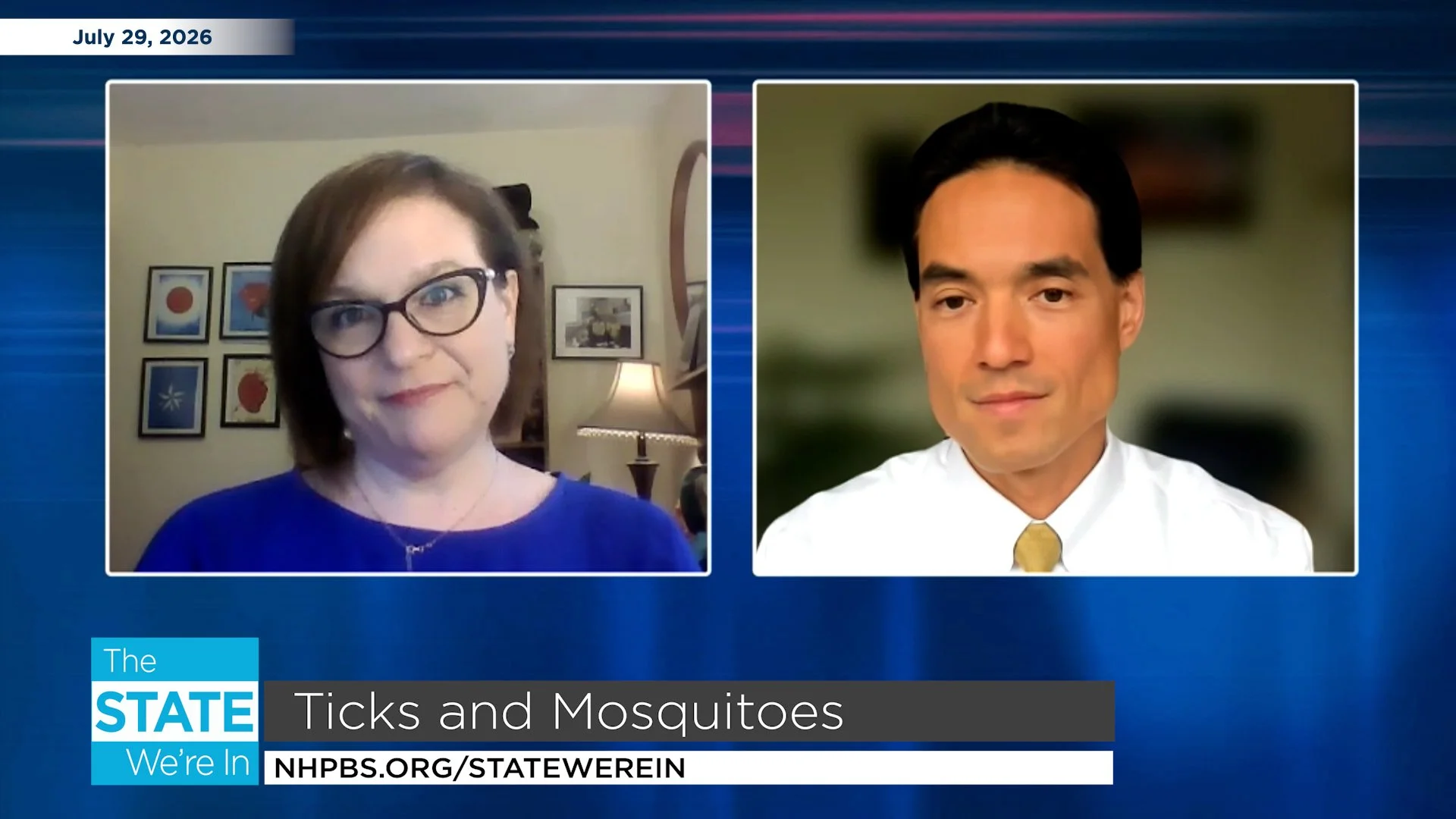
No one likes getting bitten by ticks and mosquitoes. Hopefully, it’s just painful and annoying, but sometimes these pests can cause health impacts that can be concerning. State Epidemiologist Dr. Benjamin Chan, who helps prevent and control the spread of disease and promote the health of Granite State residents, discusses what the concerns are and what we should do about them.
Melanie Plenda:
Anecdotally, how is this season for ticks and mosquitoes? What do you know about their prevalence?
Benjamin Chan:
I think maybe it would be helpful to start by saying that the health department generally tracks infections and disease. We don't routinely track some of the vectors, or the insects like ticks and mosquitoes, that can spread that disease.
There are a few ways that we can assess how active a season we're having with ticks and mosquitoes. One certainly is by how common some of these diseases are that we're tracking, like Lyme disease for ticks and West Nile virus for mosquitoes. But there are other sources of information. Mosquito trapping occurs in certain areas of the state. We also can assess and have data coming in about emergency room visits for tick bites.
I think generally what we're seeing, at least early in the season, is a very active tick bite season. There were a higher number of emergency department visits for tick bites in March and April than maybe we've seen in the last couple of years, but that largely has evened out, and the trend we're seeing now is more in line with what we've seen in past years.
Regarding mosquito season, it varies year to year, depending on weather conditions — how much rain we're getting. I don't believe that we're having a more active mosquito season than we typically see, but some of our community partners, like our towns and cities, and some of the companies that do mosquito trapping in these local towns would have a better idea.
Melanie Plenda:
To put a little bit of context around the prevalence of Lyme disease, last year there were about 1,800 cases. This year it's around 1,500 or 1,600. Not that people shouldn't be careful or aware of the disease, but how prevalent is a tick? How common is it for someone to get Lyme disease if they get bitten by a tick? Do you have a sense of that, or is there a way to quantify that?
Benjamin Chan:
It's a great question, and actually, there's not a great way to quantify the risk from any single tick bite. What I can say is that New Hampshire, including the rest of New England in general, is a high-incidence state for Lyme disease, meaning Lyme disease is found commonly in people and in ticks in our region.
I think we go back to the idea of prevention — how do people stay healthy this time of year? How do people prevent getting infected with some of these pathogens? It comes back to preventing tick bites and preventing mosquito bites. There’s a variety of ways that people can do that. With some of these infections, there are treatments – antibiotics that can be given to treat an infection. So, if for whatever reason prevention fails, somebody gets bitten by a tick and they develop Lyme disease, there are antibiotics and treatments that can be given to cure the infection.
That's not the case with all of these pathogens, particularly the viruses. Powassan virus that's transmitted through tick bites and Eastern equine encephalitis, West Nile virus and Jamestown Canyon virus that are transmitted through mosquito bites are viruses for which there are no specific treatments. There are no antibiotics or antiviral medications that work, so somebody is medically supported until their body can clear the infection on their own.
Melanie Plenda:
Generally, what symptoms should people look for with tick and mosquito bites? When should they head to a health provider versus head to the pharmacy?
Benjamin Chan:
I will point to a couple of different times when somebody should talk to their healthcare provider. The first is if somebody has severe or prolonged symptoms, the symptoms of a lot of these types of infections are not specific; fever, fatigue, maybe a mild headache, some muscle aches. They are all very common symptoms. If somebody is developing severe symptoms — severe headache and neck pain to the point where it hurts to move their neck, or family or friends are noticing the person is confused, or they're having other concerning neurologic symptoms like seizures or changes in their mentation and cognition — those are all warning signs for more severe invasive types of infections.
People should phone their healthcare provider or even go into the emergency department if they display any of those types of more concerning symptoms. The other time is if symptoms just aren't going away — prolonged fever, prolonged headache, other concerning symptoms people may be having that aren't going away — then they should be talking with their healthcare provider.
The other time when someone might want to be on the phone with a provider is if they have a tick bite and the tick has been attached for a prolonged period of time. There is a prophylactic or preventive antibiotic called doxycycline that can be given as a single dose that can prevent Lyme disease.
Now, the tick has to be attached for a certain amount of time in order for the Lyme disease bacteria to spread from the tick into the person, so that doesn't happen right away with Lyme disease. But if somebody, for example, finds an engorged or enlarged tick on themselves, it's probably been there for more than 24 hours. They can talk to their healthcare provider and get a single-dose prescription for an antibiotic that can help reduce the chances of coming down with Lyme disease.
Melanie Plenda:
What should you do if you find a tick on you? Should you bring it somewhere to be tested?
Benjamin Chan:
Generally, we don't recommend tick testing. There are places that do that that are out there, but as a general medical recommendation, testing a tick doesn't necessarily change how somebody is treated — that's sort of a core tenet, if you will. Whenever we're talking about medical recommendations, does an intervention change how you treat the patient? And in this case, taking a tick and testing it doesn't necessarily change what happens with a person who's bitten by a tick.
Melanie Plenda:
Are there other insects of concern when it comes to health impacts?
Benjamin Chan:
It's a good question. Primarily, what we're concerned about in New Hampshire is really around ticks and mosquitoes. But I think maybe it's also a good opportunity to highlight the fact that this is a time of year when people might be traveling.
So when people travel, they should be aware of the risks in the areas that they're traveling to. While ticks and mosquitoes are the primary concern here in New Hampshire — particularly around these diseases that we've been talking about — there may be insects in other locations of the U.S. or of the world, where different types of infections can be transmitted through fleas. There also might be other types of infections that are transmitted through tick bites or mosquito bites that aren't present in New Hampshire.
If people are thinking about traveling, particularly if they're traveling internationally. Generally, it's a good idea to be talking with a travel medicine clinic to see if there's certain precautions people should be taking to see if there are vaccines to prevent diseases while people are traveling.
Melanie Plenda:
What should we do going forward, in terms of prevention?
Benjamin Chan:
Some of these infections have antibiotic treatments, some of these infections have no specific treatments, particularly against some of the viruses that are transmitted through ticks and mosquitoes.
A lot of this comes back to preventing the tick bite or preventing the mosquito bite in the first place as the best way to prevent infection and stay healthy. I also mentioned there are no specific vaccines for people to prevent these types of infections either. It really comes down to preventing tick bites and preventing mosquito bites, and there are a number of ways to do that.
First, there’s avoiding habitats where ticks might be present. Ticks like to hang out in sort of borderline or transitional-type habitats where maybe you have shrubs and tall grasses, so avoiding going into those types of habitats can prevent tick bites.
Mosquitoes are most active at dawn and dusk, so to minimize the risk of mosquito bites, people can avoid going outdoors at times of the day when mosquitoes are most active around dawn and dusk.
Then, if people are outdoors or in areas where there might be ticks or mosquitoes, applying an insect repellent to exposed skin that's effective against ticks and mosquitoes is important. A lot of people know of DEET-based repellents. Some people don't like using DEET, and that's fine. There are other options out there — more natural options, like lemon or eucalyptus-based insect repellents.
There are a number of other steps people can take. There are certain types of insecticide sprays that can be put on clothing, like permethrin-based sprays, that can help repel ticks and mosquitoes. It's important to do tick checks when coming inside after being outdoors, both on yourself and also your pets and your gear.
As for mosquitoes, one way of minimizing them around one's home is to make sure that there's no standing water — buckets or pails or wheelbarrows or old tires that have standing water in them — because mosquitoes like to breed in even small amounts of standing water. We generally recommend people walk around and make sure that there aren't pails holding water in one's yard as a way to try and reduce mosquito populations around someone's home.
Melanie Plenda:
Thank you for joining us today, Dr. Chan.
“The State We’re In” is a weekly digital public affairs show produced by NH PBS and The Marlin Fitzwater Center for Communication at Franklin Pierce University. It is shared with partners in the Granite State News Collaborative, of which both organizations are members. For more information, visit collaborativenh.org.