By Rosemary Ford and Caitlin Agnew
This article is edited for length and clarity.
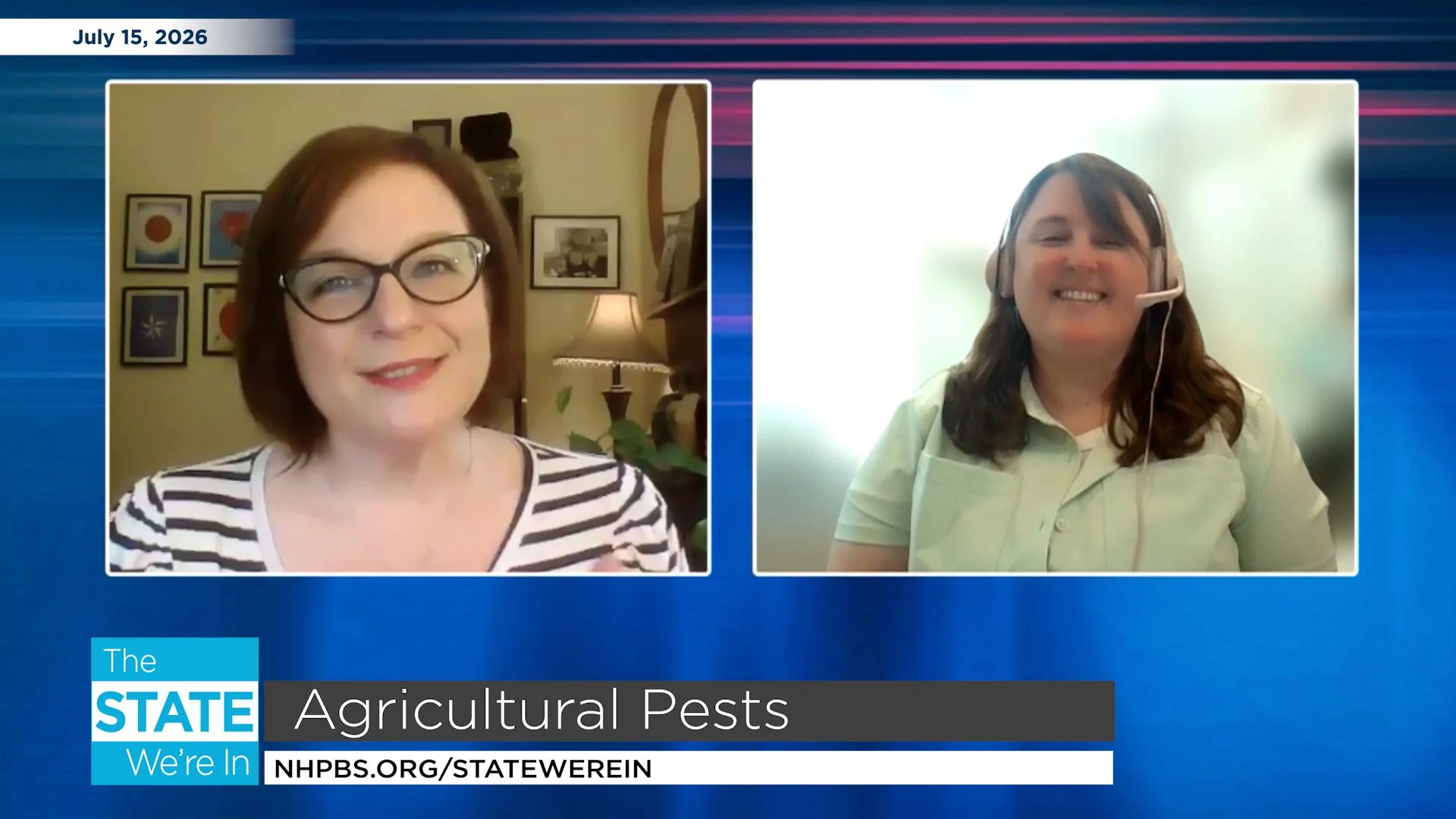
Our fruits and vegetables are constantly under watch for signs of an army of tiny invaders. How do we protect our produce from tiny insect interlopers? Dr. Amber Vinchesi-Vahl, who works at the University of New Hampshire Cooperative Extension, discusses how agricultural pests are monitored and how growers are being helped to find solutions for dealing with them.
Melanie Plenda:
What work do you do at UNH?
Amber Vinchesi-Vahl:
In addition to being the state extension specialist in entomology and integrated pest management, or IPM, I am also the state IPM coordinator, and we use all kinds of techniques to control insects beyond just chemical management.
Melanie Plenda:
What agricultural pests are you currently monitoring for?
Amber Vinchesi-Vahl:
I run the state trapping program, which is funded by the N.H. Department of Agriculture, Markets, and Foods. We're trapping for many vegetable pests, mainly sweet corn pests. We trap four different moths that affect sweet corn — it's actually the caterpillar that's causing the damage to the crop, not the moth. But we use pheromone traps to track those moths to figure out when they're arriving and what kind of pressure we have, because many of our sweet corn pests do not spend the winter in New Hampshire. They migrate north on storm fronts and wind events and jet streams. So knowing when they arrive is really important for management.
We do have some pests that overwinter here or are native. So the European corn borer is one of our sweet corn pests that does spend the winter here. The other two that migrate up are the corn earworm and the fall armyworm. We also trap for squash vine borer, which is a native squash pest to New Hampshire. Then we also trap for a couple of invasive species: the spotted wing drosophila and the brown marmorated stink bug. We also have a tree fruit trapping program that's run by my colleague Jeremy Delisle out of Merrimack County, but I kind of run this vegetable program.
Melanie Plenda:
What is the next step once you trap them?
Amber Vinchesi-Vahl:
One of the key tenets of integrated pest management is monitoring first, because then you're only implementing your controls when you know you have the pests present, and it's at actually damaging levels. We use trap thresholds to inform our growers and recommend when they should implement controls.
The thresholds are basically the amount of pests in the trap that indicate you will need to implement management to avoid economic damage. The pests may be present, but they might not be at levels where you actually need to do any management. This helps reduce pesticide inputs and pesticide costs, and saves labor, time and money for the growers as well.
Melanie Plenda:
As you mentioned, some of these are native problems, and some are invasive ones. Can you explain what that means, and why the invasive ones can cause extra headaches?
Amber Vinchesi-Vahl:
A native pest is an insect that's always been here. It's native to the United States, native to New Hampshire, New England area, and that's our squash vine borer, which is a pest of squash. It's a day flying moth, and they lay their eggs at the base of the stem, and when the larvae hatch, they bore into the stem, and as they grow, they can cause the plant to collapse.
Invasive insects are insects that are introduced from other areas of the world into the United States. They're usually not introduced with any of their predators from their native range, and they have plenty of habitat and resources once they arrive in a new place and can really take off. Invasive insects also tend to make integrated pest management a lot more difficult because they arrive, they grow exponentially, and growers have to do something to control them, and that’s usually relying on pesticide sprays until we can kind of come up with other management strategies to work with the sprays.
We also have a lot of insects in New Hampshire that we wouldn't really consider invasive anymore, but they're also not native to New Hampshire, like the European corn borer. It is not native to New Hampshire, but it's been here for a very long time. So has the Japanese beetle, but technically they're not native to New Hampshire.
Melanie Plenda:
Is climate change a factor here with these pests?
Amber Vinchesi-Vahl:
Yes, we're really noticing these shifts within our 20 years of our trapping program. We've really been able to track when the migrating pests arrive and how that changes depending on storm events and hurricanes. In the past, we used to really only see corn earworm and fall armyworm late in the season, but now sometimes we see big spikes in late July. Other things we're noticing is the unpredictable weather in the spring, with more storms maybe bringing some of our pests up sooner than we normally see them.
Insect development is really temperature-dependent. So when we have warmer weather, they're able to cycle through their generations faster. So we may have faster population buildup. They're showing up earlier and lasting longer into the fall because it's staying warmer longer as well. Also, some of the invasive insects that generally come up from the south may now be able to spend the winter here if we don't get a lot of snow cover or it stays warmer over the winter, which means they're showing up earlier in the spring.
Melanie Plenda:
What kind of economic impact do these insects have when they attack crops?
Amber Vinchesi-Vahl:
We really have great data that shows that growers are able to save a lot of money by reducing their pesticide costs. In 2025, our trapping network showed that our growers saved, on average, about three sprays in the season for sweet corn, which equates to almost $70,000 for labor, fuel and pesticide costs. They also reported increased yield, almost a 10% increase in yield than what they thought they would have had if they were not controlling.
The three sprays saved are based on using integrated pest management compared to the historic way that the pests were controlled, which was calendar-based sprays. Basically that would mean that when they thought the pest showed up, they just started spraying on a calendar basis, whether the pest was there or not. Using this trapping first is really important. They're able to target the insects more efficiently and then increase their yield.
Our growers also reported that if they were not managing for these pests, they would have had over a 50% loss.
Melanie Plenda:
You mentioned spraying and pesticides. Is that something consumers should be concerned about? And if so, what questions should they ask?
Amber Vinchesi-Vahl:
This is a great question. It's a little tricky to answer, but pesticides have a lot of rules to them. Growers aren't just out there spraying whatever they want, whenever they want. Also, all pesticides have a pre-harvest interval, or PHI, and that means that if the PHI is seven days, the grower cannot spray it within seven days of harvest — that's for safety to harvest crews, to you-pick consumers, to the grower, and that's going to make it safer. There's no residue there, but you should always wash your produce as well, but there are residue laws in the United States for pesticides. Growers are being very conscious about the way they apply pesticides.
Melanie Plenda:
Are organic pesticides less worrisome than inorganic or chemical ones? Why or why not?
Amber Vinchesi-Vahl:
Organic pesticides are generally softer chemistries, and some conventional growers will use softer chemistries or more selective chemistries. That's what we call pesticides that are really only targeting specific insect pests rather than a broad spectrum, which may be killing your beneficials as well.
Organic pesticides are still pesticides. Many of them still have labels that have to be followed, but they are derived from natural products rather than synthetic, which makes them different from your conventional pesticides. But some of them still have pre-harvest intervals. There's also a big push and increase in biological chemicals. This would be fungus or bacteria that can be applied to attack the insect pest, or even minerals like oils that you can apply that are a little bit safer as well.
Melanie Plenda:
You also mentioned pest management that doesn’t involve any kind of pesticide. Can you tell us more about those strategies? How effective are they?
Amber Vinchesi-Vahl:
Those are cultural practices. We kind of loop everything in IPM into a couple of categories. So the cultural practices are really just your production agronomic practices that many growers are already doing, like crop rotation. This is really important for disease and insect pest management.
For example, say I had cucumbers in a field in 2025. I'm going to plant something completely unrelated to cucumbers in 2026 to avoid those pests that probably spent the winter or are still in that area where I had the cucumbers, because then it's going to be harder when those insects emerge in the spring to find where I did plant the cucumbers, because now it's tomatoes there and they don't like tomatoes. You’re really trying to rotate through those crop groups to reduce your pest pressure.
Other things include manipulating your planting dates. So if any home gardeners or farmers have issues with the Colorado potato beetle, which is a big fat red beetle that eats potatoes and tomatoes. By planting in July, you're going to miss that first peak when the adults come out of overwintering and come into your tomatoes and potatoes and eggplant crops. So manipulating planting dates is something growers can do.
Other cultural control practices include planting resistant varieties for disease pest management, if they're available. And there’s site selection — trying to find areas that don't have a lot of weeds, because weeds will harbor diseases and insects.
For mechanical and physical controls, those are kind of barriers to pest entry. Many of our farms will put row cover or insect-exclusion netting over newly planted crops, and that's going to mean that any of the beetles trying to come in or other pests can't get there.
Melanie Plenda:
Just to sum up, how are New Hampshire crops looking this year? And what can we expect to see at our farm stands?
Amber Vinchesi-Vahl:
I've been to a lot of farms this summer. Crops look really great. We're seeing some of our common pest issues a little worse this year than others, but that's pretty common every year. There's always something that kind of wins out. Onion thrips are a big issue this year on a lot of our onions, but those are close to harvest, so the bulbs are looking good. Sweet corn looks really good. We've had kind of a slow start to the sweet corn pests. We haven't really been trapping too many yet, so it might be like normal years where we see the big flush in August and September instead of mid-season like we are now.
Melanie Plenda:
Thank you for joining us today, Amber.
“The State We’re In” is a weekly digital public affairs show produced by NH PBS and The Marlin Fitzwater Center for Communication at Franklin Pierce University. It is shared with partners in the Granite State News Collaborative, of which both organizations are members. For more information, visit collaborativenh.org.