By Rosemary Ford and Caitlin Agnew
This article has been edited for length and clarity.
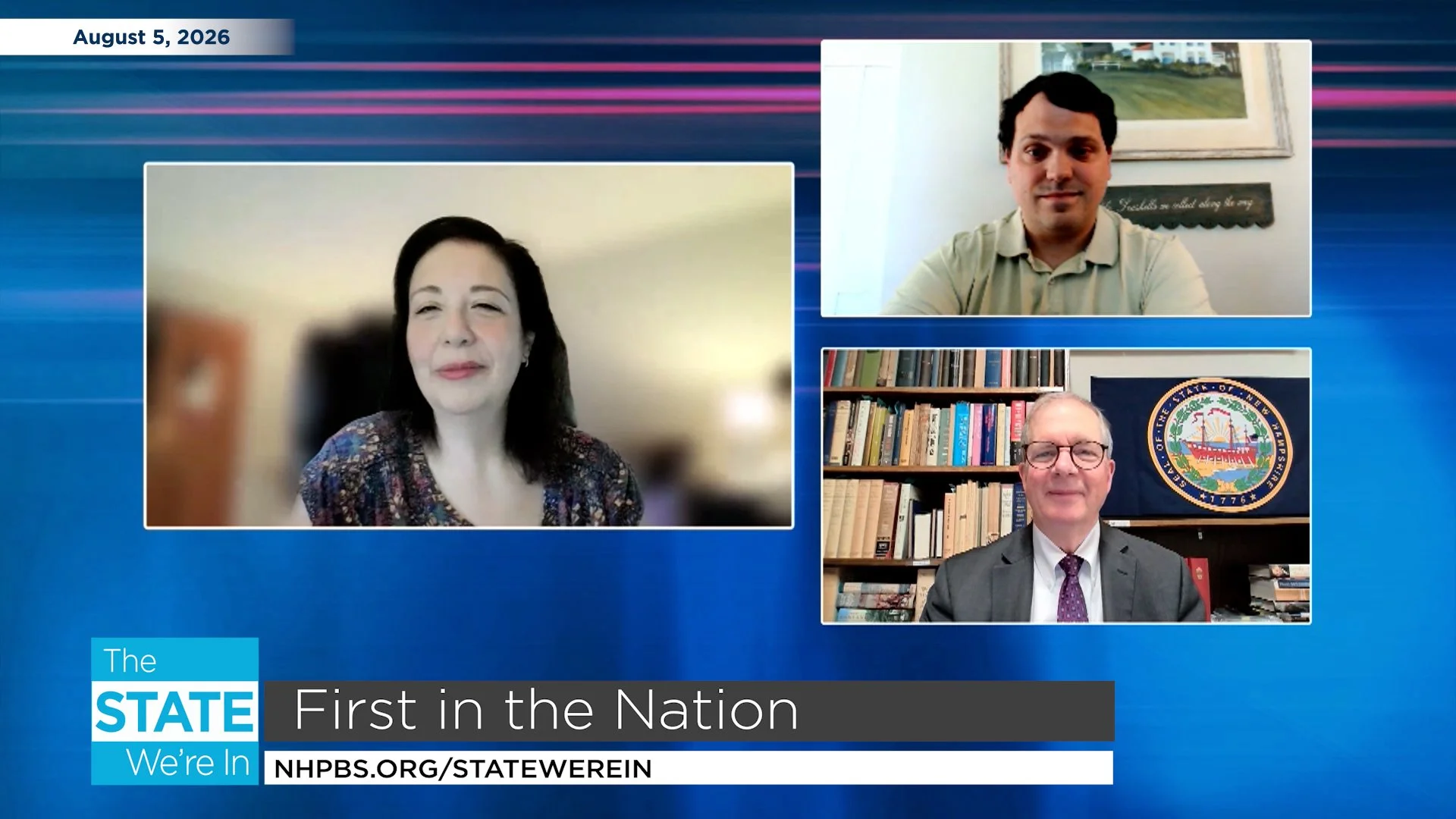
Since 1920, New Hampshire has held the first-in-the-nation presidential primary, a tradition even written into state law. But that law and tradition were disrupted in 2024, when the Democratic National Committee decided to hold its first primary elsewhere, and it will likely be disrupted again in 2028. What does that mean for New Hampshire voters and upcoming elections? Discussing that are New Hampshire Secretary of State David Scanlan and John Lappie, associate professor of political science at Plymouth State University.
Rosemary Ford:
John, to start us off, what’s the history behind New Hampshire’s first-in-the-nation primary?
John Lappie:
The first-in-the-nation primary happened more or less by accident.
In the 19th century and into the 20th century the presidential candidates were usually picked by state party leaders at a convention, and there wasn't really any participation by ordinary voters in the process. Primaries for president were democratizing reforms that began in the early 20th century, and even by the 1960s, only a couple of dozen states had primaries. But New Hampshire was an early adopter.
Our first primary was held in 1916. We became first in the nation in 1920 by accident, the Legislature decided they wanted to save money and increase participation in the primary, so they moved it to coincide with the town meeting. It was a way to save money, but of course, over time, as primaries became more common, and especially to 1952, when candidate names were actually added to the ballot in our primary instead of voters just voting for delegates representing a candidate, it became very influential.
Rosemary Ford:
David, what kind of impact do you think having the first primary has on the state and its voters?
David Scanlan:
It's not so much on the state as the rest of the country. The thing about the New Hampshire primary is that it has always been for the average voter. Back when the New Hampshire primary law was first written by a state representative from Richmond, N.H., named Stephen Bullock who was a farmer who felt that the nominations for president should be decided by the citizens and not party bosses in the back room. That principle holds true today.
So, New Hampshire has had this process where, because we were first, the candidates come here. The voters have a longstanding tradition and culture of kicking the tires of the individuals that want to be president. They have a long history of not being afraid to ask difficult questions and putting the candidates through the moves that they need to become president.
We've often heard from candidates themselves that have participated in the presidential primary that the primary made them better candidates. It has taught them how to talk to the average voter, what issues are important. In the end, New Hampshire voters may not select who ends up being the nominee, but they certainly do a great job of picking candidates who would make great presidents.
Rosemary Ford:
On July 24th, the Democratic National Committee voted for South Carolina to be the first state to hold its primary election in 2028. How does that affect New Hampshire?
David Scanlan:
New Hampshire and its primary results are unpredictable. The national party does not like that, especially when they may have a favored candidate that they think has the best chance of winning in the general election. But New Hampshire takes its role very importantly. It's a longstanding tradition that we did not take from anyone; it just began here, and we ended up being first by default. We have grown very strong roots from that point to the present time, and the service that we provide to the rest of the country in that regard is very important.
It's an easy state to campaign in. There are very few barriers to getting on the ballot. It's a small state geographically and population-wise. An unknown candidate without name recognition or a lot of money can come to New Hampshire and campaign and do really well here, and they can finish in the top three. It certainly creates a foundation for becoming the nominee.
It really comes down to a different philosophy. New Hampshire's is, “Look, we're willing to vet the candidates. We've done a good job.” The candidate that comes out of New Hampshire is the choice of the people that live and vote in this state, and it is not going to be the selection of the party elites moving forward.
If you remember when the DNC began this nominating process they had a set of criteria to determine those states that would make early primary states — efficiency, rigorousness of scheduling, and things like that. New Hampshire literally checked all the boxes in that regard. What happened on the 24th was it came down to a debate, really on ethnicity. Should a state like South Carolina, which has a predominantly black population, go before a state that has a predominantly Hispanic population, like Nevada?
Those two states were actually fighting with each other over that. It seems like the original criteria that New Hampshire did well in was just simply tossed out the window. Because of that, New Hampshire is going to fight for its traditional place on the calendar.
Rosemary Ford:
On July 22nd, the UNH Survey Center released findings that tracked Granite Staters’ opinions on prospective candidates for the 2028 primary election. Of course, we don’t know who’s running yet, but, according to their study, U.S. Rep.Alexandria Ocasio-Cortez was the favored Democrat candidate and Vice President J.D. Vance was the preferred Republican candidate. How accurate are polls like these in predicting outcomes for elections, especially this early?
John Lappie:
Polls are a snapshot in time, and those results match what people are thinking about right now. It's a long time until primary season, so the results will almost certainly look very different from what we're seeing in the polls right now.
That being said, I think we can glean something out of it based on how high-profile or low-profile the candidates are already. If you're U.S. Sen. John Ossoff, Democrat from Georgia, I'm not too disheartened by polling 2% in New Hampshire because most people don’t know who he is yet. He has a chance for growth. If I'm somebody like former Vice President Kamala Harris, and I see that I'm not polling well in New Hampshire, that's a lot more concerning, because everybody already knows who you are, and that would suggest there's not that much appetite for her candidacy.
Rosemary Ford:
How are things going for this year’s mid-terms elections? Will voters notice anything different?
David Scanlan:
There are going to be some subtle but new changes in the polling places. There has been almost a complete transition from the old electronic ballot counting devices that used optical scan technology to two new devices now that use digital scan technology. We expect that they will operate better with fewer breakdowns because they will store an image of every single ballot and that will make post-election auditing a lot easier and a lot more accurate.
There are some real benefits to this changeover. More and more polling places now are using electronic poll books for voters to check in. So a voter can show at the polls, have their photo ID scanned, voter information will pop up on the screen because the checklist is loaded into the devices before the election. Voters will be able to get in the shortest line – they won't have to get in the line where the letter of the alphabet that begins with their name always seems to be the longest.
The real benefit is at the end of the night when it's time to close the polls — simply a stroke of the keyboard will give instant results on the number of voters that checked in, which party's ballot they took, and that information can then be uploaded into the statewide voter database, so it will be more accurate.
Then we have a new accessible voting system in place for individuals with disabilities that is more user-friendly. There are also tighter requirements for voters now. Voters that are registering for the first time will have to show documentation of identity, age, domicile and citizenship. With citizenship, if a voter attests that they do not have their citizenship documentation, then they can sign an affidavit to prove that qualification.
ID requirements also have changed, especially for college students. College IDs now are no longer an acceptable form of ID, so students will have to show a driver's license either in the state of New Hampshire or the state that they lived in before or while they're attending school. So those are changes that voters should be aware of, and if they have any questions on the requirements, then they should reach out to my office or the local clerk's office in the town that they are living in while they're going to college.
Rosemary Ford:
John, what are your thoughts on the midterms, both here in New Hampshire and across the country?
John Lappie:
It could still change, but this is around the time of the year, especially Labor Day, when people start paying more attention to the general election. The overall environment is favorable to the Democrats. That matters more at the level of the U.S. House, where people usually don't know quite as much about the candidates.
I think they usually know more in a state like New Hampshire, where we only have two House members. But if you're talking about a state with dozens of House members, like Florida, New York, California, they tend to get lost in the shuffle. In those places people saying, "Well, I'm upset with this party, so I'm going to vote for the other party” — that matters a lot more.
I like to say that New Hampshire is a true purple state. We've seen this over the governorships of Sinunu and Governor Ayotte — they're winning elections as Republicans. Republicans winning the state Legislature, even as Democrats have won the federal offices. Lots of people voted for Kamala Harris and Kelly Ayotte, or Joe Biden and Chris Sununu. That used to be very common across the U.S. but is still very common in New Hampshire.
Rosemary Ford:
Thank you both for joining us today.
“The State We’re In” is a weekly digital public affairs show produced by NH PBS and The Marlin Fitzwater Center for Communication at Franklin Pierce University. It is shared with partners in the Granite State News Collaborative, of which both organizations are members. For more information, visit collaborativenh.org.