By Rosemary Ford and Caitlin Agnew
This article has been edited for length and clarity.
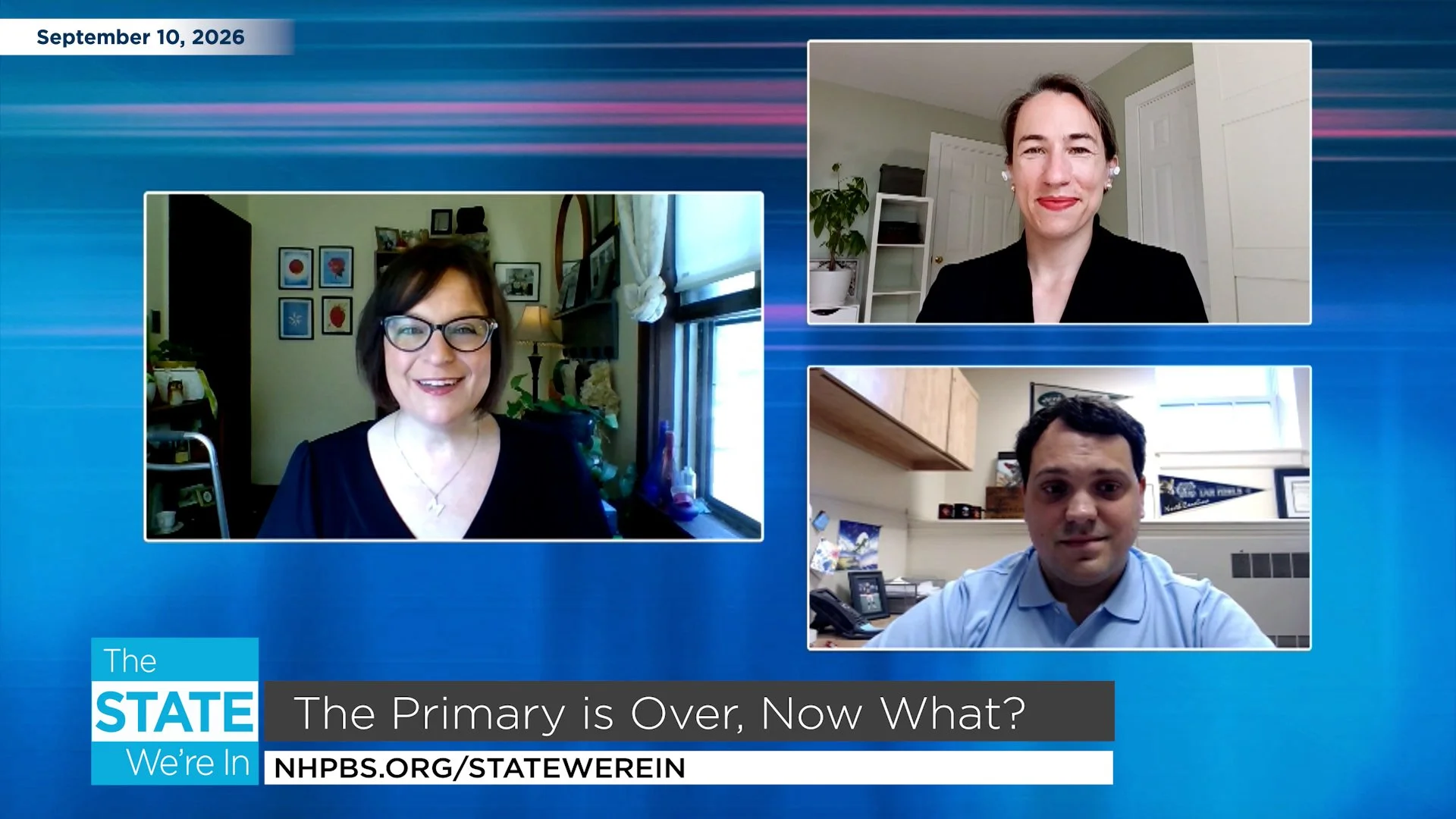
In New Hampshire’s Sept. 8 primary election, there were some surprises, perhaps, though not many. So what do the results mean, and what’s next for voters? Here to talk about the results are Anna Brown, executive director of Citizens Count, a nonprofit and nonpartisan organization dedicated to educating voters about the political process, and John Lappie, associate professor of political science at Plymouth State University.
Melanie Plenda:
The New Hampshire primary results: Were there any surprises there?
Anna Brown:
We really did see the moderates, the well-known names, prevail in New Hampshire — and this was true up and down the ballot. So, for example, if we're looking at State House races, there were some moderates who were facing challenges from the right, and there were some that were facing challenges from the left, and generally the moderates came out on top.
When you're looking at the top of the ticket, we didn't see what we've seen in other states in terms of progressive or socialist candidates beating incumbents, or certainly more moderate, well-known candidates.
John Lappie:
We saw the more well-known candidates, the more moderate candidates, winning this election. Anybody who's been watching YouTube recently and seen all their videos interrupted by Chris Pappas or John Sununu ads knows they moved on to the general election like a month ago. They knew they had won their primaries. The only real closely contested ones were the 1st C.D. primaries. Those were more closely contested, but there was a big late shift to Anthony DiLorenzo. The polling had that race pretty close with a large number of undecided, and he wound up winning by a fairly large margin. But that's not really all that uncommon in Congressional primaries that are usually pretty-low profile, compared to a Senate or gubernatorial primary. Voters often don't know much and don't make decisions until the last week of the campaign when they learn more about the candidates.
Melanie Plenda:
People are closely watching races across the country for the U.S. House as well as the Senate. How are things looking nationally as we head to November? Will we see the so-called blue wave?
John Lappie:
There's certainly potential for a blue wave. There is a lot of uncertainty right now over how effective Republican gerrymandering efforts were over the course of this year to try to limit Democratic gains.
It'll be very hard for the Republicans to maintain the House because they only have a three-seat majority. You don't need that much of a swing towards the Democrats, even with the gerrymandering, to result in a Democratic majority. The question is going to be: If there is a Democratic majority, how big is it going to be, and can they flip the Senate? There's a lot of seemingly winnable states this cycle, but in those states, it’s very easy to get close to winning and very hard to get that last 2 to 3% over to actually winning. Democrats have been plagued by that before. So I think that's going to be the big question: Can they get over the hump in the Senate?
Anna Brown:
I think that yes, economically, it's going to swing in Democrats' favor. Because if people are angry at what they're paying at the pump and they're angry about what they're paying for groceries, they may associate that with the Republicans that they voted in two years ago.
That being said, I think it's going to be important for Democrats to not just sort of run on how much people are angry with Republicans, because the approval rating for the Democratic candidates is also very low at the national level. As I said, I think if you talk to anyone from either party, I don't think most people in the United States are giving a thumbs up to anything happening in Washington D.C. right now, so I would agree with John. Polls are hard. Maybe there will be a blue wave, but I think it's going to be more of a squeaker than people might expect.
Melanie Plenda:
Do you have any sense about the issues that matter to voters, and what they may be thinking for the general election? First to Anna, then John.
Anna Brown:
The pocketbook — what you're seeing at the pump, what you're seeing at the grocery with your grocery bills. Also potentially, what people are seeing with their healthcare bills. I think that that is maybe something Democrats could see some movement on. I feel like health insurance is one of those issues where - I don't know if it gets people to the polls, but certainly Stefany Shaheen seems to be really making that the focus of her campaign in New Hampshire. So we're going to find out if that resonates with voters.
John Lappie:
The economy is definitely the number one issue, just like it was two years ago, three years ago or four years ago. It's the cost of living, and neither party is necessarily popular right now, but the Republicans have the disadvantage of being the incumbents, and I think with the president's tariff policies and the war in Iran and gas prices, it essentially made the president own the state of the economy in the minds of a lot of voters. Not necessarily that they think better of Democrats now, — polling definitely doesn't bear that out. But it is much harder for Republicans. When you make major changes to economic policy, and you have a war in the Middle East that everybody knows will lead to higher gasoline prices, then it's a lot harder to avoid blame for the state of the economy.
Melanie Plenda:
What other predictions or thoughts do you have about the election heading into November?
John Lappie:
This is going to be, again, a close race, and we'll have to wind up seeing what happens. For me, the big question is the polling. It has gotten very hard. Response rates are so low that I could easily see that the polls are missing Republicans again, and they're actually doing better than we think. But pollsters maybe have overcorrected to try and pick up Republican voters, and now they're underestimating Democrats, and the Democrats are going to win by even more than we expect. So, to borrow from meteorology, the cone of uncertainty has just gotten so much larger in our elections the last decade or so.
Anna Brown:
I hate being wrong, so if you don't predict who's going to win, then you're never wrong.
I will say what I'm most politically nerdy about is actually seeing what happens on the ballot vote that's going to come up just in New Hampshire. Every town is going to vote on whether there should be a tax cap for your local school district. This is typically something that would happen in local elections in the spring, but Republicans passed the bill, and Governor Ayotte signed it. So it's going to be on the ballot this November.
This has sort of been the Republican response to voters lamenting their high property taxes. They've said, "OK, then you have to change it at the local level because we don't want more state funding funneling down. We don't want to raise your tax rates overall.”
Thus far, attempts to impose those caps at the local level have not really been successful. We've seen voters say, "No, we want to give our schools the full budget. We don't want to have a cap.” So I think that that's kind of the political nerd question for me: What is that going to look like? Because that school-funding issue is huge at the state level, and will probably influence a lot of votes for state representative and state senator.
Melanie Plenda:
Anna, what resources will Citizens Count have for voters as we head into the November election?
Anna Brown:
Please come to our website, www.citizenscount.org We offer profiles for every candidate for state rep on up. We search for websites, Facebook email addresses, survey everyone so that they can say their positions in their own words, and if they don't respond to the survey — although most do, thankfully — we will put out voting records, other public statements they have made, and so on.
We also have information about your polling location, how to register to vote, if you need it. And I always encourage everyone: if you are ever concerned about where to vote or how to vote, call your town clerk. Local elections are where it's at in New Hampshire. That's where all the magic happens. We aren't run at the state level. It's not some nationalized process, and every local official I have encountered wants you to participate.
Melanie Plenda:
And we’ll link to that in our show notes. Thank you, John and Anna.
“The State We’re In” is a weekly digital public affairs show produced by NH PBS and The Marlin Fitzwater Center for Communication at Franklin Pierce University. It is shared with partners in the Granite State News Collaborative, of which both organizations are members. For more information, visit collaborativenh.org.