‘What matters is that people have all the information … and can make their own decision with that information’
By: Annmarie Timmins
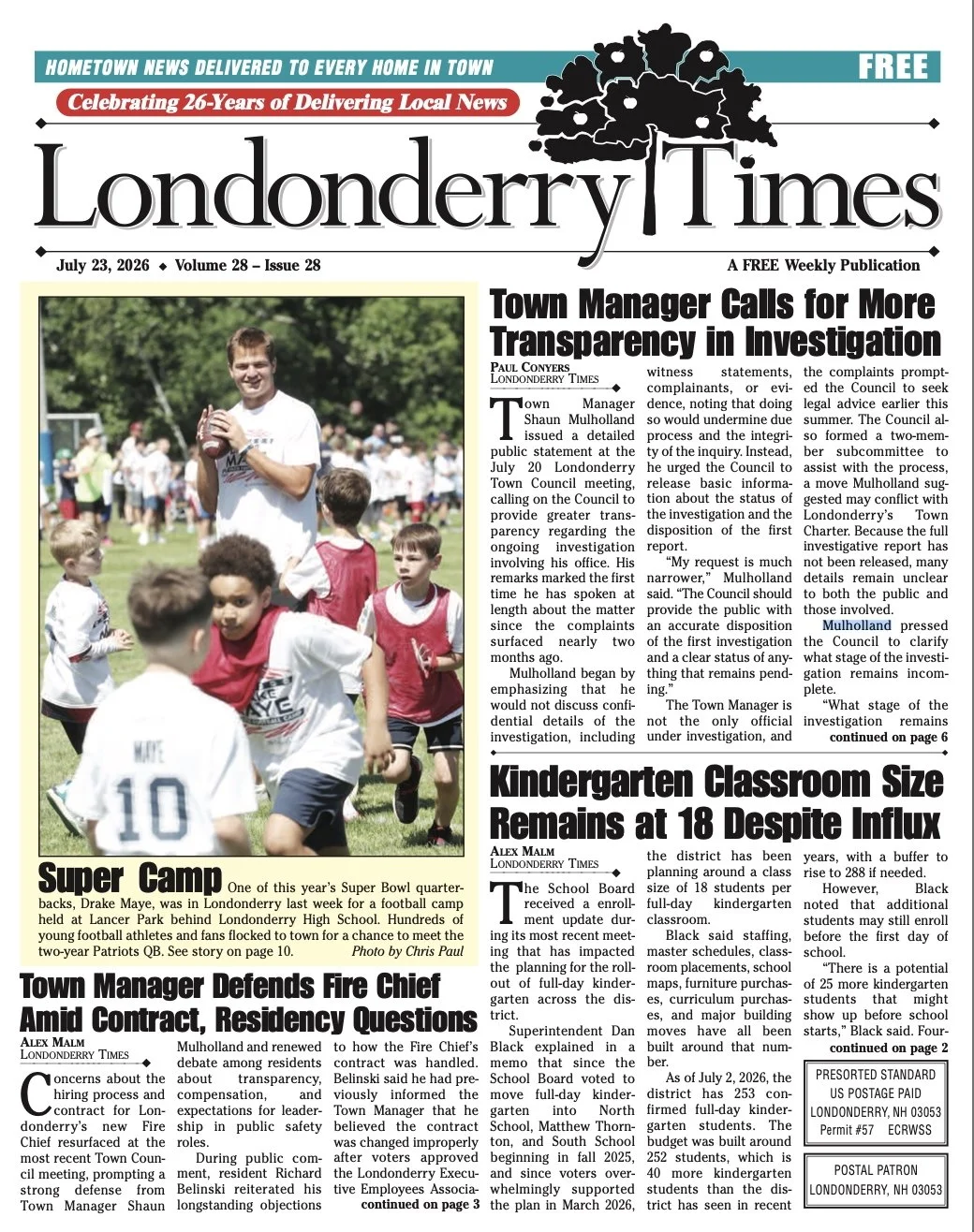
Deb and Chris Paul have grown the Londonderry newsletter they started 26 years ago into the Londonderry Times, a free weekly newspaper that’s mailed to every home and published online.
It doesn’t have the resources of The New York Times, but publisher Deb Paul would argue its tenacious reporting on town spending and policy decisions impacts more people in her town.
“You can change how your town looks, how it feels, how it behaves, and what it costs to live there,” she said. “And people don't understand that. And so that's why I think the state’s little, little community papers are so vitally important.”
There are fewer and fewer local news outlets scrutinizing town halls, school boards and elected officials, and those that remain have had to scale back to cut costs. That loss has not gone unnoticed, and in communities like Wolfeboro, Rye and Amherst, local residents are attempting to fill the void with local newsletters and websites largely with volunteers.
According to a new report from Rebuild Local News and Muck Rack, the United States has lost 81% of its local journalists since 2002, from 40 per 100,000 people in 2002 to 7.8 today. In New Hampshire, there are about seven local journalists per 100,000 people, the report said. And the local journalists who remain are covering crime and sports far more than education, health and the environment.
The consequences of news deserts to a community's civic health can be far-ranging. Researchers have linked a decline in local news reporting to lower voter turnout, increased corruption, greater loneliness, the spread of misinformation, and higher costs to local governments and taxpayers
“When you don't have accountability journalism, I hate to say it, but people will take advantage when they think no one's looking,” said Matt Baker, director of research at Rebuild Local News, a nonprofit coalition of organizations that works to promote public policies aimed at strengthening the nation’s community infrastructure.
‘Educate, inform, and connect the community’
There was no local news source in Londonderry when Deb and Chris Paul relocated from Massachusetts nearly 30 years ago. Deb decided to create one, despite having no journalism experience. Her free monthly newsletter, which she sustained with ads, launched in 2000.
“I really didn't know what I was doing. I just knew that this was something that was missing,” Deb said.
Her readers — and advertisers — did too.
After about a year, she secured enough advertising revenue to publish every other week, and then weekly. The Pauls expanded, launching the Nutfield News, which covered Derry and Auburn, and the Tri-Town Times, with a focus on Hampstead, Sandown and Chester.
“My whole plan was to try to expand this into as many towns as possible that didn't have a news outlet,” Deb said. Financial struggles, COVID and Deb’s cancer diagnosis forced the Pauls to scale back, ultimately closing down the Nutfield News and Tri-Town Times in 2022 to sustain the Londonderry Times.
Recent issues included letters to the editor, a list of Londonderry High School’s graduates, and coverage of an investigation into the town manager’s office. The paper uncovered misuse of tax revenue.
“The mission statement of the paper is to educate, inform and connect the community,” Deb said. She added, “What matters is that people have all the information, all the facts, and can make their own decision with that information.”
Filling the local news void
Anne Blodget and seven other Wolfeboro residents formed “Citizens for Wolfeboro” in 2023 to alert residents about complicated and sweeping zoning changes on the town warrant. The local newspaper had stopped covering town affairs closely.
“Those eight warrant articles were going to change our town forever,” Blodget said of the zoning changes. The group broadcast its concerns with postcards, a Facebook page and community meetings. When the warrant articles failed, Citizens for Wolfeboro was motivated to carry on and grow.
Today, almost 200 people subscribe to Citizens for Wolfeboro’s newsletter.
The group’s website focuses on local issues, including land use, water quality and financial transparency. There are links to budgets, meeting minutes and reports. A voters guide breaks down state and local voting laws. Another page navigates the town’s website to make it easier for residents to follow town boards and weigh in on issues.
“It needs to have more members and more visibility in the community because it’s serving as a common information base,” said member Howard Lowe. “When you lose news coverage, you lose that common source of information that is valuable to everyone.”
The Citizens for Wolfeboro and groups like it don't have the means to do in-depth investigative journalism. But their work is valuable, said Baker, of Rebuild Local News.
“I think they are incredibly useful just for filling in the void,” he said. “They may not do all the work. But I do think it's filling in a gap for sure.”
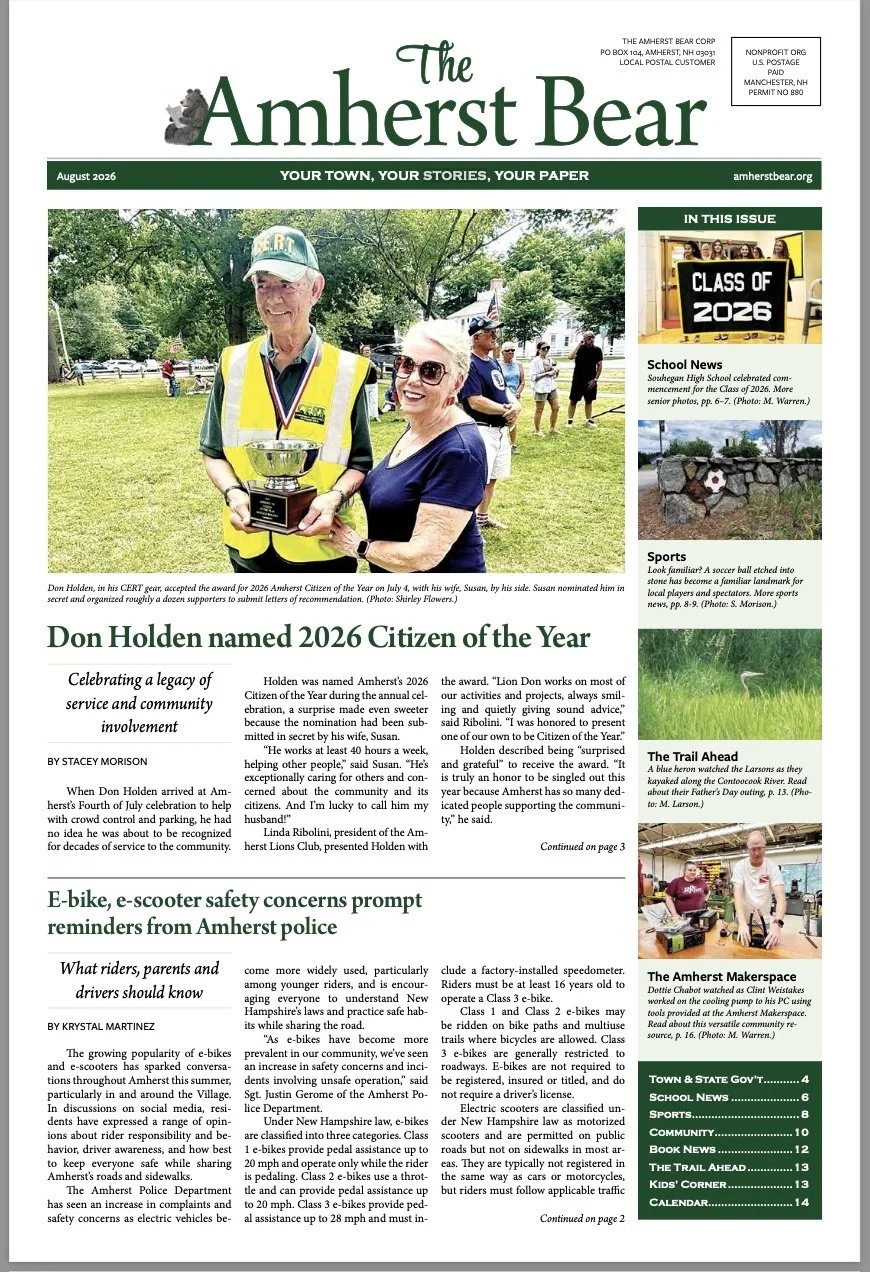
The Amherst Bear, which launched this past February with advertising revenue and $100,000 in donations, is taking a different approach following the closure of The Amherst Citizen in 2024.
The monthly community newspaper — which is published online and mailed to every home in town — focuses largely on community events, local people and “news you can use.” In the July issue, the police department highlighted its efforts to keep older residents safe. The town administrator published a list of events celebrating the country’s 250th anniversary. The lead story explored the history of the town’s iconic July 4th parade, which regularly draws governors and other elected officials.
Stacey Morison, managing editor and cofounder, said they are not “shying away” from the more contentious news either, from local elections to a vote on a controversial school renovation that has narrowly failed several times. Morrison said she wants The Bear to provide a factual alternative to Facebook.
“We should be covering [issues] in a non-biased, apolitical, fact-based way in order to provide as much information as we can so that people do feel more informed when they go to vote,” Morrison said. “And hopefully, that will lead to greater voter turnout in local elections if people feel more connected to the issues and the ballot initiatives.”
The Rye Civic League launched in 1968, well before the decline in local news, to inform residents about local issues. It disbanded in 1993 and stayed dormant until Alex Herlihy revived it in 2009 when he realized residents were learning about significant issues after they’d been decided by local officials.
“People have turned away from their local communities as they've become obsessed with national political ideologies,” Herlihy said. “I think that's the major problem. People are not paying attention to the $30 million school and town budget. They don't care how their tax dollars are being spent.”
Today, Rye Civic News publishes a monthly newsletter on its website and emails the issue to nearly 1,600 subscribers.
The June issue previewed an upcoming special town meeting and updated readers on the selectboard’s decision to remove 90 parking spaces from Ocean Boulevard, a popular scenic route along the ocean. There were links to town financial and planning documents. The issue included a list of community events and openings on town board.
The league also recaps the monthly newsletter in videos on its Facebook page and holds monthly meetings to give locals multiple ways to stay informed.
“You just never know what impact you have because it is hard to get a quantitative sense of who reads what,” Herlihy said. “But I think you also have to have faith that you are having an impact.”
These articles are being shared by partners in the Granite State News Collaborative. Don’t just read this. Share it with one person who doesn’t usually follow local news — that’s how we make an impact. For more information, visit collaborativenh.org.