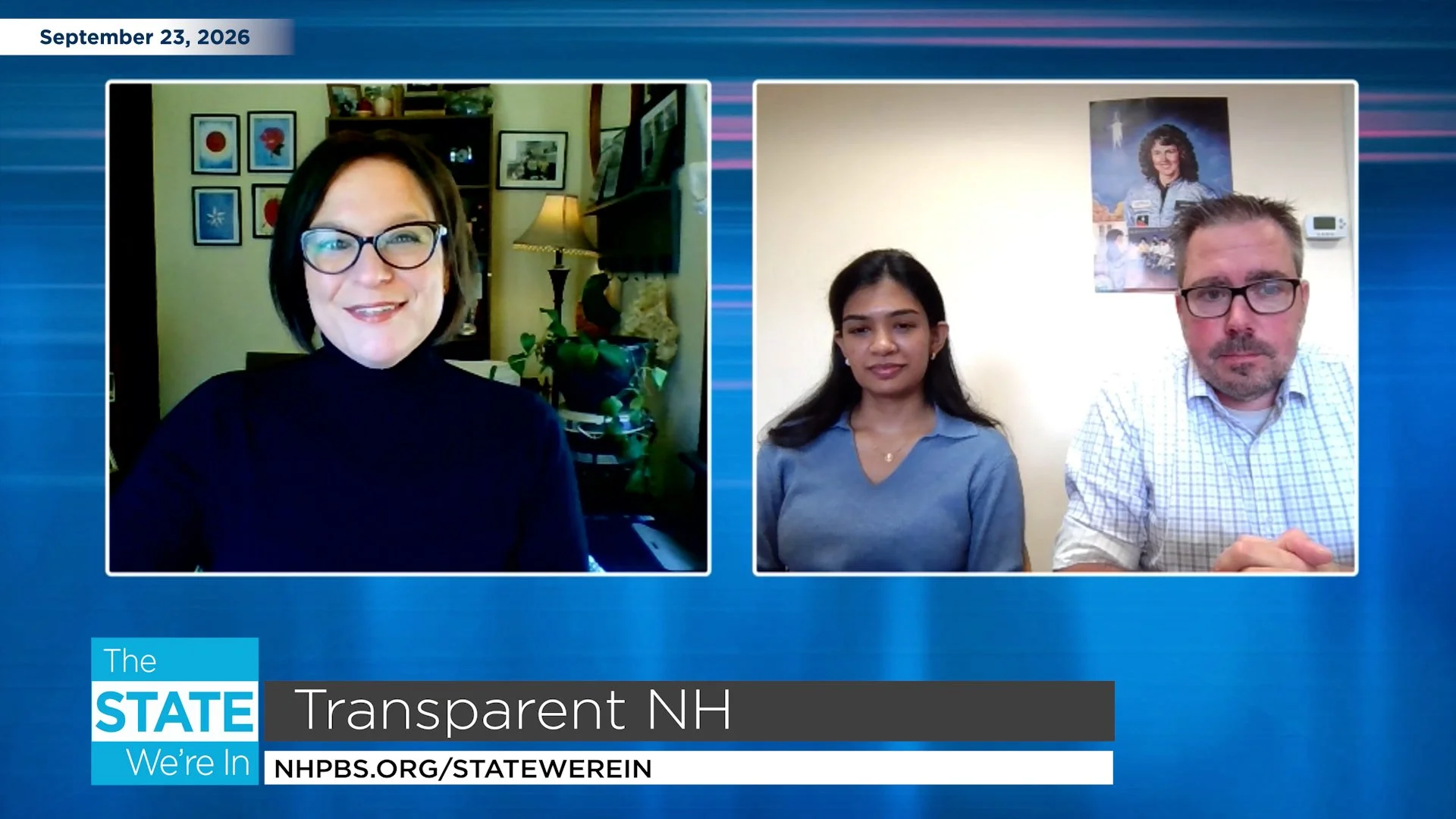
The Granite State News Collaborative, the Concord Monitor, Muck Rock and Sunlight Research teamed up for a project to see how accessible New Hampshire’s public records are. The series is called Transparent NH. Across 23 communities, and 46 agencies, 280 public records requests were submitted. What were the results? Here to talk about that are two local journalists spearheading the project, the Concord Monitor’s Editor-in-Chief Jonathan Van Fleet and reporter Sruthi Gopalakrishnan.
By Rosemary Ford and Caitlin Agnew
This article has been edited for length and clarity.
Melanie Plenda:
Jon, tell us about the series. How did it start? How long did it take? What did it involve?
Jonathan Van Fleet:
Well, it started when you, Melanie, came to me and said, "I have an idea for a project,” and I said, "I'm happy to help.” Where it began was an idea to get a comparative understanding of how different towns deal with our right-to-know law, and we started having a few meetings with the Sunlight Research Group, who then, throughout the course of the project, became MuckRock, and it started more than a year ago. I think we first had our conversations in June or July of 2025, and we first had to figure out what we wanted to ask, then we had to figure out who we're asking, and then we had to figure out how this could be of use to the news organizations in New Hampshire, and especially the people of New Hampshire. That's the groundwork that got us from beginning to then the real legwork of getting the requests sent out, answered, and then reporting on them.
Melanie Plenda:
Jon, why test public records accessibility? Can you explain to the audience why this is important and not just for journalists?
Jonathan Van Fleet:
The story mentioned this, but really, if you boil it down, the government exists to serve the people. Everything that the government does is at the behest of the people. The power of the government comes from the people. So when you really boil it down, the government should have very, very few secrets. When people want to know what their government is up to, which they are funding, and which is existing to serve, then there should be as few barriers as possible, which is why the state's right-to-know law says the greatest possible access to the actions and records of government. We can't underscore those words enough “greatest possible.”
So when you actually carry that out and you ask government agencies for these records and they put up all these barriers, you find yourself asking, is this the greatest possible access that they can give the public? And in a lot of cases, it's not. So that's what we found through the project, and we'll get to some of that. But the state Constitution, even before the right-to-know law was passed, which was initially passed in New Hampshire I think it was 1967, but the right to open government was enshrined in the state Constitution, so this isn't a new concept. This is fundamental to the state of New Hampshire and how the government serves the people.
Melanie Plenda:
Sruthi, what was it like working on this series? I imagine you had to juggle other stories as well while working on all this.
Sruthi Gopalakrishnan:
This was a yearlong project, and we did break this up into bite-sized pieces. Jon and I met with the team at MuckRock every week, figuring out what needs to be done that week. So it was better for us to just break it up into small pieces, and that actually gave me time to work on my other stories as well. If you ask me, what jumped out at me at first is how each town or community responds differently to every single request. We would file the same request with each town, and they would respond completely differently.
Melanie Plenda:
As you both were working on this series, did anything surprise you about the results, or in some cases, the lack thereof?
Sruthi Gopalakrishnan:
One thing that was very evident is a lot of the communities did not know if they should be responding to a request that came from out of state, and since MuckRock is not really based in New Hampshire, we had a lot of calls and emails. Sometimes some of the communities that I knew felt that email was not used in the right way. So we had to have a lot of conversations with them about that as well. Some were willing to give us the request if we just email them, but some wanted us to come in person and make sure that we are a New Hampshire resident before giving us a request. So they were really confused about the law when it came to out-of-state requests.
Jonathan Van Fleet:
There was that, as Sruthi was saying, the variety of responses to the identical requests was a little surprising. As Sruthi said, it was it was enlightening in some ways, but I guess what I would say is, for the most part, communicating with the local officials, what I learned is they are willing to help. They just needed a little nudge. They needed to know that their time was well spent and that they were doing something that wasn't just frivolous. And I think we got there.
Melanie Plenda:
Were there any creative denials? Or just different versions of the word no? Let’s start with Jon.
Jonathan Van Fleet:
A couple of my favorites were the city of Nashua. When we asked for the one month of emails for the Board of Aldermen president, who is Lori Wilshire, the city of Nashua said that a person is not a public agency, and so therefore you are not entitled to any emails. This is considered closed. We appealed, and we said obviously this is a public official, doing public business, with a city email account, but they never budged, and their score reflected that. But it was unique in the denials that we got. This is something that was handled routinely by other communities. Not everyone liked us asking for their emails, but we got them.
The other was the Manchester School District had asked us to pay $855 for their emails, so they were going to give us the first 250 emails free, and everything else thereafter was going to be $1 per email. The law says electronic records should be provided electronically, but it also does allow for reasonable fees to be charged. We argued that those fees were unreasonable, especially because the law does not allow them to charge for staff time. But they felt that they were on solid footing, and they maintained that that was what we had to pay. But as you can see, if the regular member of the public had to pay almost $1,000 to figure out how the school district is corresponding with parents, this was about curriculum, you could see how that would be a barrier to access.
Sruthi Gopalakrishnan:
I think those two were the weirdest ones for us. But I think when it came to evaluations, we did ask for police chief evaluations, school superintendent, as well as the city or town manager evaluations. We found that communities were more open to providing us police chief evaluations versus superintendent evaluations or the city or town manager. One reason that they kept telling us was that these are personnel records, and we felt that they were kind of unwilling to do the balancing test. So some communities, if we did talk to them and push a little, they were willing to give us. But some just rejected us when it came to those.
Melanie Plenda:
And Jon, what about the agencies that sent records? Were they complete?
Jonathan Van Fleet:
They were mostly complete. It's also interesting when you look at that. So when we asked for our school district emails, some of the communities just said, "Here's everything,” emails, and the back and forth between parents. It's very candid. There's kids' names in there. Other communities were like, "Oh, we have to black out, redact, everyone's email address, everyone's name,” and so the records become a little more obscure, you can kind of follow along.
But the level at which some of the communities just said, "Here you go.” The level at which they considered once it's a public record. So if I email my town, I expect that email and my email address to be public. It's part of the public record. The town does not need to redact my email address because I am generating a public record by communicating with my town. So they, in many cases, put on a different level of redaction. Student names, little different. I think they could argue that student names should be eliminated. But again, if the parent is the one who's generating the public record by emailing the school district, I think the folks that gave us the unredacted records were right. Obviously, I'm a staunch advocate for transparency, so I want as little redaction as possible.
In other cases, we got some records and some inconsistent redactions, but overall, I feel like mostly we got what we asked for, and in some cases, communities said what we asked for they didn't have. That was also a bit of a head scratcher. Like some communities said, we don't have a police chief evaluation. So it's like, really, no one's ever evaluated the police chief. That's interesting, but for most of the project, we got what we asked for.
Melanie Plenda:
What did the two of you learn from working on this project so far? Let’s start with Sruthi, then to Jon.
Sruthi Gopalakrishnan:
I think my biggest takeaway is that a lot of communities are willing to work with you when you file a right-to-know request, and sometimes they don't even want you to file a right to know request — just walk in, ask us if you want a particular record, which is easier for us. We are here in the customer service business, so I feel like most communities, especially the town administrators, are very open to providing requests, which was a big surprise for me.
Jonathan Van Fleet:
Yeah, I mean there was a lot to learn. What I learned is just that the variations of the way people looked at the law was surprising to me. And as Sruthi was saying, being able to communicate with folks directly made a really big difference. When you're responding to an email, you can be a little terse. You can, as a person getting that email, you can read tone into it, and when you actually talk to a lot of these folks on the phone and explain what we're looking for, and I did that in Portsmouth, they were kind of asking themselves, why shouldn't we do this? And when I explained it to them, they said, “OK.” I also learned that when the communities found out they were being compared to other communities, they kind of perked up a little bit because no one wanted to be the worst.
Melanie Plenda:
What do you hope the public takes away, or learns from the series?
Jonathan Van Fleet:
I hope that they learn. It's easy to say the government should do this, the government should do that, but the relationship between government and the people is inclined. So that's what I really want the public to understand is that the government doesn't exist to rule over them. It's the other way around. If you think about town meetings, the people are why the government exists, and that fundamental relationship that they have a right to know. That's what I hope the public understands.
Sruthi Gopalakrishnan:
I think I would just echo what Jon said, the resident public should feel like they can reach out to their town officials and find whatever information they need, and also feel comfortable filing right-to-know requests because they pay for the town officials, they pay for the government.
Melanie Plenda:
Jon, where are we in the series? What’s coming next and when?
Jonathan Van Fleet:
What we didn't do is a great job of writing about what's in the records. What we actually wrote about is what we asked for and why, and then the responses. So you got a real surface-level view of the project and how it worked, but we didn't dive into what we actually got. That's the next phase of this reporting, which should be happening over the next six months. Sruthi will be writing about how towns are using AI policies. Catherine McLaughlin will be writing about the disparity of who is answering the superintendent, police chief, town manager evaluation questions. Why is it so different in these communities? We're going to look at those school emails; there's a lot of stuff in there. So I think people will be interested to see what's in some of these.
Melanie Plenda:
Well, congratulations on the series. Great work! Looking forward to seeing more.
The State We’re in a weekly digital public affairs show is produced by NH PBS and The Marlin Fitzwater Center for Communications. It is shared with partners in the Granite State News Collaborative, of which both organizations are members.